Let’s take a look at what everyone’s been watching most this morning: $XAU
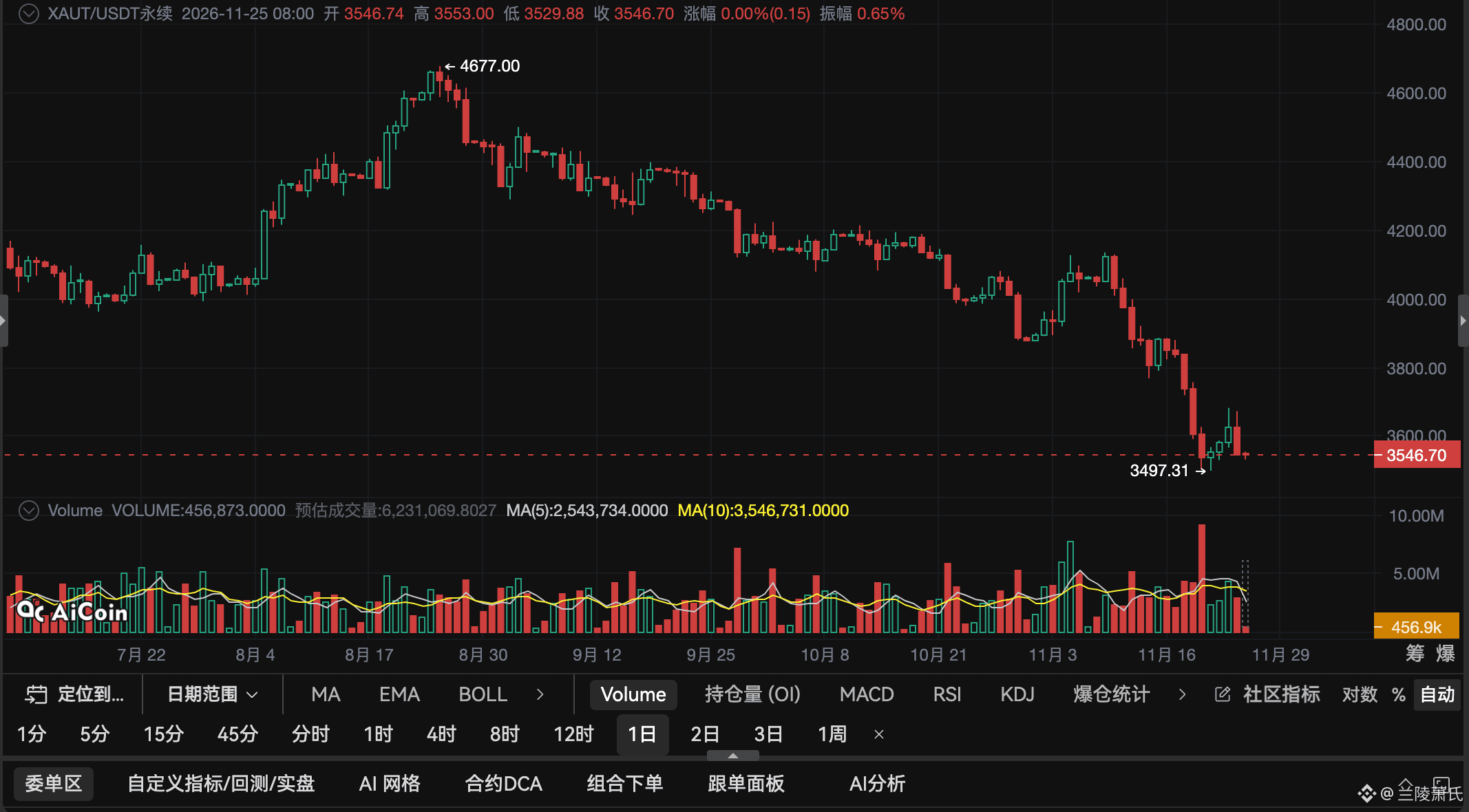
Gold is currently trading weakly in the 3553–3560 range. Yesterday, it fell from above 3630 and dropped around 2% in a single day.
Bear in mind that gold has already pulled back more than 11% from its highs over the past month. A few days ago, it plunged to around 3500, its year-to-date low, and hardly looked like a safe-haven asset at all.
Why hasn’t gold been acting as a safe haven in this downturn—and why has it fallen so sharply instead?
The reasoning is pretty straightforward:
First, macro expectations are putting too much pressure on the market. The 10-year U.S. Treasury yield has climbed to a high of 4.93%, and Fed officials have continued to sound hawkish over the past couple of days. The market has priced in a probability of over 93.5% that the Fed will raise rates by another 25 basis points in December. The dollar and Treasury yields are both strengthening, so non-yielding gold is naturally taking the hit first.
Second, the recent turbulence in U.S. tech stocks, especially AI shares, and the crypto market forced many institutions and large investors to sell their most liquid holdings—gold—to raise cash and cover margin calls elsewhere. Long positions got caught in a cascade of selling, adding further weight to the market.
What should we watch next? The key turning point is tonight’s release of U.S. core PCE inflation data for October, the inflation measure the Fed watches most closely. Big investors are staying on the sidelines until the data comes out.
Technically, the most important support below is the year-to-date low support zone of 3500–3513.
A few days ago, gold briefly plunged to around 3502 before quickly rebounding to 3685. This suggests that dip buyers are stepping in to defend the psychological 3500 level.
If tonight’s PCE data is moderate and doesn’t come in far above expectations, a retest of around 3500–3520 could still offer an opportunity to take a small position in stages and bet on a rebound. Keep your stop-loss firmly below 3480. The first resistance above is around 3620–3630, with stronger resistance in the 3685–3700 range. If the rebound stalls at resistance, take profits first.
But let’s be clear: if tonight’s PCE data comes in much hotter than expected, breaks through 3500, and fails to recover, that would open up much more downside. Don’t stubbornly try to catch a falling knife.
Markets don’t go up forever, and they don’t go down forever either. Around tonight’s data release, we’re likely to see sharp moves in both directions as the market shakes out positions. If you trade gold futures or high-leverage CFDs, be disciplined, reduce your leverage, and wait for the data to come out and the market to settle before entering. There’s no need to rush.