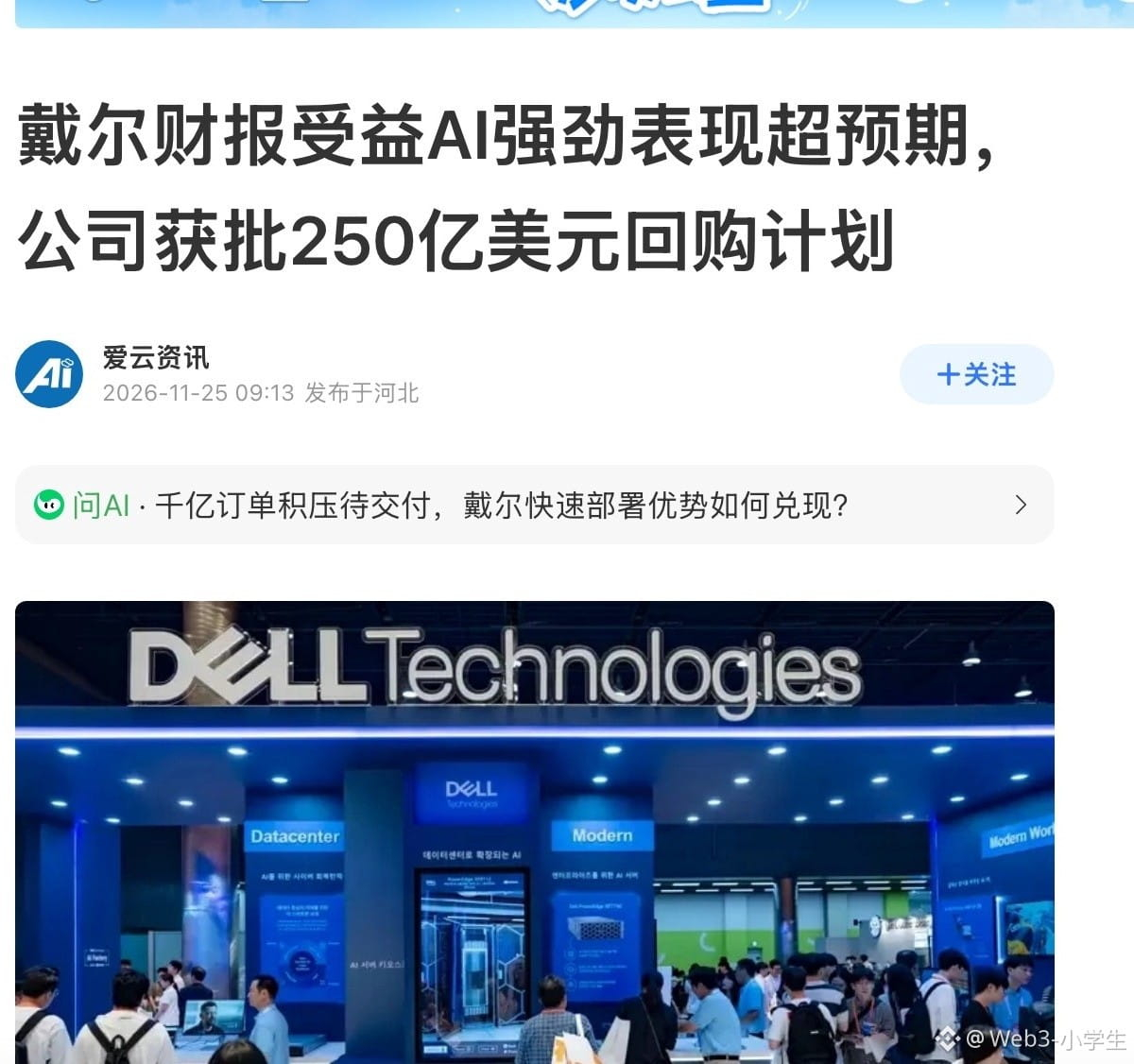
Dell was valued two different ways in a single day. It closed last night at 295.28, down 11.83%. Then, after its earnings report came out after hours, it climbed back 4%.
During the day, investors were selling a story. At night, they were buying orders. The same AI, but the pricing had almost nothing to do with itself.
Three media outlets wrote about the same thing last night. The Wall Street Journal said the relief rally sparked by Jensen Huang’s return had run out of steam. CNBC’s headline was that Dell beat earnings expectations and approved a $25 billion buyback. The Financial Times wrote that Anthropic had fallen below its IPO price.
Three headlines crowded into the same night, all pointing to one thing: the market was starting to reckon with these things separately.
Dell’s third-quarter revenue was $54.94 billion; analysts had expected just $49.32 billion. Adjusted earnings per share came in at $9.45, versus expectations of $6.59.
Its infrastructure business, which sells servers, brought in $41.97 billion—$6.7 billion more than expected. AI servers accounted for $22 billion of that, up 291% year over year. Margins may be thin, but this business has turned Dell from a PC seller into a provider of computing power. COO Clark’s remark, “We’ve completely transformed ourselves,” was about this line item.
At quarter-end, its undelivered AI server orders had piled up to $132.3 billion, a record high. The full-year revenue forecast was raised from $192 billion to $202 billion, including $78 billion in AI servers. The board also approved a separate $25 billion buyback.
The money is right there. So the 4% after-hours gain wasn’t a bet on the idea that AI will change the world; it was a bet on this string of numbers that add up. Money flows where the numbers point.
Some people will compare this to the boom around 2000. Back then, even the companies buying servers weren’t making money themselves; the orders were just on paper. Dell says it now has 7,500 customers, and checks where the money is coming from, who the end customer is, and whether power and land are in place before accepting each order. That sounds pretty solid.
But backlog isn’t revenue. That $132.3 billion has to be delivered over the coming years, and Dell itself has warned that memory costs will remain a headwind through 2027.
The PC business was down to just $12.89 billion, below expectations of $14.33 billion. Growth slowed from 20% last quarter to 3%. Customers are shifting their money to servers. That’s a real crack in the picture.
No one knows how much of that $132.3 billion can be delivered at today’s prices. The story makes sense, but it hasn’t been proven.
What really matters is this structure. Long-term stories are priced according to discount rates; the longer the duration, the harder they get hit. That’s exactly what drove last night’s decline in $QQQB . Once orders turn into inventory on the books and buybacks, they shift from the distant future into the present, making them somewhat more resilient. The same money in a story and in an order is not the same thing.
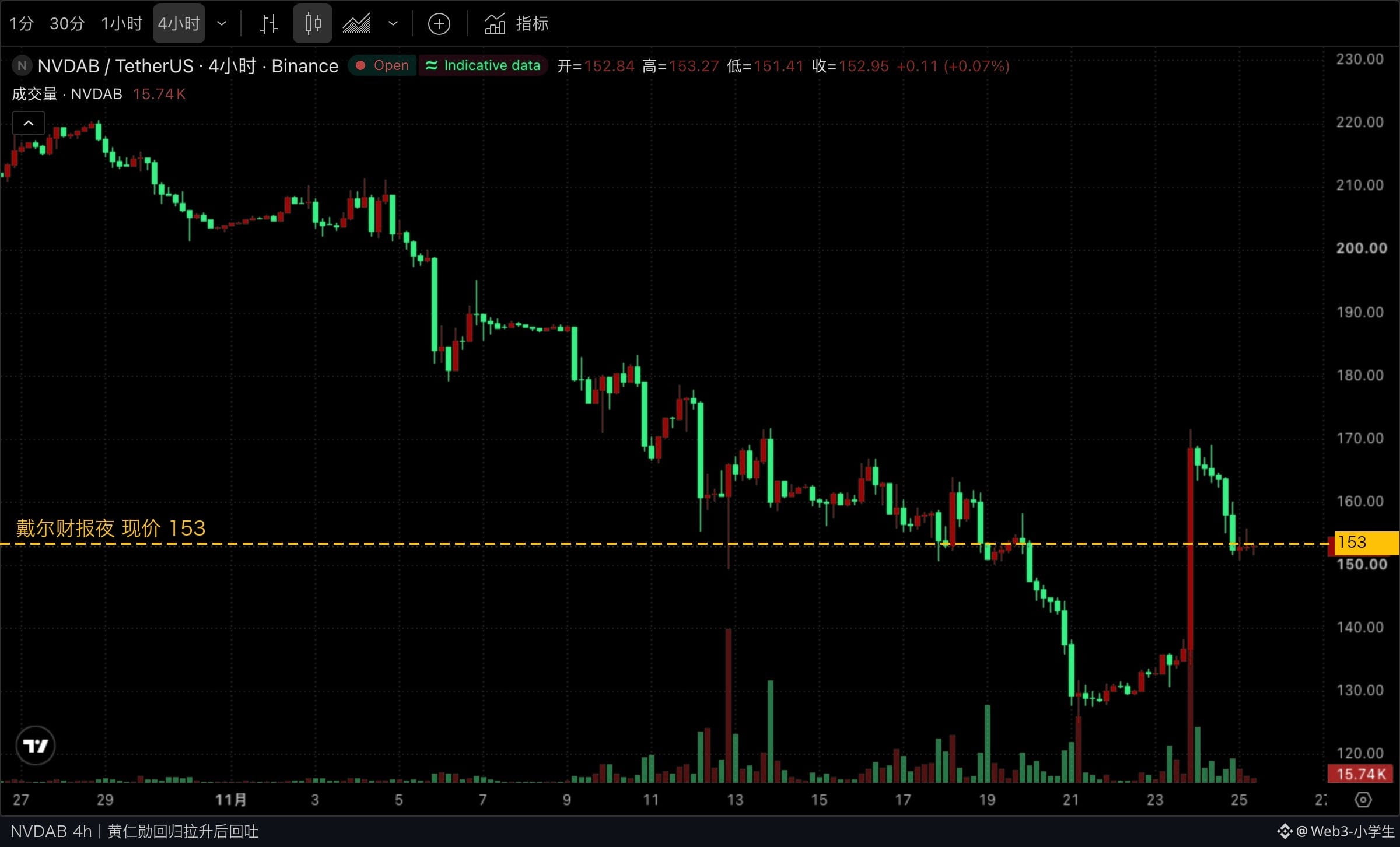
To see whether this buyback can actually happen, I’m watching the inventory line in the next earnings report. The December 9 rate decision can change the discount rate, but it can’t change the orders. $BTC 59521, down 3.27%. $NVDAB 153.08. The market’s attitude toward AI last night is written in these two prices. This is not investment advice.
#股票财报季 #US stocks