Trying to withdraw crypto from a Philippines-licensed exchange to your own wallet, only to find that the route is no longer supported? Don’t jump to the conclusion that the central bank has passed a law banning all platforms nationwide from connecting to self-hosted wallets.
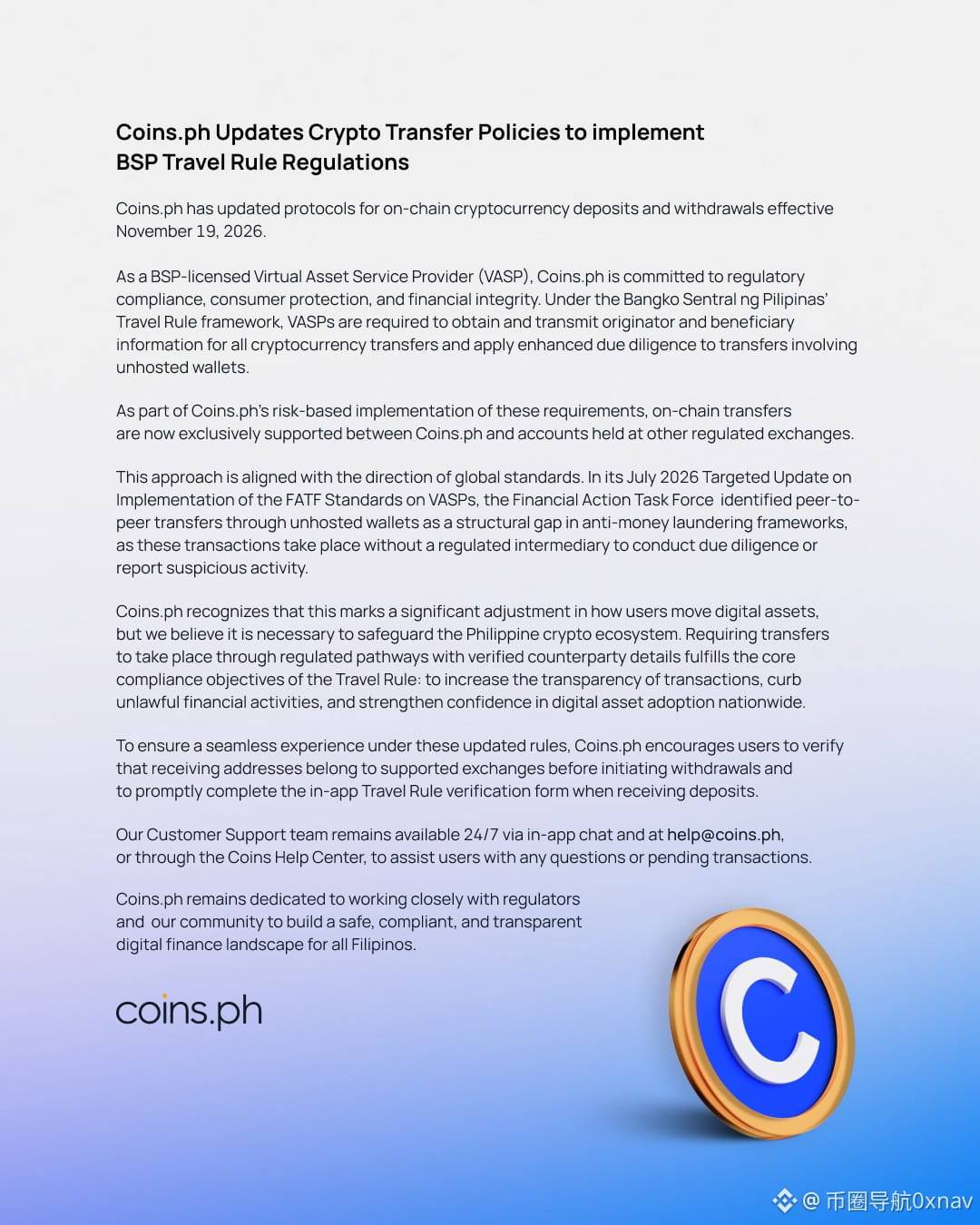
On November 24, Coins.ph issued an official statement: As a virtual asset service provider licensed by the Bangko Sentral ng Pilipinas (BSP), it updated its on-chain deposit and withdrawal rules effective November 19. The statement described the change as a “risk-based implementation”: the Travel Rule requires the collection and transmission of information about the originator and beneficiary of every crypto transfer, and enhanced due diligence for transfers involving unhosted wallets. On that basis, the platform now supports on-chain transfers only between accounts at other regulated exchanges.
A few points that directly affect everyday users 👇
🔹 Self-hosted wallets are no longer supported. The official help center states that you can only withdraw to, or deposit from, accounts at other regulated exchanges. The November 24 statement also advises users to confirm that a withdrawal address belongs to a supported exchange before sending funds, and to complete the Travel Rule verification form in the app as soon as possible after receiving a deposit.
🔹 You must provide information about the other party for every on-chain transfer, regardless of the amount. For withdrawals, submit the recipient’s name, wallet address, destination wallet type, destination exchange, and purpose of the transfer. Funds will be sent only after verification. For deposits, you’ll receive a notification and then need to provide information about the sender; funds will be credited only after verification. The help center explains that this change won’t affect you if you don’t normally transfer crypto to or from outside the platform.
🔹 This is not a new nationwide ban. The statement cites BSP Circular No. 1108 from 2021 and Memorandum M-2023-042 from December 2023. The framework requires identifying both parties to a transaction and conducting enhanced due diligence for unhosted wallets. Narrowing the route to transfers only between regulated exchanges is this platform’s own way of implementing the rules. The official statement also notes that, in its July 2026 targeted update, the Financial Action Task Force (FATF) described peer-to-peer transfers through unhosted wallets as a structural gap in the anti-money-laundering framework, because no regulated institution is in the middle to conduct due diligence and report suspicious activity. This is the international context cited by the platform; it does not mean that FATF or the BSP has specifically instructed all exchanges to cut off transfers to and from self-hosted wallets.
🔹 The platform also acknowledges that this is a significant change to how users move crypto, but says it is necessary to improve transfer transparency and curb illicit financial activity.
If you still use this platform to deposit or withdraw crypto, check that the recipient address belongs to a supported exchange account before withdrawing. If your deposit is marked “pending,” complete the verification form as soon as possible. Can the self-hosted wallet you usually use still connect directly to locally licensed exchanges?
#Coinsph停止自托管钱包转账 #BTC #ETH