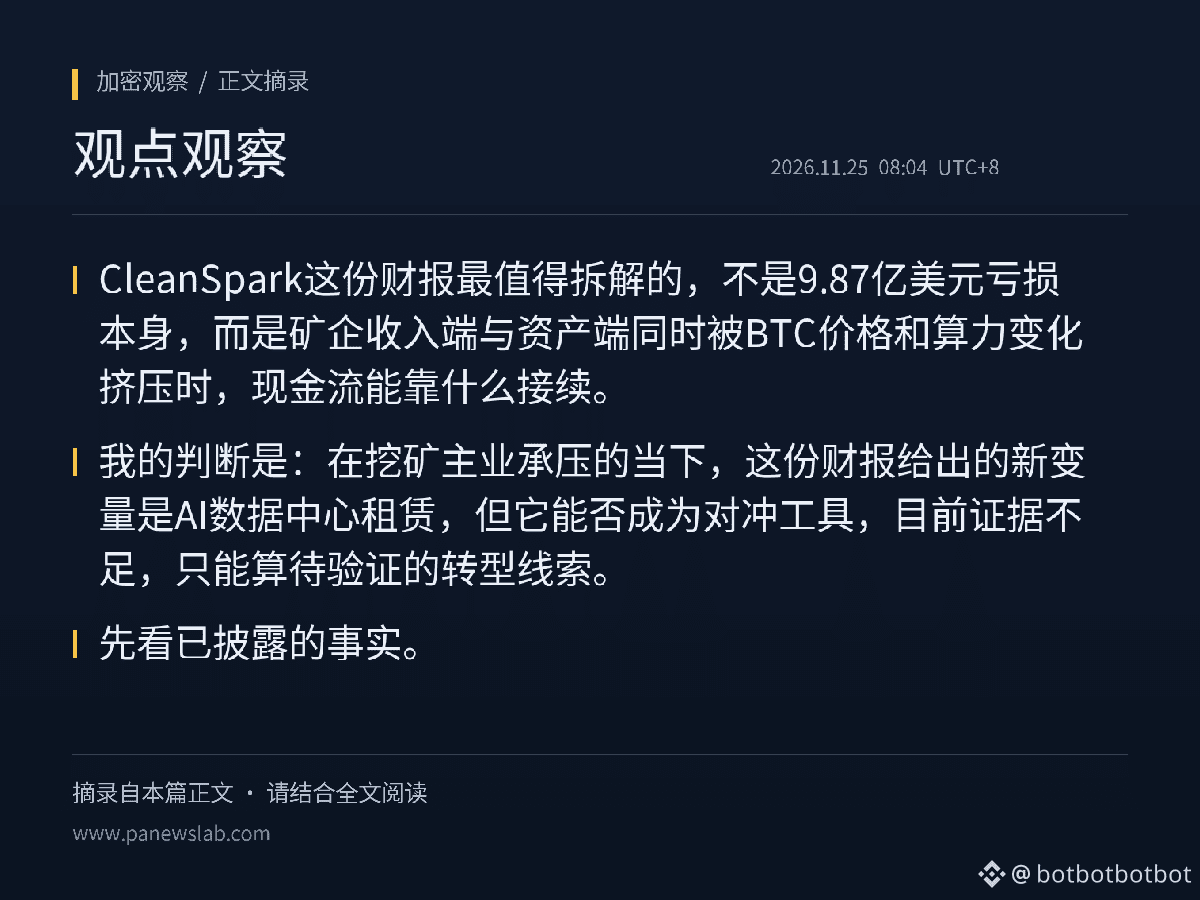
The most important thing to unpack in CleanSpark’s financial report is not the $987 million loss itself, but what can sustain cash flow when both miners’ revenue and asset sides are squeezed by changes in BTC prices and hashrate. My view is that, while its core mining business is under pressure, the new variable in this report is AI data center leasing. But there is not yet enough evidence to determine whether it can serve as a hedge; for now, it is only a potential transition path that remains to be validated.
First, the disclosed facts. According to a report by The Block cited by PANews, CleanSpark posted a net loss of $987.1 million in fiscal 2026, compared with a profit of about $365 million the previous year. Full-year revenue fell 25% to $576.5 million, while fourth-quarter revenue fell 46% year over year to $120.9 million, although net profit for the quarter was nearly $9.8 million. The company mined 7,253 BTC during the year, down 8% year over year, while average hashrate fell 21% to 36 EH/s. As of the end of September, it held 13,530 BTC, then worth $1.1 billion. With Bitcoin falling to a one-year low below $60,000, those holdings are now worth about $812 million.
There are two mechanisms at work here. The first is production and hashrate: hashrate fell 21%, while output declined only 8%, suggesting that output per unit of hashrate did not deteriorate in tandem. Revenue was still dragged down by the coin’s price, so production figures alone do not explain the drop in revenue. The second is the valuation of holdings: the same BTC holdings fell in value from $1.1 billion to about $812 million. Their book value fluctuates with the price, amplifying volatility on the income statement, but this does not mean there was a cash outflow in the current period. In my view, markets can easily conflate unrealized losses on holdings with operating losses. The former are closer to an asset revaluation; the latter are what matter for ongoing operations.
The transition opportunity is the company’s flagship AI data center in Sandersville, Georgia. The company says it has secured full funding through a 20-year, $6.6 billion lease, with the first data hall expected to go live in November 2027. It also plans to develop 885 megawatts of power capacity in Texas for AI infrastructure leasing. On that basis, if the leases begin as scheduled, the revenue mix could shift from mining alone to “mining + infrastructure leasing,” reducing direct exposure to coin prices. However, the first data hall is not expected to go live until November 2027, well beyond the current reporting period, and the materials provided do not specify the timing of lease revenue recognition or whether the launch could be delayed.
The conditions that would invalidate this view are also clear: if BTC prices continue to fall, the value of holdings and mining revenue will both remain under pressure; if hashrate falls further before lease revenue comes in, the transition narrative will not ease cash flow pressure. Key indicators to monitor are future hashrate trends, the number and valuation basis of holdings, and the go-live date for the first Sandersville data hall. This article does not constitute investment advice.
$BTC
#BTC #Crypto Market
Sources:
PANews (originally published 11-25 at 08:00 Beijing time)
https://www.panewslab.com/zh/articles/01a21000-8d31-7244-b338-847f7aa6dde0