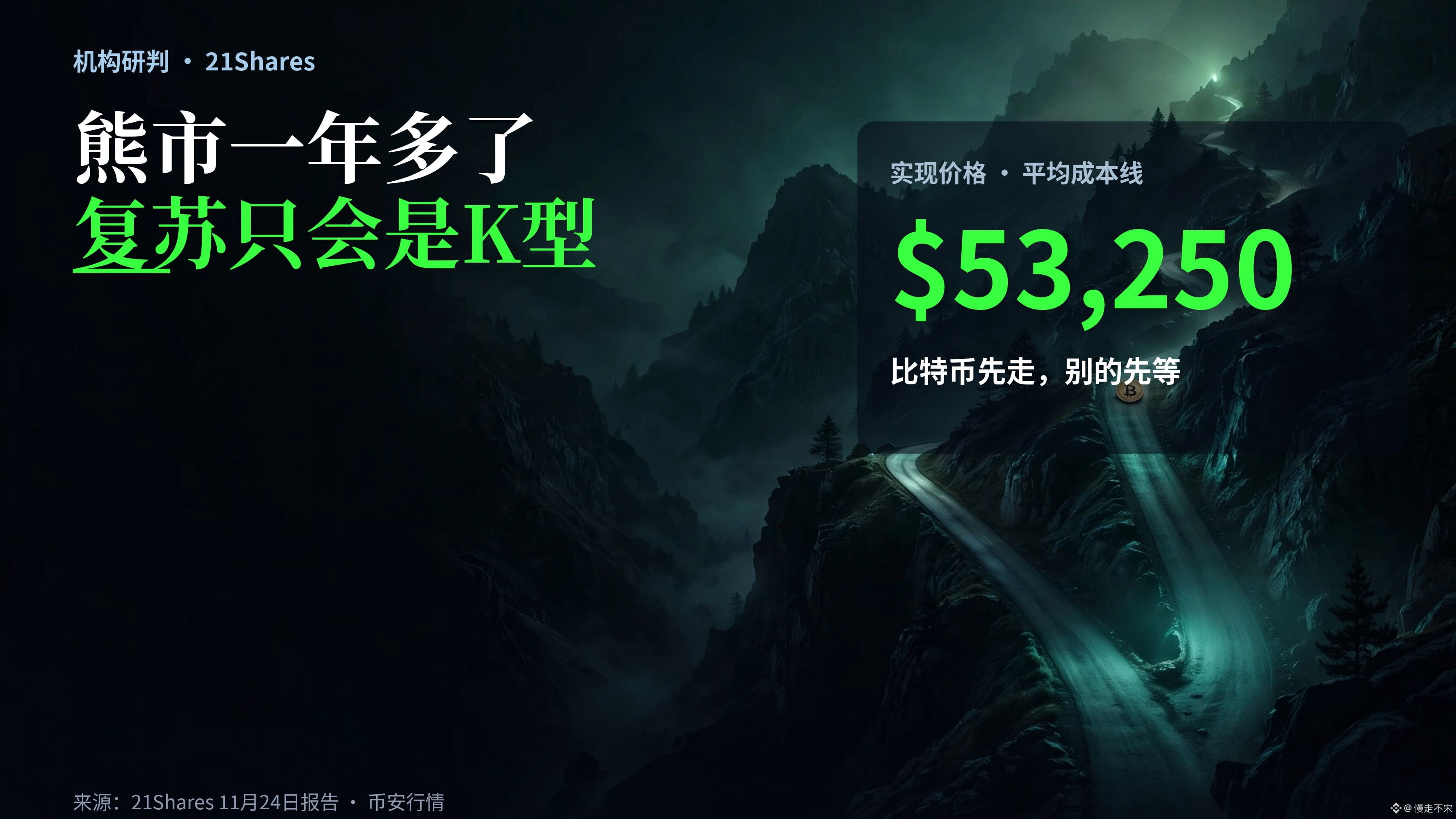
The bear market has lasted over a year. 21Shares says the recovery won’t lift everything together—it will diverge.
In a report yesterday (November 24), asset manager 21Shares said Bitcoin has been in a cyclical bear market for over a year. Historically, bear markets of this kind have lasted an average of about two and a half years, with an average decline of 84%—but this time, it’s unlikely to fall as deeply as in previous bear markets, with institutions and ETFs already in the market.
Their view is that the recovery will be K-shaped: Bitcoin, 24-hour trading venues, privacy protocols, and quantum-resistant solutions will lead, while other areas will lag behind. AI and robotics are drawing talent and capital away from crypto.
There are two key levels to watch: on the downside, $53,250—the average cost basis for all Bitcoin in the market (realized price); on the upside, the $73,000–$75,500 range. A return to that range, combined with sustained net inflows into ETFs and a recovery in stablecoin balances, would signal that demand has truly returned.
One overhang remains: the $2.2 billion in coins from the Binance hack has not moved, and could flow into the market through over-the-counter channels in the coming months. If the December rate hike is larger than expected, the bear market could drag on.
$BTC is currently at $59,898, down 1.98% over 24 hours, and trading between $59,260 and $61,682 today.
The next level to watch: will the $53,250 average cost basis hold? If not, the vertical part of the K-shape breaks first.
$BTC
Not investment advice.