

After a sharp drop, the instinct is to wait for it to go “even lower.” After a sharp rise, it’s to open a short, because “surely it can’t keep rising forever.” Both impulses seem logical. And both, when you look not at a single trade but at hundreds of thousands, work against the trader.
I measure this constantly across the 34 coins covered by Cryptanov signals, and dozens of other coins for comparison. The picture is always the same: the market has an asymmetry, and it has persisted for years.
Error No. 1. Waiting for continuation after a dump
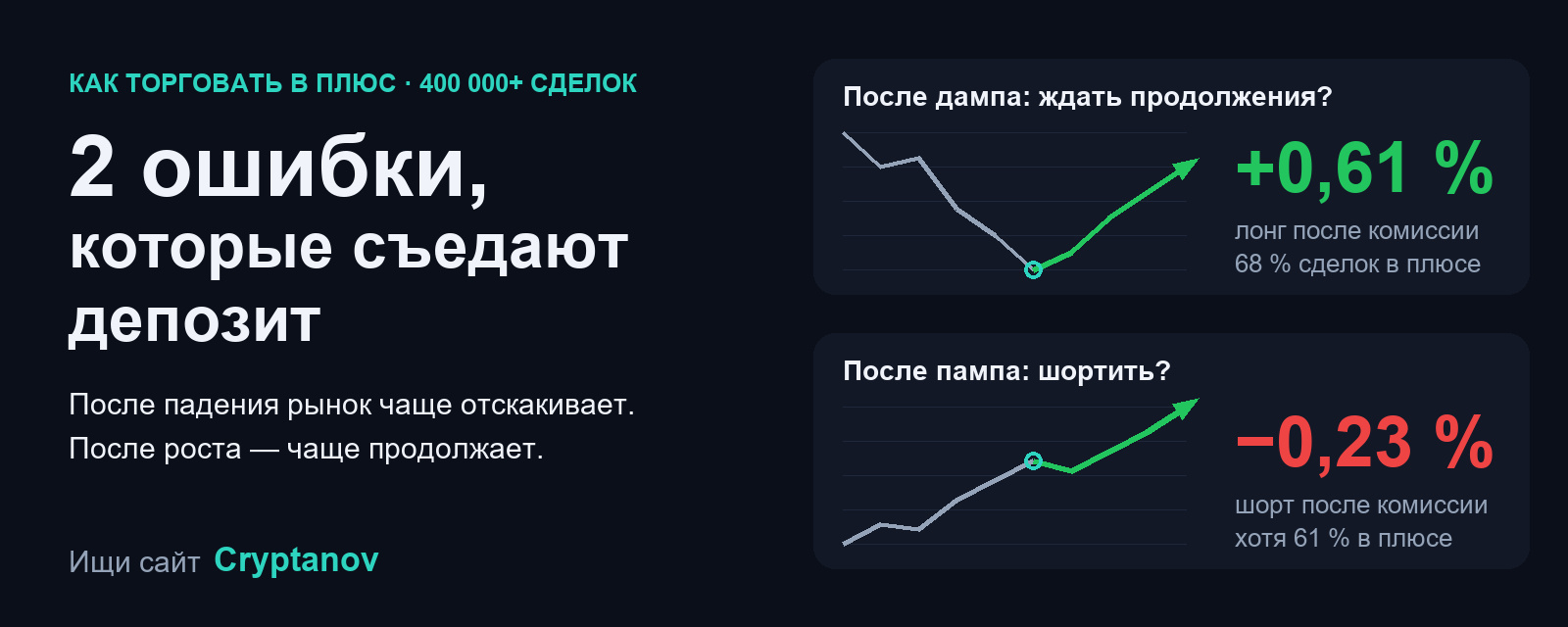
If you take every long entry after significant drops (more than 190,000 cases over 6 years), you get:
▫️ average result after fees: +0.61% per trade
▫️ 68% of trades closed in profit
▫️ profitable in 5 out of 6 years
Yes, sometimes the price keeps falling after a drop—we’ve all seen it. But overall, a bounce is more common than a continuation. Anyone who waits for “more” after every dump regularly misses the strongest upward moves.
Error No. 2. Shorting after a pump
Here, the paradox is more interesting. Shorts after a sharp rise (more than 200,000 cases) close in profit in 61% of trades—that is, they win more often than they lose. Sounds like a great strategy.
But the average result after fees is −0.23% per trade. And it’s negative in 5 out of 6 years.
Here’s why: shorting a pump often brings a small profit, but sometimes the price just keeps rising—and one such case wipes out a dozen small wins. A short can work in the short term. Over the long run, the aggregate data points to continuation.
That’s the asymmetry
📉 After a drop, the market is more likely to bounce.
📈 After a rise, the market is more likely to continue.
It sounds contradictory, but it’s the same underlying principle: drops are often driven by panic, and panic runs out; strong rises are often driven by new demand, and that doesn’t end in a single candle.
Two simple rules
1️⃣ Don’t assume a drop will continue. Look for signs that the selling is running out of steam.
2️⃣ Don’t short a pump just because it’s “gone up too much.” A high percentage of small wins doesn’t necessarily mean your account is in profit.
This isn’t just a beginner’s mistake. Experienced traders fall for the second rule even more often: a pretty win rate on shorts feels reassuring—until one trade wipes it all out.
Buying the dip is no secret; everyone does it. The difference lies in exactly where you enter and how you allocate risk. That’s what CAFE measures—every day, in a live market, without removing losses.
The “How to Trade Profitably” series will continue. Search for the Cryptanov website.