


If you spend most of your time watching short-term crypto price charts, it is easy to miss how much the underlying industry has changed over the past few years. Token prices still swing on headlines, and social media timelines still chase whatever narrative happens to be trending that week. Underneath that daily noise, however, a quieter and far more important shift is taking place.
On November 28 and 29, industry builders, institutional leaders, policymakers, and community members will gather at the Queen Sirikit National Convention Center in Bangkok for Binance Blockchain Week 2026. The theme chosen for this year is a single word: “Evolve.”
Unlike earlier industry conferences that revolved around bold predictions of replacing the entire global financial system overnight, this year’s agenda points toward a more grounded reality. True evolution in technology rarely happens through sudden disruption. Instead, it happens when rough, experimental tools are refined until they become reliable enough for businesses, institutions, and everyday people to use without friction.
Whether you are attending in Bangkok or following the sessions online, the conversations on this year’s stage offer a clear look at where crypto is actually making progress and where serious work still needs to be done.

Fixing the Friction Between Traditional Money and On-Chain Liquidity
To understand why institutional interest in blockchain has moved past the experimental stage, it helps to look at how traditional finance handles routine operations behind the scenes.
Consider a regional supply-chain business or a cross-border online merchant operating across Asia. When that business receives payments from overseas buyers on a Friday afternoon, its working capital often gets stuck in banking queues until Monday or Tuesday. Along the way, funds pass through multiple intermediary banks, each taking a slice in wire fees and currency conversion spreads. Even large asset managers face similar bottlenecks when moving collateral or settling treasury transactions outside standard market hours
Public blockchains and regulated stablecoins offer a straightforward mechanical upgrade to that process: programmable, around-the-clock settlement with transparent audit trails.
That practical utility explains why the speaker lineup in Bangkok brings together major traditional financial names like BlackRock, Franklin Templeton, Visa, and PayPay alongside blockchain-native organizations such as Ondo Finance, Tether, and Celo. Tokenized real-world assets ranging from short-term government treasuries to money market funds are no longer treated as theoretical concepts. They are actively being tested as ways to keep capital productive twenty-four hours a day and reduce manual reconciliation delays.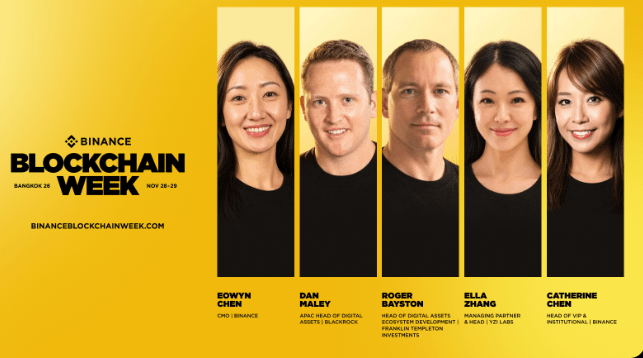
Still, bringing institutional capital on-chain is far from automatic. Large financial institutions operate under strict fiduciary duties. They require clear custody standards, deep secondary-market liquidity, and predictable legal treatment if something goes wrong. The real value of seeing traditional finance executives and Web3 builders on the same stage lies in examining how both sides solve these operational hurdles—such as connecting fragmented liquidity across different blockchains without introducing new smart contract risks.
Why Southeast Asia Is a Natural Testing Ground
Location matters when an industry talks about real-world adoption, and hosting Binance Blockchain Week 2026 in Bangkok carries clear significance
Across much of Southeast Asia, millions of people skipped legacy desktop banking and traditional credit cards altogether, jumping straight to mobile wallets and instant QR-code payments. Consumers and small shopkeepers in the region already expect digital money to move instantly on a smartphone screen at virtually zero cost.
Because those habits are already in place, digital assets and stablecoin payment rails do not have to teach users an entirely new behavior they simply need to integrate smoothly into existing mobile workflows while offering better cross-border efficiency.
At the same time, sustainable adoption cannot happen in a regulatory vacuum. That is why the participation of policymakers and regulators from countries such as Thailand, Kazakhstan, and Bhutan stands out on the Bangkok schedule. Different jurisdictions are taking distinct approaches to digital asset oversight, from licensing local exchanges to exploring sovereign digital infrastructure and tokenized bonds.
When regulators and builders sit in the same room, the conversation shifts from abstract bans or blanket approvals to practical questions: How do you protect retail users from fraud without choking off open software development? How do you verify compliance across borders while respecting user privacy? Clear, workable answers to those questions will determine whether blockchain stays confined to trading apps or becomes part of everyday commerce.
Accountability in an Era of Automated Software and AI
Another major thread running through the 2026 agenda looks forward to what happens when artificial intelligence meets on-chain infrastructure.
Over the past year, AI tools have moved rapidly from simple chatbots to autonomous software assistants capable of researching markets, managing workflows, and executing multi-step tasks. Yet as soon as an automated agent needs to pay for an API call, purchase verified data, or settle a micro-transaction with another digital service, legacy banking systems hit a wall. Traditional bank accounts and payment cards were built around human identity checks, monthly billing cycles, and manual approvals—not software programs executing hundreds of small transactions per minute.
Blockchain networks provide programmable rails that fit automated software naturally, provided strict guardrails are built in from the start. Instead of giving an AI agent unrestricted access to funds, developers can use smart wallets governed by cryptographic rules: predefined spending limits per hour, approved destination addresses and real-time on-chain logs of every action taken.
Equally important is data integrity. If automated systems are going to make financial or operational decisions on behalf of users, there needs to be a reliable way to verify that the underlying data was not tampered with. Watching teams from BNB Chain, YZi Labs, and on-chain analytics platforms like Nansen discuss this intersection is particularly relevant right now. The projects that earn lasting trust in this category will not be the ones slapping “AI” onto a whitepaper—they will be the ones building verifiable data pipelines and permissioned wallets that keep humans firmly in control.
Earning Public Trust Through Security and Grounded Use Cases
No honest conversation about crypto’s evolution can ignore the obstacles that still hold everyday users back. For many newcomers, self-custody feels intimidating. Phishing links, malicious smart contract approvals, and cross-border scams remain persistent threats, and a single mistake can result in irreversible loss
If the industry wants the next hundred million users to feel comfortable holding digital assets, security cannot be treated as an afterthought left entirely to individual vigilance.
That is what makes the Bangkok sessions on collective cyber defense so notable. Bringing together the Royal Thai Police Cyber Crime Investigation Bureau alongside blockchain security and intelligence firms such as Elliptic, TRM Labs, and Binance highlights how threat prevention is maturing. Real-time data sharing between exchanges, on-chain investigators, and law enforcement helps trace stolen funds faster, disrupt scam networks earlier, and protect everyday users all while preserving the open nature of public networks.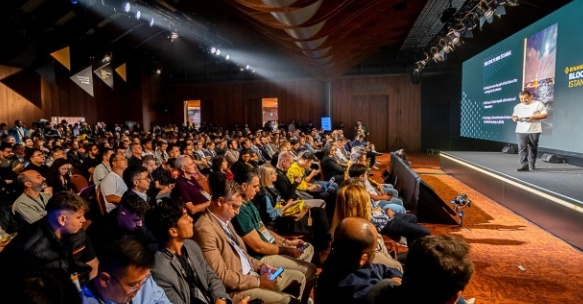
A similar sense of realism shows up in the event’s look at blockchain in humanitarian aid, featuring representatives from UNICEF alongside field practitioners. Delivering emergency relief funds digitally can bypass damaged banking infrastructure, reduce administrative overhead, and provide transparent records of where aid goes. Yet speakers on this topic are also openly examining the practical limitations: how recipients convert digital funds into local cash when crisis strikes, how to design interfaces for people unfamiliar with private keys, and how systems function when mobile connectivity is unreliable.
Acknowledging what works alongside what still needs improvement is a sign of an industry that has outgrown empty hype.
Looking Ahead: What “Evolve” Demands From All of Us
Even if you are tuning into Binance Blockchain Week 2026 from thousands of miles away, the themes on the table in Bangkok serve as a useful benchmark for evaluating where crypto goes next.
Markets will always have cycles of excitement and caution, but long-term value comes from infrastructure that solves real problems quietly and reliably. Over the next few years, the projects that stand out will be the ones focused on making cross-border payments cheaper, institutional assets more accessible, automated tools safer, and self-custody far less intimidating for ordinary people.
Evolution is not just something builders and regulators carry out on stage it also shapes how we as users, creators, and market participants evaluate new ideas, ask tougher questions, and separate genuine utility from short-term noise.
As the sessions unfold on November 28 and 29, I will be watching three key areas closely:
Institutional & Payment Rails: How quickly tokenized treasuries and regulated stablecoins move from pilot programs into everyday settlement tools.
Safe AI & On-Chain Verification: How developers build strict spending controls and verifiable data standards for autonomous software agents.
User Protection & Accessibility: How security partnerships and simpler wallet designs lower the barrier for everyday newcomers.
Which area of this evolution do you think needs the most attention right now stronger user security, clearer global regulation or simpler everyday payment apps? Share your thoughts below and join the conversation.