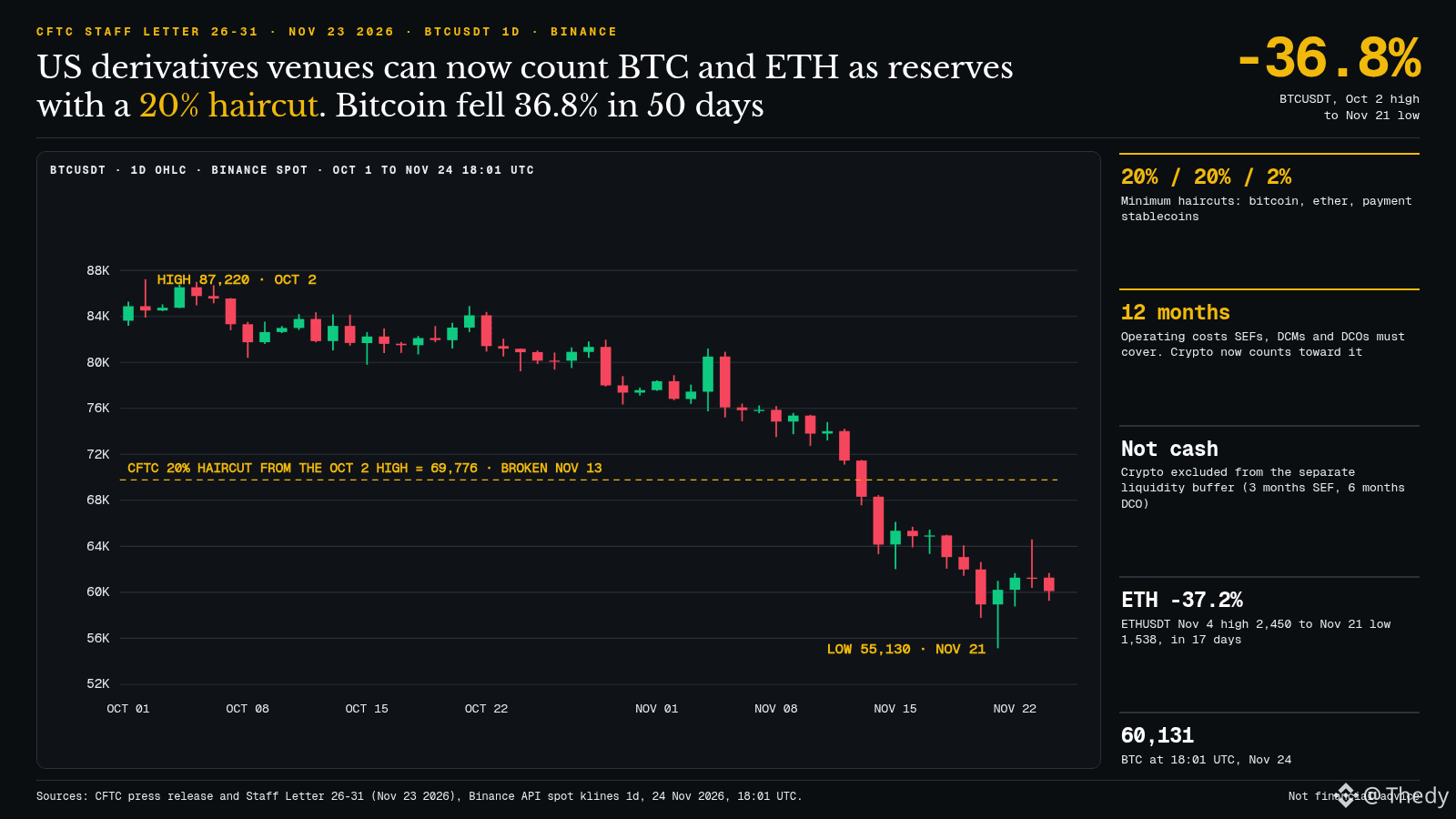
The CFTC now allows US derivatives platforms to count $BTC and $ETH toward their financial reserves, with a minimum haircut of 20%. As of 24/11, bitcoin remains about 31% below its October high.
The question that keeps coming up: will US exchanges buy bitcoin? Not directly.
What the text says. On 23/11, two CFTC divisions published a staff advisory (Staff Letter 26-31). SEFs, DCMs and clearinghouses (DCOs) must hold resources covering at least 12 months of operating costs. Bitcoin, ether and payment stablecoins can now count toward this buffer, after a haircut: at least 20% for BTC and ETH, and 2% for stablecoins. The staff also cites “wrong-way risk”: losses and a crypto downturn happening at the same time.
What it doesn’t say. Crypto isn’t cash under GAAP, so it doesn’t count toward the separate liquidity buffer (3 months of costs for an SEF, 6 for a DCO). And this is only the staff’s view, not a new rule.
On Binance, $BTC fell from 87,220 (02/10) to 55,130 (21/11), down 36.8% in 50 days. The -20% threshold from that high (69,776) was breached as early as 13/11. ETH did worse: 2,450 on 04/11, 1,538 on 21/11, down 37.2% in 17 days. BTC is worth about 60,130 at 18:01 UTC.
My take: another step forward in US regulatory plumbing, but a 20% haircut seems modest given what we’ve just experienced. A buffer filled with BTC at 87,000 would have lost more than its haircut in six weeks. I expect cautious use, not a wave of buying. Above 64,600 (the 23/11 squeeze peak), the issue becomes more comfortable; below 55,130, the debate over the haircut will quickly return.
In your view, is a 20% haircut on $BTC for a 12-month reserve too lax or too strict?
#CFTC #Bitcoin