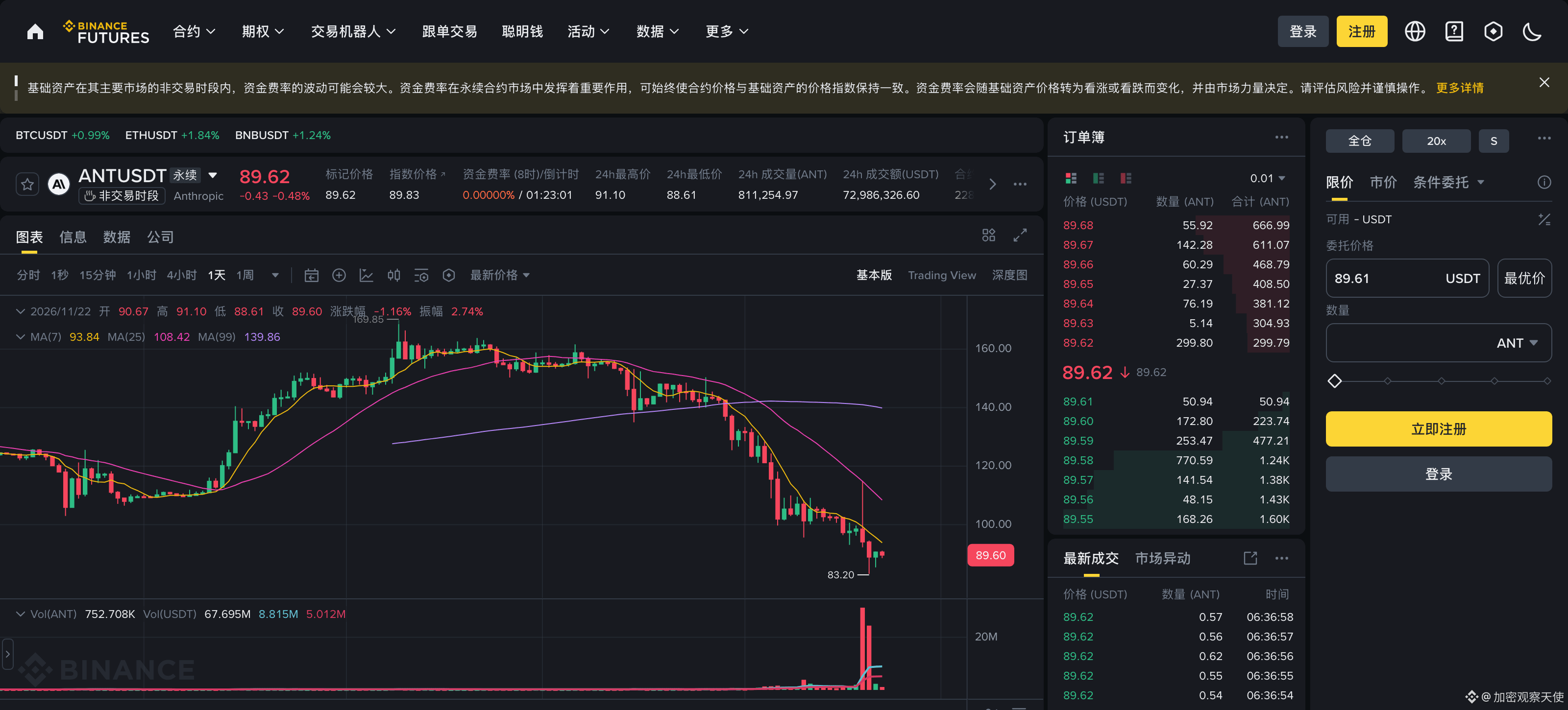
At 1:15 a.m. on November 20, the ANTUSDT pre-market contract switched to a standard contract.
What changed wasn’t the name. The mark price switched from the pre-market trading price to the median of three prices.
The nominal opening time that evening was 10:30. The conversion happened at 1:15, 165 minutes later.
The announcement stated that the trigger condition was that it be the official listing day and a stable index price could be calculated.
Only once the index price could be calculated did the contract become a standard contract.
And this announcement was published just twenty minutes before the switch.
Trading didn’t stop during that time, and orders and positions weren’t canceled.
The only thing changing was how the mark price was calculated.
The new algorithm takes the median of three prices: one from each of two price sources, plus the contract’s own price.
The advantage is that if one price source is wrong, the other two can keep it in check.
The announcement also specified a 1% per-second cap.
1.01 to the 60th power is 1.8167.
At the maximum rate for a full minute, that’s 81.7%.
This is a speed limit, not a limit on the magnitude of the move.
Read 1% per second as 1% per minute, and the difference is exactly 80 percentage points.
The changes to funding were more pronounced.
There were seven pre-market settlement points, each at 0.005%.
After conversion, across nine settlement points, the highest was 0.106017%, the lowest was negative 0.036169%, and four were zero.
The spread between the high and low was 0.142 percentage points—28.4 times the original fixed rate.
The reason is that the interest component drops to zero.
The premium index is only available after conversion, and from then on, funding follows the premium or discount in the order book.
The upper and lower limits are +2.00% and −2.00%, and settlement still occurs every eight hours.
The announcement also exempted the contract from the settlement-interval adjustment rule.
That means even if a settlement hits the upper limit, the interval won’t shorten from eight hours to one hour.
The impact won’t happen more frequently.
Based on the 20x limit shown on the page, a single 0.106% settlement equals 2.12% of margin.
One settlement can eat through more than two percentage points of your buffer.
The announcement ended with a reminder: the stock price may never reach the issue price.
The pre-market trading price isn’t a promise; it’s just a quote that hasn’t yet been tested by the official opening.
Over the weekend, “Non-trading hours” appeared next to the trading pair’s name, and the page also warned that funding-rate volatility could increase.
These contracts have thin order books, so slippage and funding costs can both be amplified.
Leveraged contracts can wipe out all of your principal.
This article uses only the fixed values in the announcement and settled funding records; it does not cite the current price.
Next time you see “pre-market” after a contract name, will you check its funding history first?
Rules and product parameters may change. Please refer to the official page. The above is an analysis of the rules and does not constitute investment advice. #DYOR