When the market suddenly plunges, readers often wonder: If my collateral ratio is still 60%, why was my account suddenly liquidated?
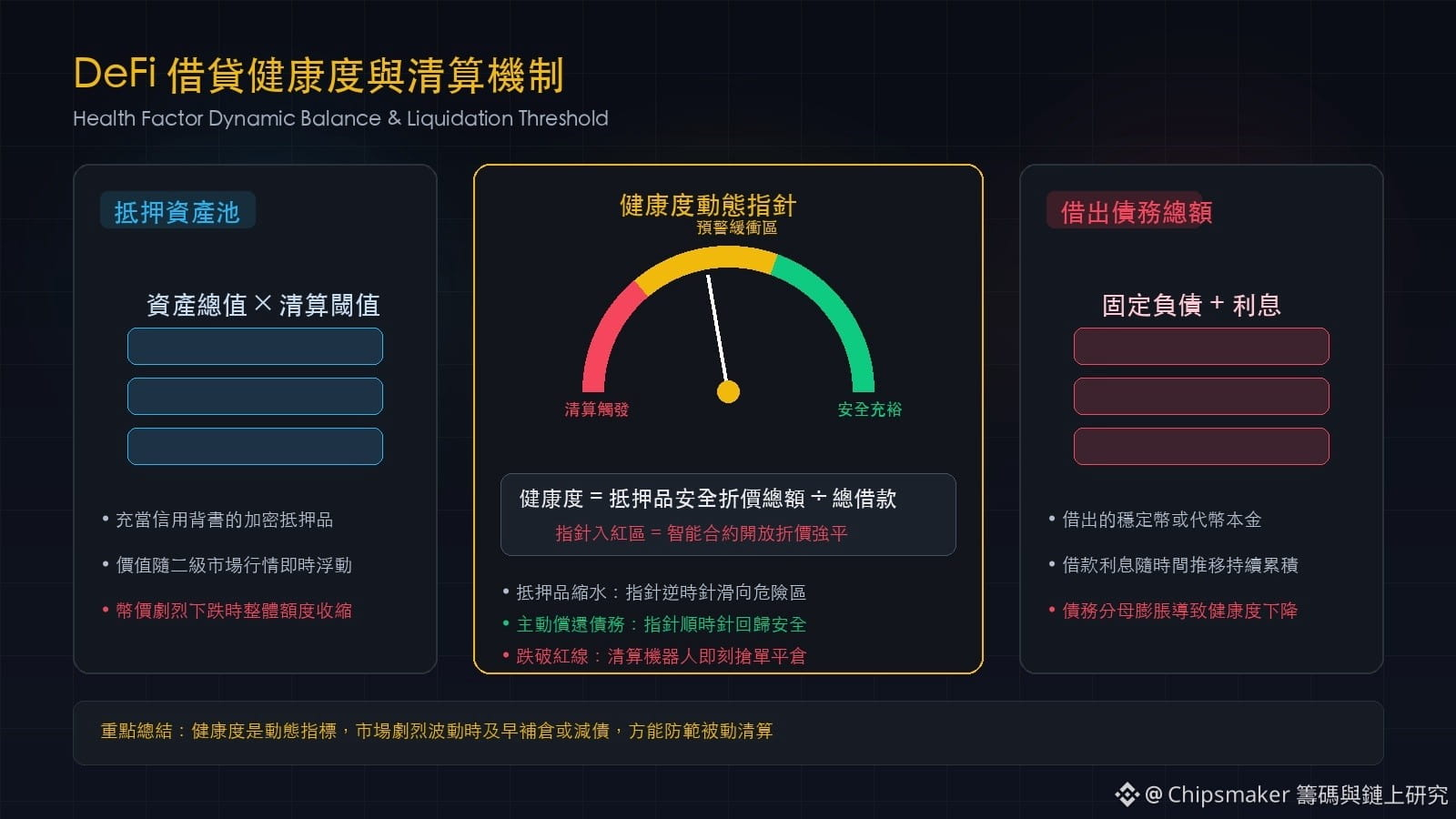
DeFi lending protocols such as Aave don’t send manual margin-call notices; they simply monitor your “Health Factor.” Think of it like pawning a watch: the shop doesn’t lend you money based on the watch’s full price. First, it applies a safety discount to the watch’s value (the liquidation threshold), then divides that by your loan amount. Essentially, the Health Factor is “(total collateral value × liquidation threshold) ÷ total borrowed.” Anything above 1 is safe; once it falls below 1, the smart contract allows liquidators to seize the collateral at a discount.
Look at the market tonight. According to Binance spot market data, ETH fell to $1,688, down about 6.86% on the day; AAVE is currently trading at $94.3. Foreign media report that publicly listed company BTCS sold about 27,000 ETH to repay its Aave loan. The reason: when the market value of ETH collateral shrinks while the debt remains fixed, the Health Factor is pushed toward the 1.0 danger line, forcing institutions to sell assets and repay loans to protect themselves.
A common misconception is, “As long as the price hasn’t fallen to the liquidation price, I’m safe.” In reality, the Health Factor changes constantly. Borrowing interest increases the denominator every day. During a sharp crash, network congestion and soaring gas fees can make things worse. If you have only a fragile buffer, such as 1.05, your position may be liquidated by bots before your collateral top-up is even confirmed.
In a volatile market, your first priority should be staying safe: maintaining a healthy Health Factor matters more than buying the dip.
This is solely my personal analysis. Please do your own research (DYOR) before investing.
$ETH $AAVE