
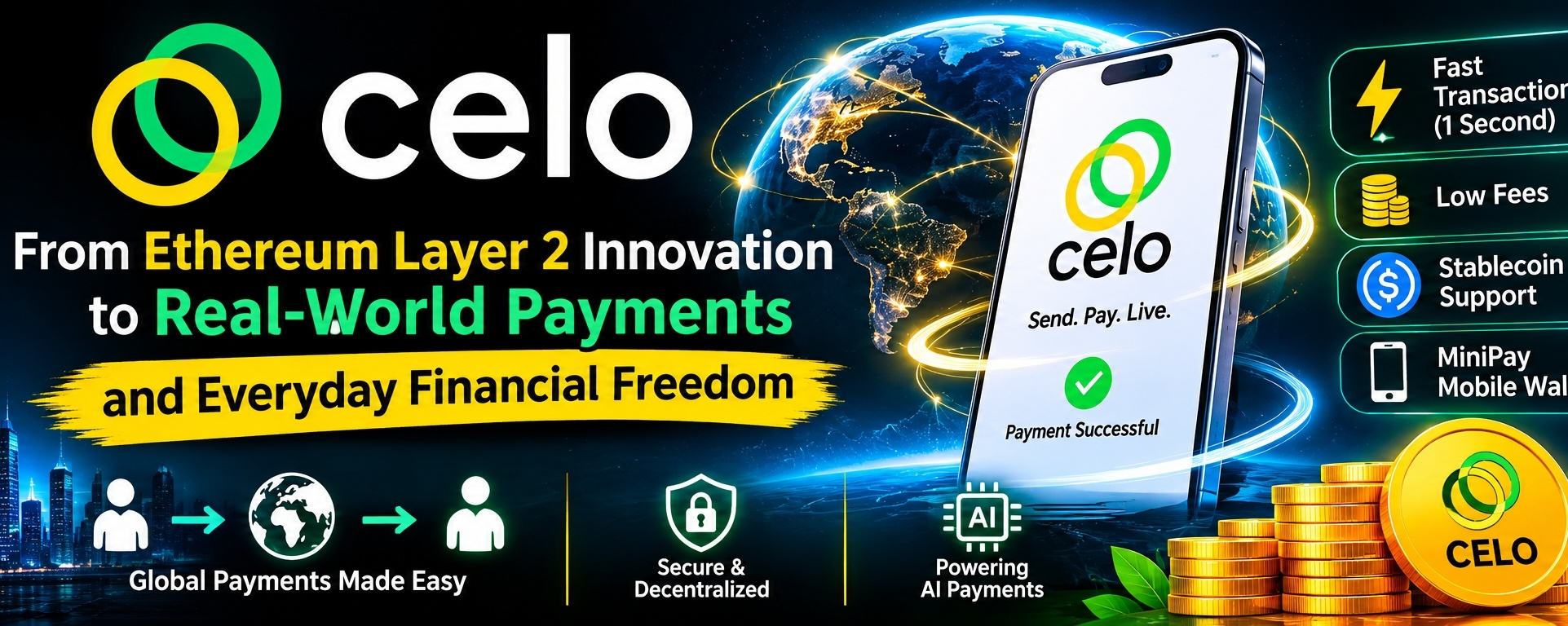


Celo is taking a different route from many blockchain projects. Instead of focusing only on trading, liquidity or attracting attention in the Layer 2 market, it is trying to solve something people deal with every day: moving money without unnecessary costs, delays or complicated steps.
What caught my attention about @undefined is that its identity has stayed connected to real-world payments even after a major change in its technology.
On March 26, 2025, Celo officially moved from an independent Ethereum-compatible Layer 1 to an Ethereum Layer 2. For some projects, a transition like this could mean rebuilding their entire direction. Celo took a different approach. It changed the foundation while keeping the purpose that had shaped its ecosystem from the beginning.
I think that decision says a lot about where the team wants to take the network.
Celo had already spent years working on mobile-friendly financial applications, low-cost transactions and stablecoin payments. Its goal was never simply to become another place where people exchange tokens. It wanted blockchain technology to be useful for people who might not even care about the technology behind it.
Moving closer to Ethereum gave the project an opportunity to build on a larger ecosystem instead of carrying every infrastructure responsibility independently.
The migration was approved by the community in May 2024 and went live at block 31,056,500. One detail I find particularly important is that Celo preserved its existing blockchain state and nearly five years of transaction history. Developers and users were not being asked to abandon everything they had already built.
The new network uses the Optimism OP Stack, giving developers an Ethereum-compatible environment and access to familiar tools.
But the interesting part is how Celo combines this with EigenDA.
Ethereum provides the settlement foundation, while EigenDA handles data availability. This allows Celo to pursue lower transaction costs without publishing all transaction data directly to Ethereum.
There is a trade-off here. Celo's Optimium architecture has different data availability assumptions from a traditional rollup that publishes its transaction data to Ethereum. That distinction matters when discussing security, and I wouldn't overlook it simply because the network is now an Ethereum L2.
For a payment-focused blockchain, keeping transactions affordable is important. But affordability means little if users cannot rely on the system.
Celo has continued working on this side of its architecture through the Jello hardfork, activated on December 10, 2025.
The upgrade introduced OP Succinct Lite, developed with Succinct and EigenDA. It brought zero-knowledge-powered fault-proof infrastructure and a verification bridge for EigenDA data availability.
What I find encouraging is the effort to make the network's claims more independently verifiable rather than relying entirely on trust in infrastructure operators.
There is still work to do around challenger participation, upgrade permissions and decentralization. Nevertheless, these improvements show that Celo is taking its security responsibilities seriously as its architecture evolves.
Its connection to the Optimism Superchain also creates another opportunity.
Celo can develop its own payment-focused applications while benefiting from shared OP Stack infrastructure and potential connections with other networks.
I don't think Celo needs to compete with every other Layer 2 on the same terms. Its advantage is that it already has a particular area of focus.
Payments.
Consider someone sending money to family in another country. That person probably doesn't care whether the transaction uses an Optimistic Rollup or a particular data availability solution. They want their money to arrive quickly, with as little cost as possible.
That is the kind of experience Celo wants to make accessible.
Features such as one-second block times, low transaction fees, stablecoin support and fee abstraction are designed around this idea.
Fee abstraction deserves more attention than it usually receives. On many blockchains, someone holding stablecoins still needs a separate amount of the native token to pay transaction fees.
That can be frustrating for someone who just wants to send digital dollars.
Celo supports paying gas fees with selected ERC-20 assets, including stablecoins. In practical terms, users can interact with supported applications without always having to acquire CELO first.
It might seem like a small improvement, but removing these extra steps makes the experience much more approachable.
This is also why MiniPay is such an interesting part of the ecosystem.
Built by Opera, MiniPay is a self-custodial wallet designed to make stablecoin payments accessible through mobile devices. It brings blockchain-based financial services closer to the way people already use everyday applications.
Think about someone who wants to receive money, save in digital dollars or make a payment using their smartphone. They shouldn't have to understand several blockchain concepts before getting started.
MiniPay is trying to remove that friction.
Its October 20, 2026 ecosystem update reported more than 20 million wallet activations, over 600 million transactions, more than $2.3 billion in processed volume and users across 70+ countries. The ecosystem also reported 77 Mini Apps.
These figures show that the project has built a considerable distribution channel.
However, I wouldn't automatically treat wallet activations as active users. The more useful question is how many people continue using MiniPay after their first transaction.
Regular payments, returning users and genuine demand for its applications will tell us much more about the strength of this adoption.
Another development came on November 19, 2026, when MiniPay announced its upgrade to Privy, Stripe's wallet infrastructure platform.
The integration brings familiar access options such as email, social login and passkeys while retaining self-custody and the ability to export keys.
This is a practical improvement.
Many people are comfortable using mobile banking applications but become hesitant when they encounter seed phrases, private keys and network fees. Making wallet access feel more familiar could help reduce that hesitation.
The challenge is maintaining simplicity without compromising users' control over their funds.
Celo's stablecoin ecosystem gives this payment strategy another dimension.
The network supports assets such as USDT and USDC, alongside Mento's local-currency stablecoins.
This matters because not everyone has the same financial needs. A person in Brazil may prefer access to assets connected to the Brazilian real, while someone in another country may need a different local-currency option.
Stablecoins can support cross-border transfers, digital savings, merchant payments and other financial applications. Local-currency assets also create opportunities for services that go beyond simply sending US dollars from one wallet to another.
Of course, liquidity, local regulations and conversion options still matter. Having a stablecoin available on a blockchain doesn't automatically make it useful in every market.
But connecting blockchain payments with actual local financial needs is a direction I find worth following.
Celo is also exploring a market that could become increasingly relevant as AI applications develop.
AI agents may eventually need to purchase computing resources, access data, use APIs and pay for online services without requiring someone to manually handle every transaction.
That creates a need for payment infrastructure that software can interact with directly.
The x402 protocol is one approach. It allows internet services to request payment through an HTTP-based payment flow.
Celo's x402 infrastructure supports stablecoin payments, giving developers another way to build applications where agents can pay for services using digital assets.
In October 2026, Celo also introduced buy, a marketplace providing AI agents access to more than 700 services.
I find this direction interesting because it gives Celo another potential use beyond traditional wallet-to-wallet transfers.
Imagine an AI agent that needs computing power to complete a task. It could find a suitable service, check the price and make a payment as part of its workflow.
That is a different type of payment activity from a person sending money to another person.
Still, there is a big difference between making this infrastructure available and seeing widespread usage. Recurring payments, actual service demand and reliable settlement will determine whether this opportunity becomes meaningful.
The CELO token also remains an important part of the network.
It serves as the native asset and participates in transaction fees, governance and the network's staking framework. Fee abstraction means supported tokens can also be used to pay gas, but that doesn't remove CELO's role from the ecosystem.
One thing I would keep separate is network growth and token performance.
More applications, more stablecoin transfers and additional users can strengthen the ecosystem, but they do not automatically guarantee higher CELO demand or price appreciation.
The connection between transaction activity, staking, governance and token economics deserves attention. Sustainable growth needs to create real value rather than relying entirely on market excitement.
For me, the most interesting question about Celo isn't how many new features it can introduce next year.
It's whether people will continue choosing its applications because they make everyday financial activities easier.
I would watch MiniPay's returning users, stablecoin payment frequency, developer activity, security improvements and the actual benefits coming from Superchain integration.
These are better signs of progress than announcements alone.
Celo has already made a significant architectural change. It has moved closer to Ethereum, adopted the OP Stack, introduced a separate data availability layer through EigenDA and continued improving its verification infrastructure.
But its original focus remains recognizable.
It wants someone to be able to send money from a phone without worrying about complicated blockchain procedures. It wants stablecoins to be useful beyond trading screens. And it wants financial applications to reach people who have never considered themselves part of the crypto industry.
That is the part I find most interesting about Celo.
A blockchain doesn't become successful just because its technology is impressive. People need a reason to use it repeatedly.
If Celo can make sending money, receiving payments and accessing digital financial services feel as simple as using an ordinary mobile application, it will have something more valuable than another technical upgrade.
It will have a place in people' everyday lives.
And that is the kind of growth I want to see from $CELO