
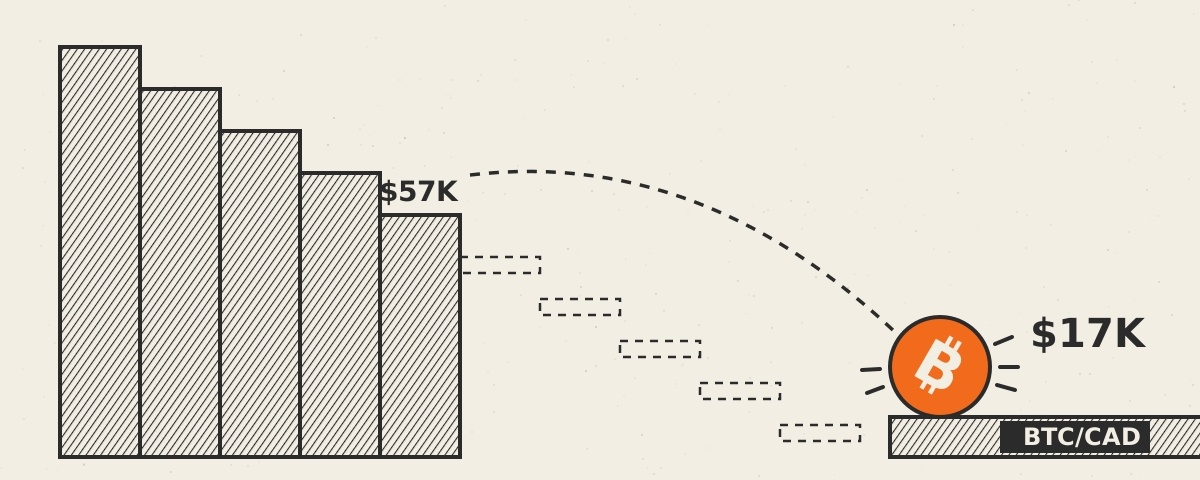

✨ While Bitcoin was plunging below $60,000 in global markets, one of Kraken’s order books told a completely different story.
✨ The BTC/CAD pair fell to 24,250 Canadian dollars, or around $16,900—a level Bitcoin hadn’t seen since the FTX collapse four years ago.
✨ More surprisingly, Kraken confirmed that all executed trades would remain valid.
💡 The problem was with the Canadian dollar, not Bitcoin:
✨ Kraken’s support team explained that the platform’s Canadian dollar pairs came under heavy selling pressure starting around 20:00 GMT on November 20, causing their prices to fall far below those on other markets.
✨ Meanwhile, BTC/USD on the same platform was trading between $57,000 and $58,000.
✨ The platform confirmed that its systems processed orders correctly, and that its security team found no evidence of a hack or compromised accounts.
⚙️ The anomaly was not limited to Bitcoin.
✨ Data tracked by the CryptoReviewing account showed similar sharp movements in most Canadian dollar-denominated pairs, including Ethereum, Solana, XRP, USDC, and USDT—even the US dollar/Canadian dollar pair.
✨ ETH/CAD fell below 800 Canadian dollars, while USD/CAD hit just 0.3.
⚙️ In other words, the issue was on the Canadian dollar side of the order books, not with the cryptocurrencies themselves.
✨ Prices also remained decoupled from the market for hours, rather than seconds as in typical flash crashes, before returning to normal around 10:00 GMT.
💡 What happened?
💥 The most likely explanation is simple: liquidity disappeared.
✨ When large sell orders hit an order book without enough buy orders near the prevailing price, they continue executing at progressively lower prices.
✨ In a market shallow enough, that can result in a massive gap like this one.
✨ Analyst KALEO offered a more optimistic interpretation.
✨ He believes Bitcoin effectively returned to its post-FTX lows near $16,900 in a single move on Kraken, and that whoever triggered the sell-off may have helped set a bottom for the entire market.
💡 The lesson for traders is clear:
✨ Market orders in illiquid pairs can execute at disastrous prices, so limit orders should always be used.