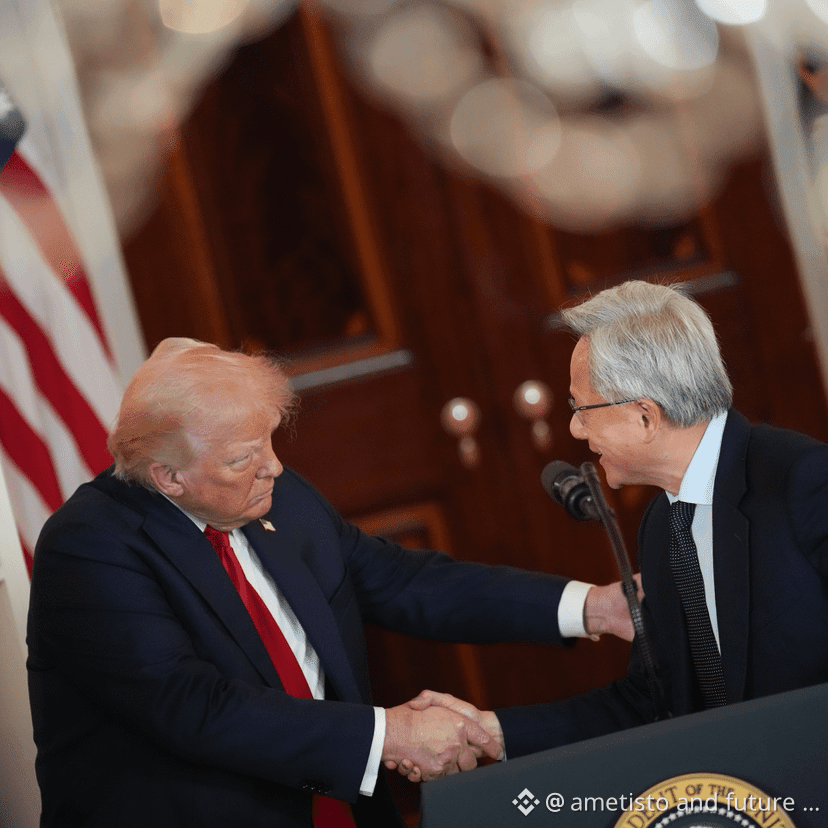
TRUMP STEPPED IN TO SAVE NVIDIA: WHEN ARTIFICIAL INTELLIGENCE BECOMES A MATTER OF STATE
$NVDAB
A Wall Street Journal report revealed the behind-the-scenes details of the intense operation led by the White House to reinstate Jensen Huang as head of Nvidia.
For 48 hours, Donald Trump, Vice President JD Vance, and members of the U.S. government worked to persuade the company’s board of directors to reconsider its decision.
The Department of Justice informed the White House that there was no evidence Huang had committed any crimes or posed a national security threat.
The result was an extraordinary turnaround. The board unanimously approved the executive’s return, Nvidia shares surged 31.48%, and the S&P 500 rose 4.7%.
But the episode reveals something far greater than a corporate crisis.
Nvidia has become so important to the U.S. economy, artificial intelligence infrastructure, and technological competition with China that its stability is now being treated as a matter of national strategy.
Meanwhile, investigations are ongoing, and Republican and Democratic lawmakers are questioning the presidential intervention.
In my view, we are witnessing a transformation in the relationship between governments and tech giants. The concentration of computing power is beginning to take on geopolitical significance comparable to that of energy resources.
For the cryptocurrency market, the recovery in risk appetite could also benefit Bitcoin ($BTC ) and projects associated with artificial intelligence and decentralized computing.
But there is a troubling contradiction: an industry that promises to transform the entire global economy shows an extraordinary dependence on a single company and its top executive.
Has Nvidia become too big to fail, or too important for Washington to allow it to fall?
#Nvidia #Trump #AI #Bitcoin #Geopolitics #WallStreet