

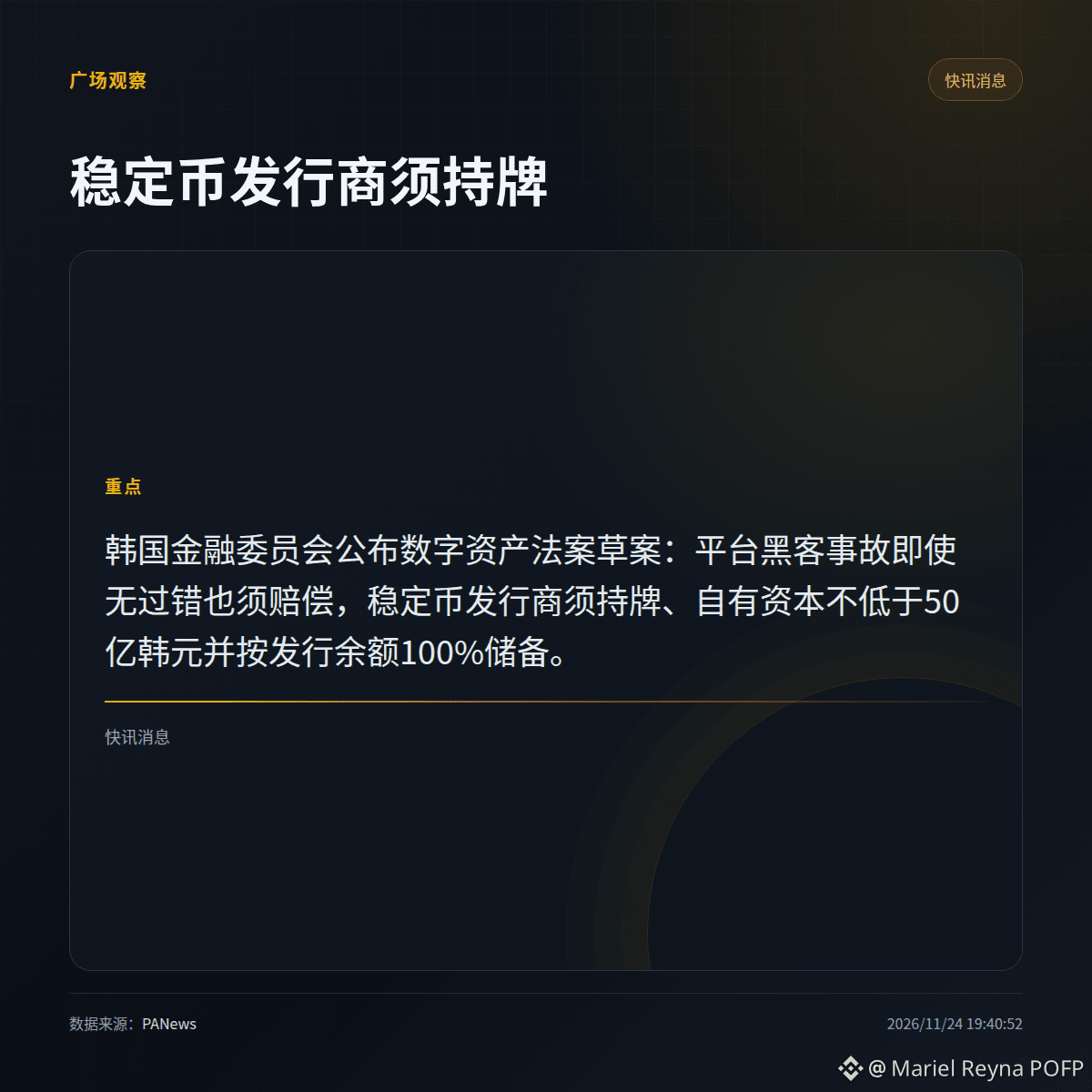
Under the Financial Services Commission of Korea’s draft Digital Asset Act, stablecoin issuers face a hard capital requirement of at least 5 billion won. They must also hold or place in trust reserve assets equal to at least 100% of the outstanding issuance with banks or other institutions, and may not pay interest to holders. Initially, issuance is proposed to be limited to consortiums in which banks collectively hold a majority stake, though fintech or technology companies may be the single largest shareholder. For cross-border issuance, foreign issuers that meet their home country’s regulatory requirements may also issue and redeem stablecoins in Korea after establishing a branch, completing registration, and filing a currency declaration. I think the provision with the greatest impact on ordinary users is the allocation of liability: platforms must compensate users for hacking incidents even if they were not at fault. $BTC #KoreanDigitalAssetAct#Stablecoins. Let’s see whether the market buys it—don’t rush in just because you saw the headline.
Join global crypto users on Binance Square
⚡️ Get latest and useful information about crypto.
💬 Trusted by the world’s largest crypto exchange.
👍 Discover real insights from verified creators.
Email / Phone number