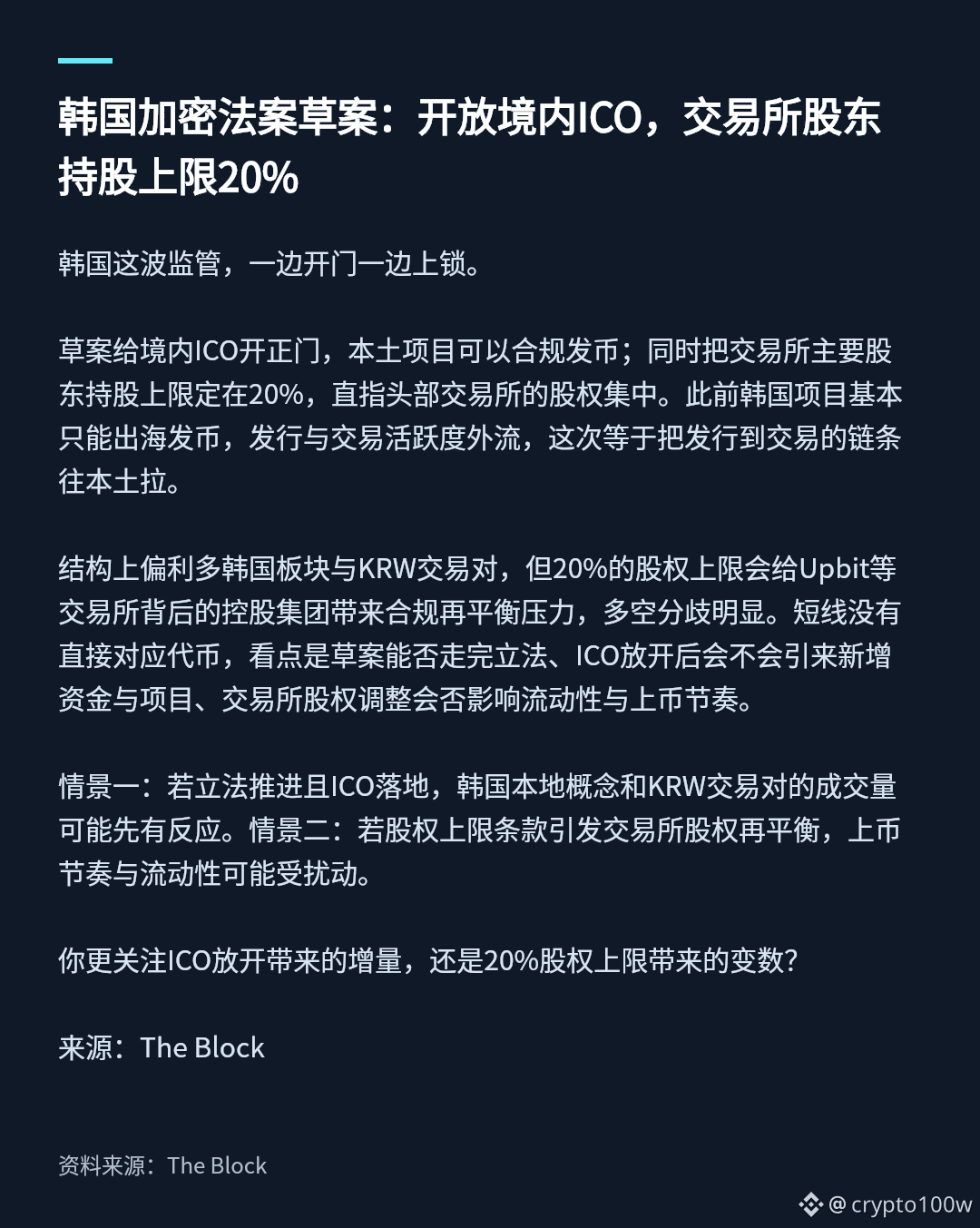
South Korea’s latest regulatory move opens one door while locking another.
The draft bill opens the door to domestic ICOs, allowing local projects to issue tokens in compliance with the law. At the same time, it caps major shareholders’ stakes in exchanges at 20%, directly targeting ownership concentration at leading exchanges. Until now, South Korean projects have largely had to go overseas to issue tokens, with issuance and trading activity moving abroad. This move effectively brings the entire chain, from issuance to trading, back onshore.
Structurally, this is somewhat positive for South Korean crypto assets and KRW trading pairs. But the 20% ownership cap could put pressure on the controlling groups behind exchanges such as Upbit to rebalance their holdings to comply, creating a clear divide between bullish and bearish views. There is no directly affected token in the short term. The key questions are whether the draft will complete the legislative process, whether opening the door to ICOs will attract new capital and projects, and whether changes to exchange ownership will affect liquidity and the pace of new listings.
Scenario 1: If the legislation advances and ICOs are allowed, trading volumes in South Korean projects and KRW trading pairs may react first. Scenario 2: If the ownership cap prompts exchanges to rebalance their shareholdings, listing schedules and liquidity may be disrupted.
Which are you paying more attention to: the new activity brought by opening the door to ICOs, or the uncertainty created by the 20% ownership cap?
Source: The Block
Image 1: Draft South Korean Crypto Bill: Domestic ICOs to Open, Exchange Shareholders’ Stakes Capped at 20% · Key News
Image source: https://www.theblock.co/news/regulation/2026-11-24-south-korea-new-crypto-bill-445494