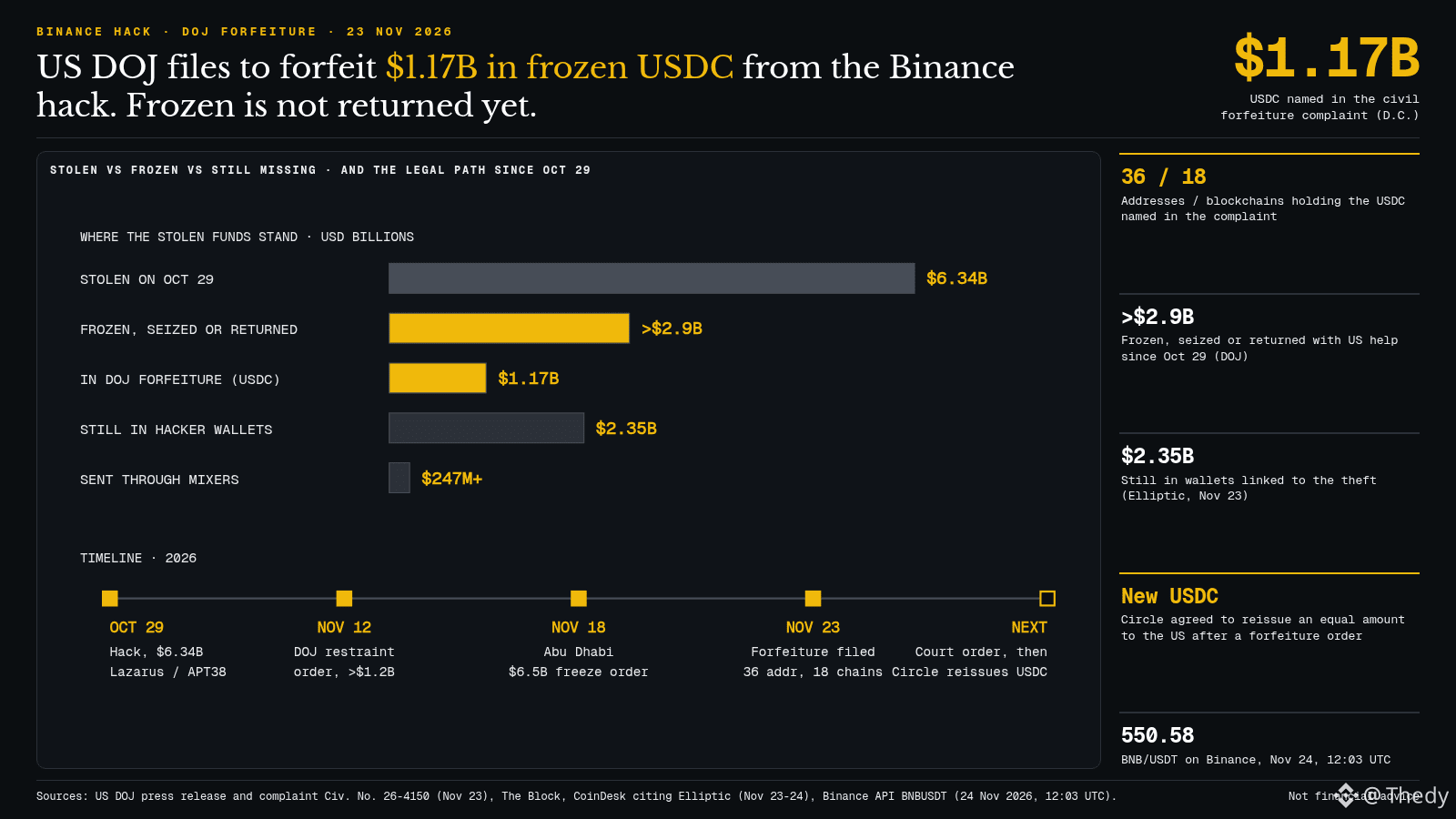
The U.S. DOJ filed a civil forfeiture complaint on 23/11 seeking $1.17 billion in USDC linked to the October 29 Binance hack. This is not a new freeze: it’s the step intended to turn blocked funds into recovered funds.
What the documents say:
- 36 addresses across 18 blockchains, already under a freeze order since 12/11 (complaint Civ. No. 26-4150, District of Columbia, via The Block).
- Circle cannot move the blocked tokens. The issuer has committed to issuing the same amount of new USDC and transferring them to the United States once forfeiture is ordered.
- More than $2.9 billion frozen, seized, or returned with U.S. assistance since the theft, compared with the more than $2.7 billion announced on 12/11 (DOJ).
- Around $2.35 billion is still sitting in wallets linked to the attack, attributed to Lazarus / APT38, and at least $247 million has passed through mixers (Elliptic via CoinDesk).
My take: USDC is the easy part, because a centralized issuer can freeze it. The real issue is the $2.35 billion that nobody can freeze, even with the global $6.5 billion order Binance obtained in Abu Dhabi on 18/11. Binance says it has already reimbursed customers using its own funds, so these recoveries mainly rebuild its balance sheet.
Two things to watch:
- A swift order would make this case a precedent for recovering stolen stablecoins within weeks;
- Major movements from the unfrozen wallets would be a reminder that more than a third of the loot remains movable.
$BNB at $550.58 on Binance at 12:03 UTC, $BTC toward $60,300.
Freeze and reissue USDC: protection for victims or an argument against centralized stablecoins?
#Binance #CryptoNews
Sources: DOJ (press release and complaint dated 23/11), The Block, CoinDesk/Elliptic, Binance API. Not financial advice.