#感恩节交易周开启,市场能否迎来修复性反弹?
“The U.S. stock market always rises in the week before Thanksgiving” is one of the most widely cited calendar effects. But after recalculating the S&P 500’s 46 years of data from 1980 to 2025, the conclusion needs a caveat.
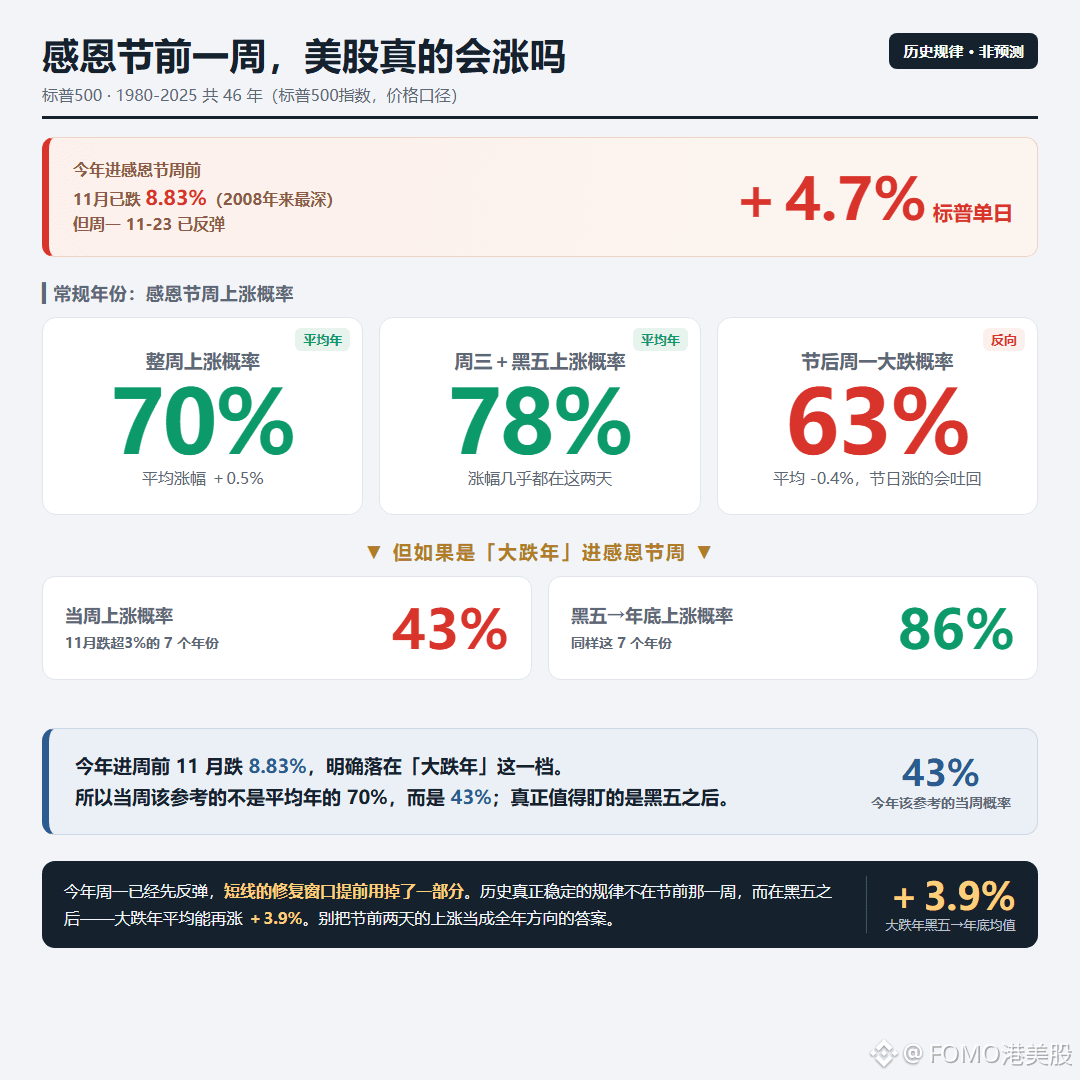
In ordinary years, it does rise. The market is up 69.6% of the time over the full week, with an average gain of 0.45%. Nearly all of that gain is concentrated on Wednesday and Black Friday, when the combined probability of a rise is 78%. But the first Monday after the holiday tends to go the other way: the market fell 29 times in 46 years, with an average loss of −0.36%—often giving back what it gained before the holiday.
The key is how the years are grouped. Historically, there have been only seven years in which the market had fallen more than 3% in November. In those years, the probability of a gain during Thanksgiving week drops to just 43%, with a median return of −0.03%—about as likely as flipping a coin. This year fits that pattern: the market was down 8.83% in November before the week began, its steepest drop since 2008. However, it had already rebounded 4.73% on Monday, as Nvidia $NVDAB 's comeback helped drive the Nasdaq up 6.51%, using up some of the short-term recovery potential early.
The most counterintuitive finding comes last: in years with steep declines, the market rose in six of the seven years from Black Friday through the end of December, averaging +3.93%—more than twice the +1.37% seen in ordinary years. The week before Thanksgiving says little about the full year; the period after Black Friday is the window worth watching.
#标普500 #纳斯达克