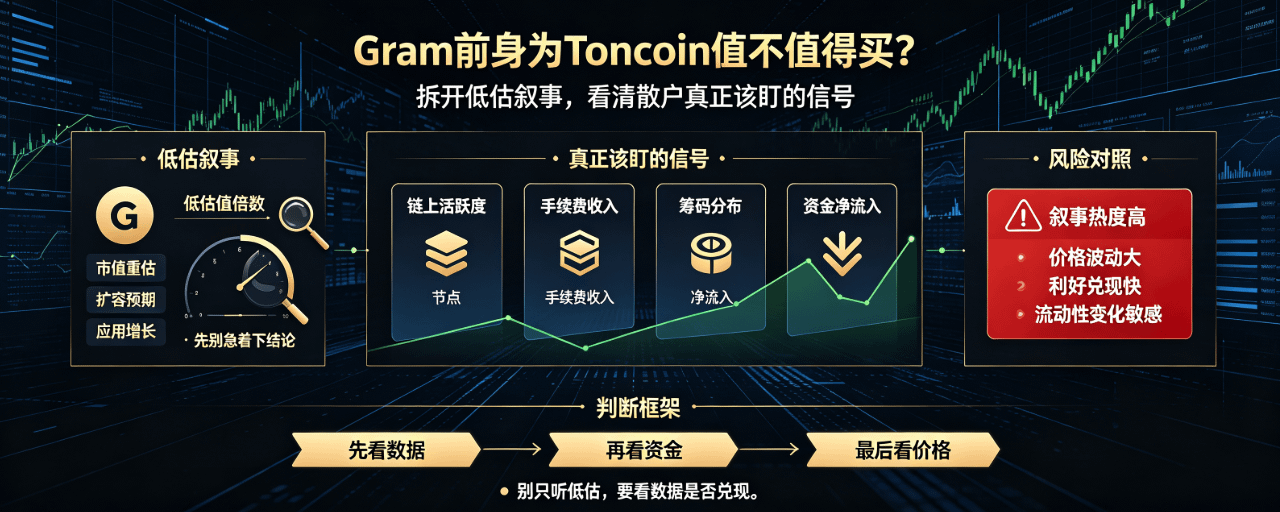

Is Gram (formerly Toncoin) worth buying? Unpacking the “undervalued” narrative and identifying the signals retail investors should really watch
Before deciding whether Gram is worth investing in, it’s important to clarify a fact that marketing language can easily obscure: Gram isn’t a new project—it was renamed from Toncoin on June 15, 2026. The community vote passed with 81.22% approval, while the blockchain, balances, smart contracts, and staked positions all remain unchanged. There was no token swap or migration. So the name “Gram” represents the narrative of Telegram founder Pavel Durov re-entering the scene, not a fundamental reset for a new asset.
On November 10, Durov publicly called Gram “seriously undervalued” and said it should rank among the top three cryptocurrencies by market capitalization. Yet at the same time, Gram was priced at around $1.06 to $1.15, down about 85% to 87% from its June 2024 all-time high of $8.25, and near the bottom of its 52-week range. There is a huge gap between the founder’s “undervalued” assessment and the price the market has assigned over nearly a year. Retail investors need to judge whether this gap will ultimately close because “fundamentals catch up with the narrative” or because “the narrative gives way to fundamentals.”
First key question: 700K wallets or 53K active addresses—which is the real figure?
Durov highlighted ecosystem growth: Telegram’s self-custodial Gram wallet launched in July 2026 and opened globally on October 9. By November 12, the number of wallets had exceeded 3.53 million, with nearly 650,000 added in just 48 hours. The mechanism is that receiving 0.1 GRAM automatically activates a wallet.
But AInvest’s analysis reveals the core contradiction: wallet activation does not equal real users. As of mid-November, there were only about 53,000 daily active addresses, roughly 1.5% of all wallets; only about 188,000 addresses actually held GRAM, with a combined balance of around 1.68 million tokens worth only about $2.05 million. The activation mechanism created impressive “address counts,” but the vast majority of activated wallets have never engaged in sustained on-chain activity. What retail investors should really look at is not “how many wallets there are,” but “how many addresses are consistently using, holding, and trading.” An active rate of 1.5% shows that a gap still remains between Telegram’s social traffic and genuine demand on the TON chain.
Second key question: TVL fell from $780 million to $45 million—where did the liquidity go?
The TON ecosystem’s current total value locked (TVL) is about $45.7 million, compared with a historical peak of $780 million—a decline of more than 94%. It is also highly concentrated in a handful of staking protocols such as Tonstakers and Stakee, with limited application diversity. On-chain observations from the Gate community are even more blunt: liquidity in Gram-related trading pairs has fallen from around $40 million six months ago to about $10 million, with “no crash, no announcement, just a slow distribution.” By the time retail investors realize what is happening, liquidity may already be so thin that “even whales can’t get out.”
What does low liquidity mean? A relatively small sell order can significantly depress the price, and the price drop can then trigger the liquidation of leveraged positions. Bybit’s research report defines $1.00–$1.10 as a “pullback pressure zone,” noting that the sensitivity of highly leveraged capital makes this range a focal point for short-term speculative sentiment. The $1.00 level is a technical and psychological dividing line; if it breaks, stop-losses should be strictly enforced. Coinpaper likewise notes that if support at $1.10 fails, Gram risks retesting $1.
Third key question: Inflation rises from 0.6% to 4%—who pays the bill?
After the block-speed upgrade in April 2026, Gram’s annualized inflation rate rose from about 0.6% to about 4%. With no order-of-magnitude jump in demand yet, the higher inflation rate means continued supply dilution. A 16% annualized staking yield sounds attractive, but part of that return is essentially a hedge against inflation and falling prices, rather than a purely incremental gain. TON Strategy’s (Nasdaq: TONX) Q3 financial report offers an institutional perspective: despite generating about $13.1 million in staking rewards, the company recorded an unrealized loss of $27.2 million due to a decline in Gram’s fair value, resulting in a net loss of $22.9 million. A 16% staking yield did not prevent the institution’s holdings from losing value on paper.
Fourth easily overlooked structural risk: Who controls the network?
Durov is both Telegram’s founder and TON’s largest validator. In April and May, Telegram took over the TON Foundation’s main responsibilities through the “Make TON Great Again” initiative. AInvest characterizes this as a conflict of interest: the power to promote the Gram narrative and lead network validation is concentrated in the same person, creating tension between the degree of decentralization in network governance and the token’s decentralization narrative. For retail investors, this means the authority to interpret and change the rules is not distributed, which could amplify decision-making risks in extreme circumstances.
The real decision-making framework for retail investors: Don’t bet on “undervalued”—bet on “conditions”
Whether Gram is worth buying does not depend on Durov saying it is “worth a top-three ranking,” but on whether the following three conditions can each be verified through on-chain data:
Condition one: Can the share of active addresses rise from 1.5% and establish an upward trend? The growth in wallet numbers has already demonstrated Telegram’s distribution capabilities, but only a sustained rise in the share of active addresses would show that social traffic is converting into real on-chain demand. This is the hardest indicator in any narrative to fake—and the one most worth tracking.
Condition two: Can TVL stop falling and show structural improvement? Recovering from $45 million to the hundreds-of-millions range will require more than staking rewards; it will take substantial growth across diverse use cases such as DeFi, payments, and mini apps. TVL supported by a single staking protocol is far less resilient than that of a diversified ecosystem.
Condition three: Can spot demand absorb supply in the $1.00–$1.10 range during deleveraging? This range is both a technical support level and a zone where leveraged positions are heavily concentrated and liquidations cluster. If the price stabilizes there on declining volume, with no signs of further liquidity depletion, it would indicate that selling pressure is easing at the margin. If it breaks below $1.00 on rising volume, the bearish structure will be confirmed, with the next reference level lower down.
Until verifiable marginal changes emerge in these three conditions, Gram’s “undervaluation” is just a founder’s narrative, not an investment thesis that has been established. The 16% staking yield and Telegram’s billion-plus user base are both real, but between “existing in reality” and “being priced in” lies a gap that must be bridged with active-user data and liquidity.
⚠️ The above is an objective summary of public-market data and institutional views and does not constitute investment advice. The crypto market carries extremely high risks; please make decisions prudently based on your own risk tolerance.
Discussion: Gram’s 1.5% active-address share versus the $1.00–$1.10 resistance zone—which signal do you think will point the way first? 👇
$GRAM $TON #GRAM #TON #代币经济学 #活跃地址 #风险管理