
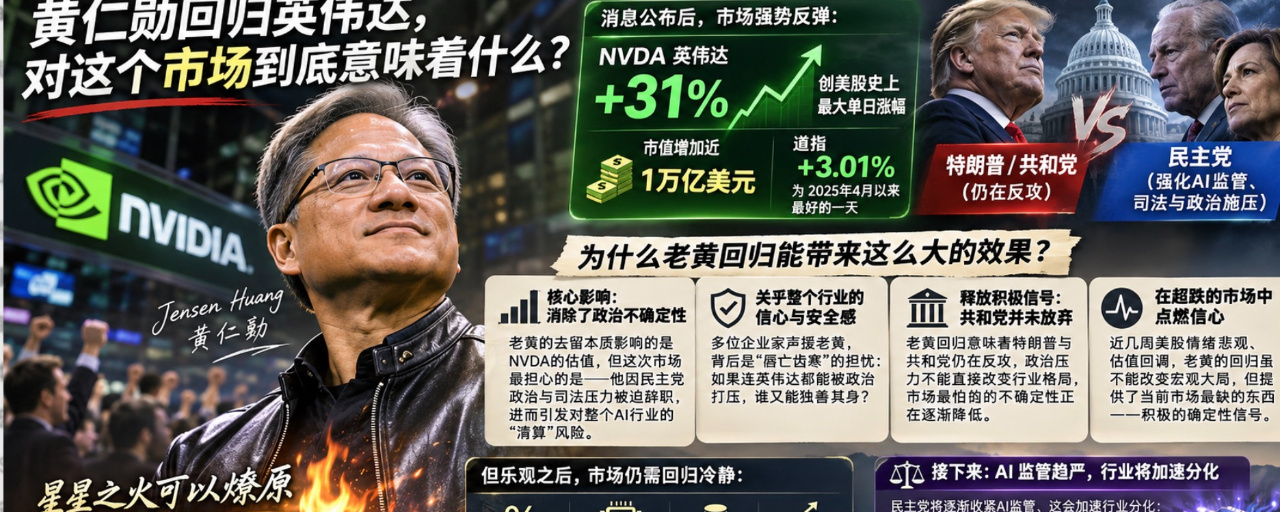

What does Jensen Huang’s return to Nvidia really mean for the market?
After news broke last night that Jensen Huang was returning to Nvidia, the stock rose about 31% in a single day—the biggest single-day gain in U.S. stock market history. Its market value increased by nearly $1 trillion, and the Dow rose 3.01%, its best day since April 2025.
Why can Lao Huang’s return have such a big impact? Is he really that important?
Strictly speaking, Lao Huang’s staying or leaving has the greatest impact on $NVDA ’s valuation. But at this stage, what the market is most worried about is Lao Huang being forced to resign under political pressure—the resulting political uncertainty.
Under normal circumstances, if Nvidia lost Jensen Huang, its valuation and investor confidence would decline somewhat, but it wouldn’t be cause for despair, because one day Huang would inevitably have to step down. But his resignation now, under political and legal pressure from the Democrats, has the market worried that the Democrats are going to purge the “AI” industry. No matter how powerful a businessperson is, they are still weak when facing the machinery of the state and the political system. #黄仁勋回归推动NVDA单日暴涨31%
So after Jensen Huang resigned, many business leaders realized that they were all in the same boat and voiced their support for him. But deep down, they were still worried: who doesn’t have a few skeletons in the closet? As for investors, every new administration brings a new set of officials. With the Democrats controlling Congress, how could they not settle accounts with Trump and the Republicans? What’s more, the Republicans and Trump have clearly shown political weakness lately, leading the market to reassess all its expectations for Trump’s remaining two years in office.
So Huang’s return to Nvidia means that Trump and the Republicans haven’t given up completely and are beginning to fight back. It also shows that political pressure cannot directly change the industry landscape. Although Huang may still face congressional hearings and judicial investigations—or adjustments—the AI industry will also face challenges from Democratic legislation and industry restrictions. But the market isn’t afraid of challenges; it fears uncertainty most of all.
Clearly, U.S. stocks have been deeply oversold amid pessimism in recent weeks. Huang’s return cannot change the macroeconomic situation or the political predicament, but it still represents a positive signal—and that is exactly what the market has been missing most.
A single spark can start a prairie fire. Over the past few weeks, U.S. stocks have been like dry kindling, gradually drained of moisture. Huang’s return was that tiny spark that rekindled market confidence, creating last night’s “spectacle” in U.S. stocks.
Of course, after the optimism, it’s important to regain perspective. Political uncertainty is becoming clearer, which has temporarily removed one potential pitfall. The market still needs to resolve uncertainty around macroeconomic interest rates and industry narratives, among other things.
If the U.S. stock market and investment markets were surrounded by “tigers and wolves” in recent weeks, the road ahead will still be full of challenges. Looking at today’s Asian markets and U.S. premarket trading, Huang’s return has resolved the underlying uncertainty. But questions remain about the industry narrative, revenue-generating ability, cash flow, and return on investment.
The Democrats are gradually tightening AI regulations, which will inevitably accelerate the divergence within the industry. Across the entire AI supply chain, those with the most complete business models for commercializing AI, who can recoup their investments fastest and achieve the highest returns most efficiently, will be the ones able to attract more capital in the “limited easing” environment ahead!
There’s a lot of heated debate about rate hike expectations right now, but in reality, we’re not yet in the middle or latter stages of a rate-hiking cycle. Market liquidity isn’t that tight; there’s still plenty of money around. What’s missing is a reason to get it flowing!