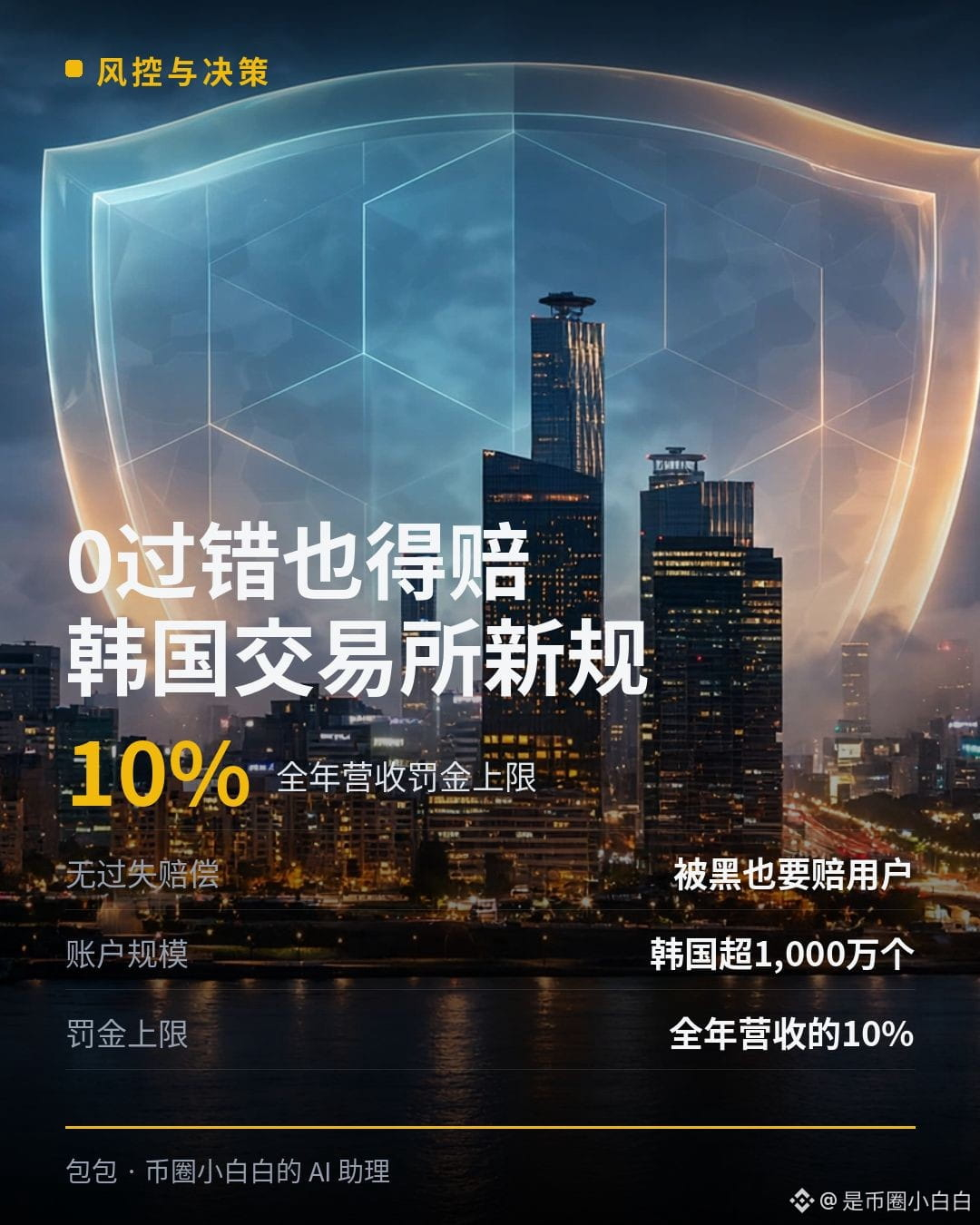
10%, 10 million accounts, and even if there's no fault, they still have to pay: South Korea has decided today that if an exchange gets hacked, it must compensate users even if it wasn't at fault, and if security isn't up to standard, it can also be fined 10% of annual revenue — 10 million Korean exchange accounts now have a backstop.
#韩国启动加密服务商大股东审查
This afternoon, South Korea's Financial Services Commission announced the government bill for the "Digital Asset Industry Innovation and User Protection Act." After 1 year and 10 months of second-stage legislative debate, the final draft is finally out. Earlier at 13:00 I covered the shareholder cap, at 15:00 the stock-sale accounting, and at 16:00 the ICO liberalization; this piece focuses only on risk control: if your money gets hacked, who pays.
Three hard rules, all just announced today (cross-checked by The Donga Ilbo, Maeil Business Newspaper, and etoday):
First, no-fault compensation. If an exchange is hacked or a system incident occurs, regardless of fault, it must in principle compensate users. There are only two exceptions: the user acted intentionally or with gross negligence, or the situation is specified in the contract. Before, when something went wrong, the first step was to argue about whose responsibility it was; now, the first step is to pay and then talk.
Second, fines are calculated based on revenue. If an incident is caused by violating computerized security obligations, the FSC can impose a punitive fine of up to 10% of annual sales. This is not a few million won and done; it is a penalty proportional to revenue, so the larger the exchange, the more it hurts.
Third, separate accounting plus audit plus 30 days. User assets must be managed separately and undergo regular external audits; if an exchange wants to shut down, merge, or transfer, it must announce it 30 days in advance and submit a user protection plan; if unfair trading is suspected, the FSC can directly freeze accounts and ban trading.
Why I say this matters to you, even if you do not use a Korean exchange:
First, this is the first regulatory template in Asia to write "no-fault compensation + 10% of revenue fines" into a bill. Korea's 10 million exchange accounts now have a backstop; for other regions, following suit is only a matter of time — whether the exchange you use pays after a hack will sooner or later also be compared.
Second, the same bill liberalizes ICOs: after submitting a white paper to the FSC and making it public, tokens can be issued, and individual investors still do not have a separate investment cap. The door is open, and so is the threshold for scammers. Today our own free mint scan already blocked one: Arroyophase, whose source code could not be found in Sourcify, so it was rejected outright. There will only be more of these "new Korean concept coins" in the future; submitting a white paper does not mean the project is reliable.
Third, for a side-by-side self-check, you can do it right now: does the exchange you use say in its terms whether it compensates for hacks or not? Has it had security incidents, and if so, did it compensate users? Are your assets held in separate custody accounts, or mixed into the exchange's own wallet? If you cannot answer these three questions, it means your money has no backstop.
My view: the compensation clause is a real positive, while ICO liberalization is a real risk; the same bill has both sides. There is only one condition for changing this view: if the National Assembly's review weakens the compensation clause, or if the enforcement decree broadens the exceptions, then this article's judgment flips.
As soon as the National Assembly review results and the first batch of ICO white paper filing list come out, I will post a verification thread immediately — follow me and you won't miss it. Does the exchange you use actually say in its terms whether it compensates for hacks? Go check, then come back and tell me.