Beginner Lesson 50: Why Is the Execution Price Different from What You Saw? Understand Slippage First
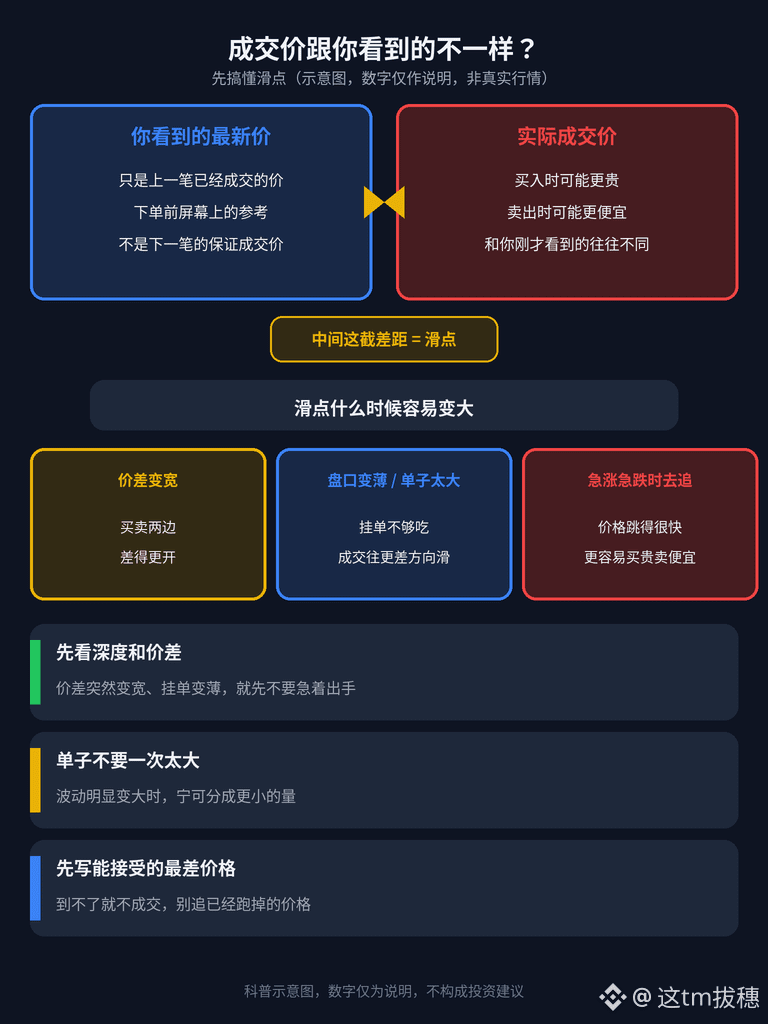
Many beginners watch the latest price before placing an order and assume their trade will execute at that price. But once the order is filled, they find they bought for more than expected or sold for less, and that price difference has already eaten into their plan. This gap is called slippage. It doesn’t necessarily mean the platform made a mistake. More often, the order book is moving, and the price you saw is no longer the price at which the next trade can execute.
1. When is slippage more likely to increase?
1) The latest price you see is just the price of the previous completed trade, not a guaranteed price for the next one;
2) When the bid-ask spread widens, the order book gets thinner, or your order is too large relative to the available liquidity, your trade may slide to a worse price;
3) During sharp rises or falls, just after news breaks, or when everyone is rushing in at once, slippage is often more noticeable than usual.
For example, in Binance spot market conditions at around 14:08 on November 22 (Taipei time), $BTC was up approximately 6.01% over 24 hours, while $ETH was up approximately 6.57%, with the broader market rebounding. At the same time, the popular coin $ZEC (Zcash) was up about 13.83% over 24 hours, with a trading volume of about 173 million USDT. Its high for the day was about 807.95, its low about 686.94, and its latest price about 785.16. It had climbed from its low to its high that day, with greater volatility than the broader market. During a rapid rally like this, if you chase the price near the top with a market order, your execution price can easily be worse than the price you just saw. Check the bid-ask spread and order book depth before deciding whether to trade.
Quick question before you continue: After a trade, have you checked how much the actual execution price differed from the price you saw at the time? If you have, comment 1; if you generally haven’t, comment 2.
2. How to reduce the impact of slippage in practice
Before placing an order, check the spread and the size of the orders on both sides of the book. If the spread suddenly widens or the order book gets thinner, don’t rush into a trade. Avoid placing one very large order; when volatility has already picked up, consider splitting it into smaller amounts. First write down the worst price you’re willing to accept. If the market can’t reach it, don’t trade—don’t chase a price that has already moved just to get filled immediately. Order books for assets like Bitcoin and Ethereum are usually deeper, while coins with greater volatility require an extra check of the order book depth. During sharp rises or falls, pause and wait for the order book to settle a little before placing an order.
3. Common beginner mistakes
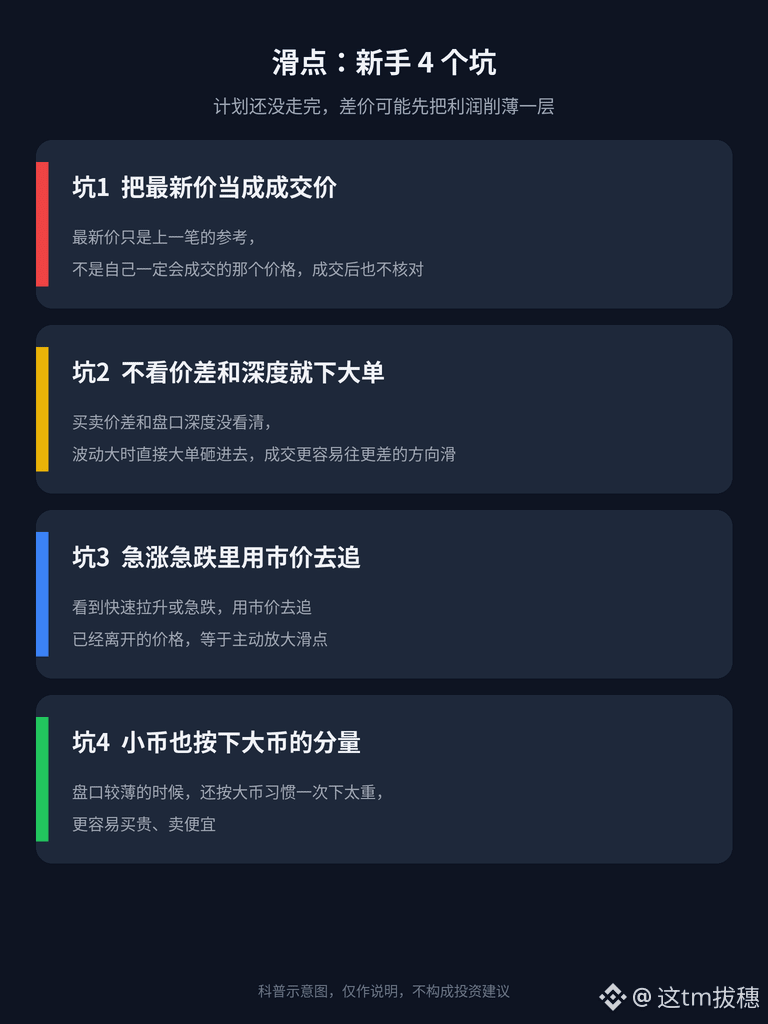
1) Treating the latest price as a guaranteed execution price and not checking after the trade;
2) Ignoring the bid-ask spread and order book depth, then placing a large order when volatility is high;
3) Chasing a price that has already moved by using a market order during a rapid rally or sharp drop;
4) Placing an order that’s too large in one go on smaller coins with thinner order books, as if trading a large-cap coin.
In short: The latest price is only a reference, not a guaranteed execution price. Slippage is more likely to increase when the spread widens, the order book gets thinner, your order is too large, or the market is rising or falling sharply. Check the depth first, then set the worst price you’re willing to accept. That moment when you chase the price is often when you lose the most.
A specific question: Before placing your next order, would you choose A—check the bid-ask spread and order book depth first, then decide whether to trade—or B—place an order based directly on the latest price? Just reply with a letter in the comments.
The content above is for educational purposes only and does not constitute investment advice. Crypto assets are highly volatile, and futures contracts carry even greater risks. Please participate only with money you can afford to lose.
#新手入门 #技术分析 #币安广场