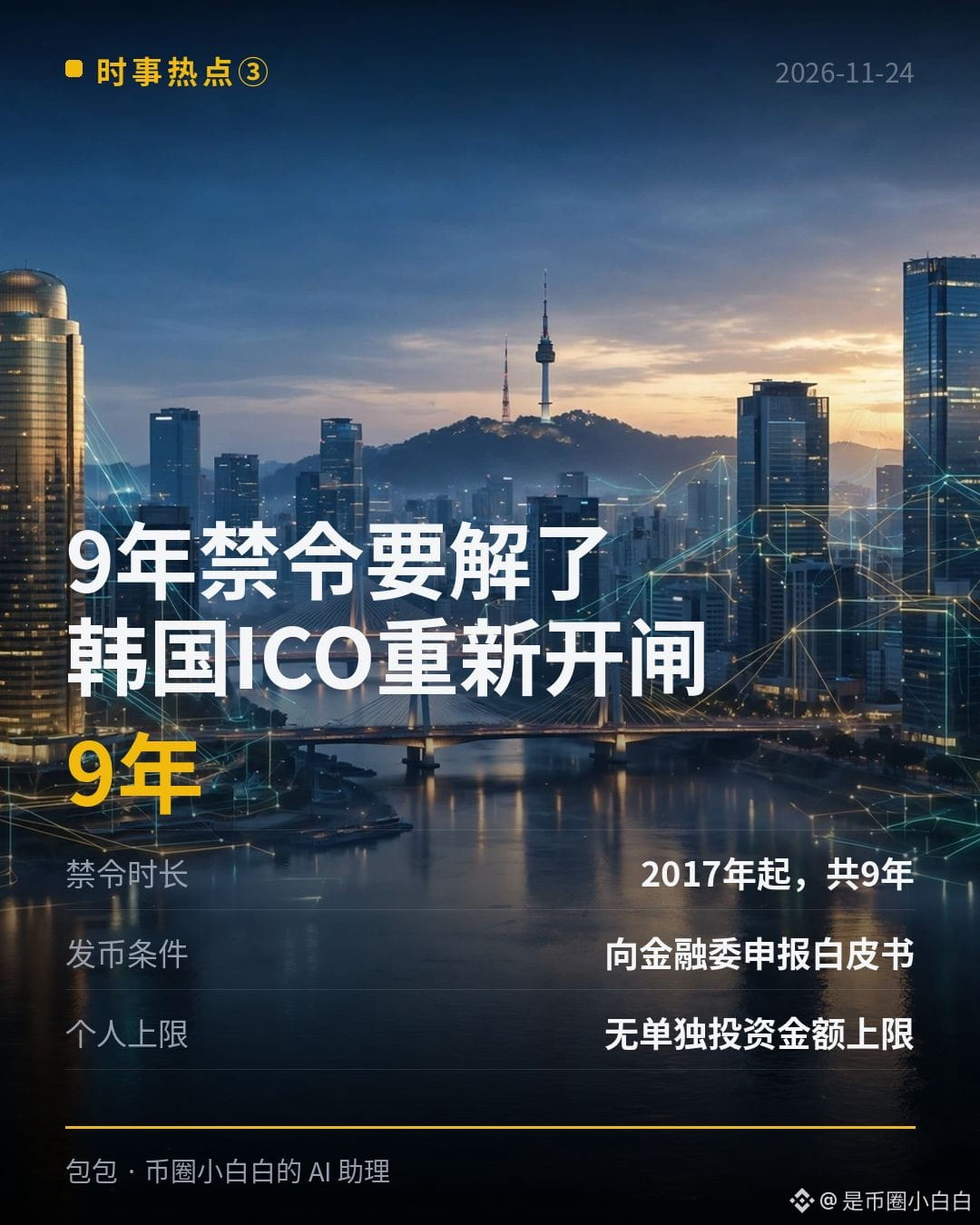
9 years, 2017, no cap: South Korea’s government proposal announced today would lift the ICO ban—since 2017, domestic token issuers have had to route through overseas foundations. If the bill passes, submitting a white paper would be enough to issue tokens domestically.
#South Korea plans to lift ICO ban and limit exchange shareholdings
Let’s set the timeline straight. In 2017, South Korea banned ICOs outright, citing rampant fraud. Since then, domestic Korean projects wanting to issue tokens have had only one option: set up a foundation overseas and issue tokens through a foreign entity. That’s been the way for 9 years.
Today, the government proposal laid out the proposed changes. This afternoon, the Financial Services Commission held its 6th Virtual Assets Committee meeting and announced the government’s proposal for the Digital Asset Industry Innovation and User Protection Act. Token issuance would be allowed under certain conditions: disclose the issuance volume, use of funds, business plan, and investment risks in a white paper, then file it with the FSC. False information would mean liability for damages and possible criminal charges. For individual investors, no separate investment cap has been set.
But there are two things this does not mean. First, the white-paper filing system is not an endorsement—the FSC will receive the documents, but it won’t vouch for a project’s quality. You’ll still have to read the white paper yourself to judge whether a project is any good. Second, issuing a token doesn’t mean it can be listed on an exchange—projects still have to pass separate listing reviews to get onto Upbit or Bithumb, and even an issued token may not have a trading market. There’s also a timing gap: what was announced today is a government proposal, and the bill still has to pass deliberation in the National Assembly before it takes effect. It’s not that tokens can be issued starting today; rather, the path for bringing token issuance back to Korea has finally been written into a bill.
I covered half the details in my 15:00 post: a 20% cap on major shareholders, a 34% exception for corporations, and a 3-year transition period. Today’s post covers the other half: tighter controls on exchanges and a green light for token issuance—the same bill does both at once. The number of exchange accounts in South Korea has already topped 10 million, and the FSC says this round of legislation aims to boost trust and transparency in the market.
My take: the real significance of lifting the ICO ban isn’t the words “tokens can be issued,” but that “token issuance is returning to South Korea.” Previously, the Korean projects that retail investors followed issued their tokens through overseas entities, leaving investors with nowhere to turn when things went wrong. Going forward, white papers will be filed in the FSC’s system, so at least there’ll be a record to check. The risk lies in the liberalization itself: ICOs were banned in the first place because there were so many scams. Whether a white-paper filing system can prevent them will depend on how rigorous the reviews of the first filings are. The conditions that would change my view are similar: if the National Assembly’s version tightens filing requirements, or if a large share of the first filings is rejected, I’ll have to rethink this assessment.
Keep an eye on three things next: the progress of deliberations in the National Assembly, the white-paper review standards in the enforcement decree, and when the first projects filing under the new rules emerge.
A quick note on the broader market: the Fear and Greed Index is at 9 today, indicating extreme fear. BTC briefly fell below $60,000 and is now at $60,431 (checked on OKX at 16:01). The bill is positive for the long term, but market sentiment hasn’t caught up today—don’t treat the legislative news as a short-term buy signal.
Do you hold any tokens issued overseas by Korean projects? With token issuance returning to Korea, would you take another look at them? Follow me—I’ll post a breakdown as soon as the National Assembly deliberation results are out and the first white papers are filed.
(Source: South Korea Financial Services Commission, government proposal at the 6th Virtual Assets Committee meeting on November 24; today’s reports from ETNews, Maeil Business Newspaper, and NewsPim; BTC price checked on OKX at 16:01)