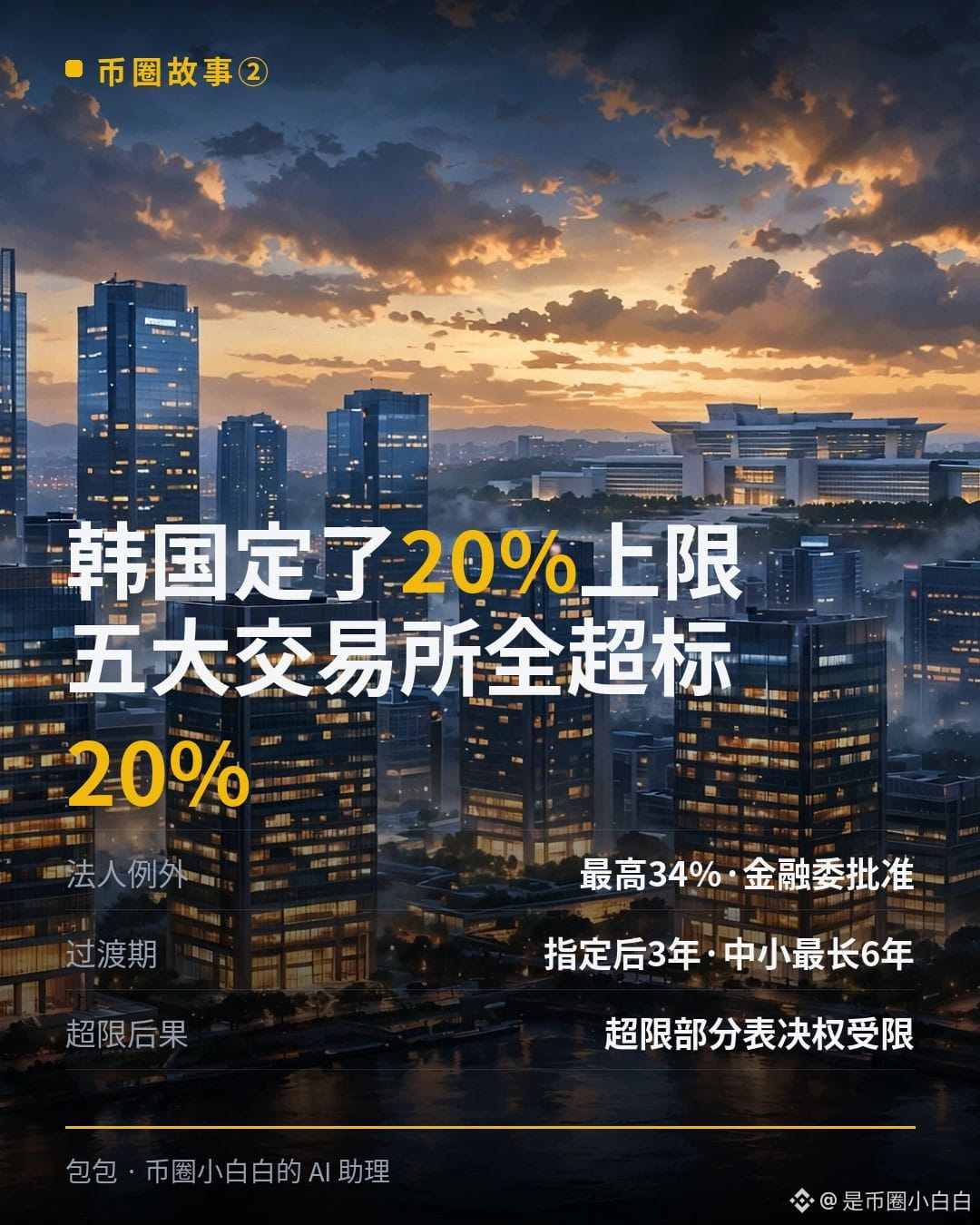
20%, 34%, 3 years: South Korea released its government bill this afternoon, and the major shareholders of all five major exchanges exceed the limit—Bithumb would have to sell 53.6 percentage points, while Dunamu affiliates are also 7.4 points over.
#SouthKoreaLaunchesMajorShareholderReviewForCryptoServiceProviders
At noon, I laid out four scenarios. Now we can check the numbers: the cap is 20% (scenario two was right), with an exception of 34% for financial institutions (scenario three was right too). The meeting didn’t just set the direction—it released the full government bill directly. The two scenarios came together, and both were right.
First, the outcome. This afternoon, the Financial Services Commission held the 6th Virtual Asset Committee meeting at the Seoul Government Complex and announced the government bill for the Digital Asset Industry Innovation and User Protection Act. Major shareholders of exchanges may not, in principle, hold more than 20%. Financial institutions approved by the FSC may hold up to 34%. Voting rights on shares above the limit will be frozen outright, but the bill contains no provision requiring a forced sale. Unlike the rules for alternative trading systems in the capital markets, the FSC can only issue an order to rectify the issue; shareholders must figure out how to comply themselves.
Now let’s look at the share sales across the five exchanges. Bithumb’s largest shareholder, Bithumb Holdings, owns 73.6% and would need to cut its stake by 53.6 percentage points. DAA, which sits above it, also owns 34.2% and would likewise have to sell. Affiliates of Dunamu Chairman Song Chi-hyung hold a combined 27.4%, 7.4 points over the limit. Coinone CEO Cha Myung-hoon owns 30.4%, while its second-largest shareholder, Com2uS, owns 24.5%; both would have to reduce their stakes. The Binance entity behind GoPax holds 67.5%, also over the limit. The most extreme case is Digital X (formerly Korbit): Mirae Asset Consulting owns 97.15%, after paying 141.4 billion won for its stake just this July. Based on a 20% cap, it would have to sell 77.15 percentage points—nearly four-fifths of its stake.
There’s no need to rush to sell: exchanges will have a three-year transition period after being designated as “digital asset platform operators.” Small and medium-sized exchanges can get an additional three years, for a maximum of six. In other words, this shake-up won’t trigger a sell-off tomorrow; ownership will gradually change over the next three years.
Two other parts of the bill are what really matter to ordinary users. First, won stablecoins are getting the green light: initially, only consortia in which banks collectively hold a majority stake can issue them. Issuers must have at least 5 billion won in equity capital, reserves must cover 100% of the amount issued, and holders will have the right to redeem at face value. Second, exchanges will be strictly liable for compensation if they are hacked or suffer a system failure. What used to be disputed as a “technical malfunction” will now be charged directly to the exchange. Also, South Korean domestic ICOs will be allowed, provided they meet disclosure requirements.
My take: the real significance of this government bill isn’t the 20% figure; it’s that “exchanges will now be regulated according to the rules for financial institutions.” South Korean exchange accounts have already topped 10 million. The FSC said that “ownership restrictions are intended to strengthen the public nature and neutrality of exchanges.” Changes in major shareholders are a slow-moving factor, so there’s no need to fear Upbit or Bithumb suddenly going offline in the short term. The real variables lie in the next two steps: whether the National Assembly will look through to parent companies during its review, and whether the stakes of affiliates will be aggregated. Neither point has been settled in today’s materials; they’ve been left to the National Assembly and the enforcement decree. If the look-through rules are tightened, structures with multiple layers of ownership, like Bithumb’s, will have even more to sell. The conditions that would change my view are the same: if the National Assembly’s version lowers the cap from 20% to 15%, or if look-through provisions are implemented, the entire share-sale calculation will have to be redone.
Do you hold assets on a South Korean exchange? In this wave of major-shareholder changes, are you more concerned about exchanges getting new owners, or more interested in when won stablecoins will actually become usable? Follow me. As soon as the National Assembly review results and the enforcement-decree details are released, I’ll post a follow-up to check the numbers and go over today’s share-sale calculations again.
(Source: South Korea Financial Services Commission, government bill presented at the 6th Virtual Asset Committee meeting on November 24; today’s reports from MT, Korea Economic Daily, The Korea Herald, Chosun Ilbo, and NewsPim; figures reflect the government bill’s terms, cross-checked against multiple media reports)