South Korea is getting serious: won stablecoins approved, ICOs unbanned, and exchange major shareholders capped at 20%.
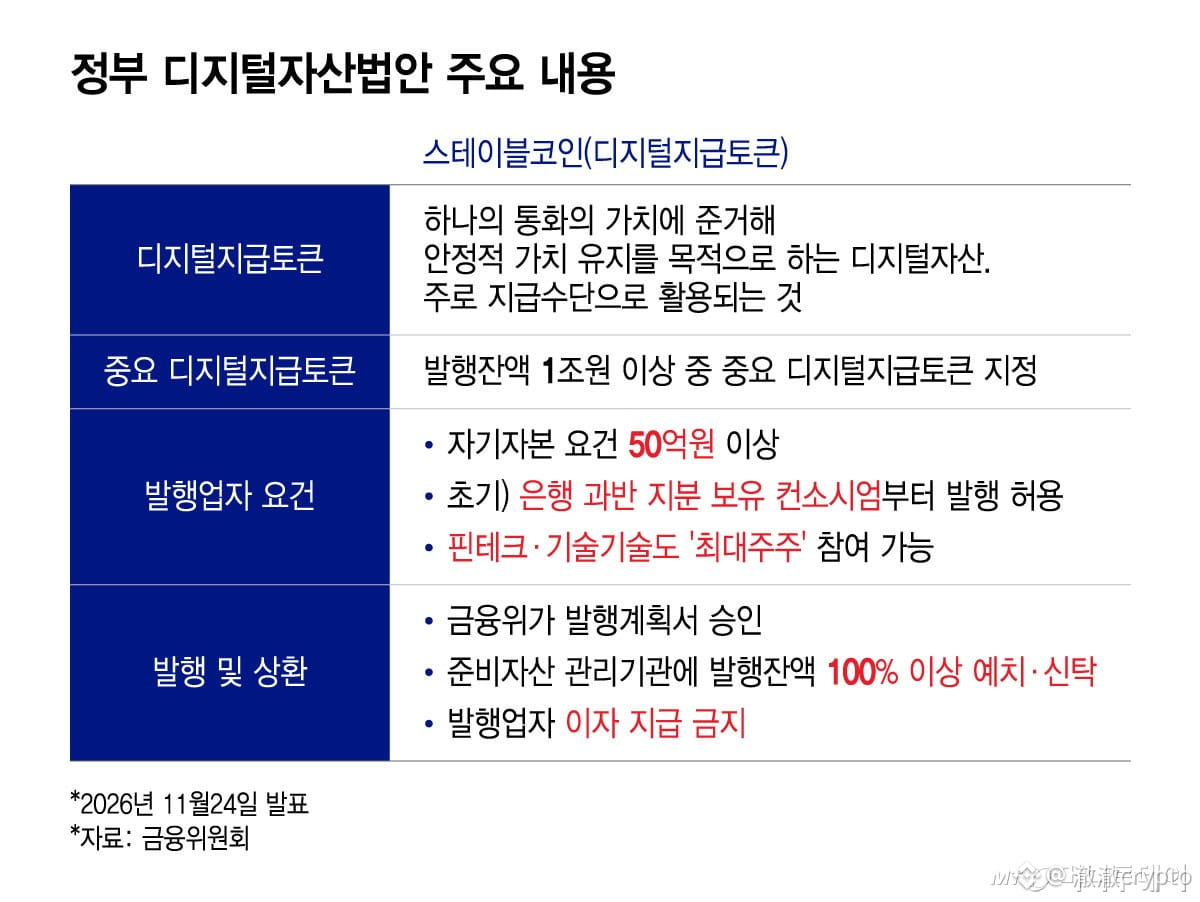
Today (November 24), South Korea’s Financial Services Commission released the government’s draft Digital Asset Industry Act: won stablecoins will initially be issued by consortia dominated by banks. Foreign issuers can also issue them after setting up a branch in Seoul and registering—for example, Circle’s USDC.
Major shareholders of exchanges will generally be capped at a 20% stake, but can hold up to 34% with FSC approval. Upbit and Bithumb will both have to go through the licensing process again.
Domestic ICOs are being unbanned after nine years: issuers must submit a white paper and notify the FSC; they must hold 100% of reserves in banks or government bonds. Platforms must compensate users on a no-fault basis if hackers steal their coins, and violations can incur fines of up to 10% of sales.
At the time of writing, BTC was at $60,516, down 1.56% over 24 hours (Finnhub real-time price).
This is the final direction for South Korea’s second-phase crypto regulation legislation. The approval of won stablecoins and lifting of the ICO ban are genuine liberalization, but the bill still has to pass the National Assembly, so the rollout depends on parliament.
I’m watching two things: the National Assembly’s review progress and the list of the first bank consortia. If the Assembly delays it until next year or tightens the 20% cap further, the upside will be discounted.
With won stablecoins approved and ICOs unbanned, who do you think will benefit first—Upbit or Bithumb—or will the banks claim the seats first?
$BTC $ETH $SOL
#韩国 #WonStablecoin