Why can’t we simply apply historical drawdowns to this Bitcoin cycle?
First, Bitcoin’s drawdowns have gradually narrowed with each bear market.
In the 2013 bear market, Bitcoin fell from $1,163 to $152, a drop of about 87%;
In the 2018 bear market, it fell from $19,600 to $3,150, a drop of about 84%;
In the 2022 bear market, it fell from $69,000 to $15,500, a drop of about 78%.
As we can see, as the Bitcoin market has grown, drawdowns in successive bear markets have narrowed. So we can’t simply apply the 70%–80% drawdown from the previous cycle to predict the bottom of this bear market.
Second, the structure of Bitcoin holdings has changed significantly in this cycle.
Spot Bitcoin ETFs and Bitcoin treasury companies (DATs) have become major holders, collectively holding more than 10% of Bitcoin’s supply.
In the later stages of previous bull markets, many retail investors bought near the top. Once the bear market began, prices kept falling and their losses grew, leading many to eventually sell at a loss and exit the market—creating sustained selling pressure.
But this cycle is different. A large share of the Bitcoin bought near the top is held by ETFs and treasury companies. These holders differ from retail investors of the past in their investment rationale, the nature of their capital, and their holding periods. Their holdings may not quickly turn into selling pressure when prices fall.
Notably, since the bear market began on October 6 last year, Bitcoin treasury companies have actually increased the amount of Bitcoin they hold.
This suggests that institutional and treasury-company holdings have not seen large-scale, concentrated selling as prices fell, unlike in past bear markets dominated by retail investor selling.
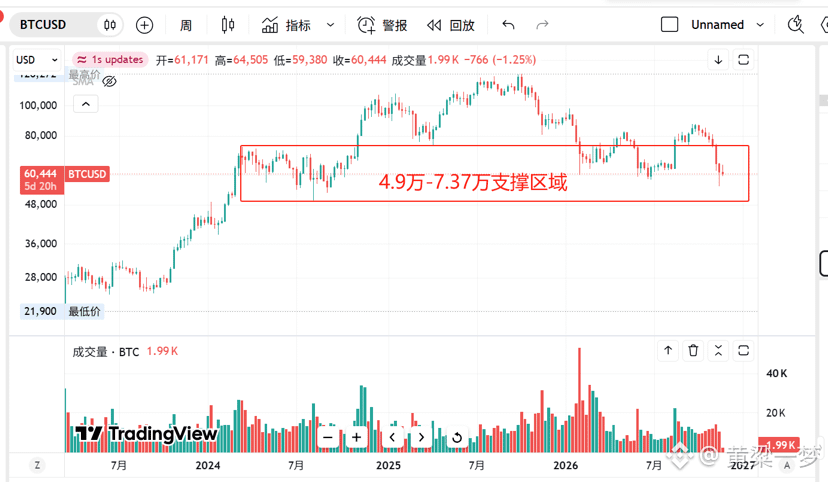
Third, Bitcoin has important support zones.
From March to October 2024, Bitcoin traded in a range of $49,000 to $73,700 for about seven months, building up a large volume of historical trading positions.
The holdings accumulated in this range have become an important support zone in this bear market. Now that Bitcoin has re-entered this range, potential buying demand is providing strong support for the price.
Therefore, I believe Bitcoin’s drawdown in this bear market will be significantly smaller than in previous cycles, and it is unlikely to fall below the key support level of $49,000. We can no longer simply apply historical drawdowns and assume that Bitcoin is bound to fall 70%–80%.
$BTC