
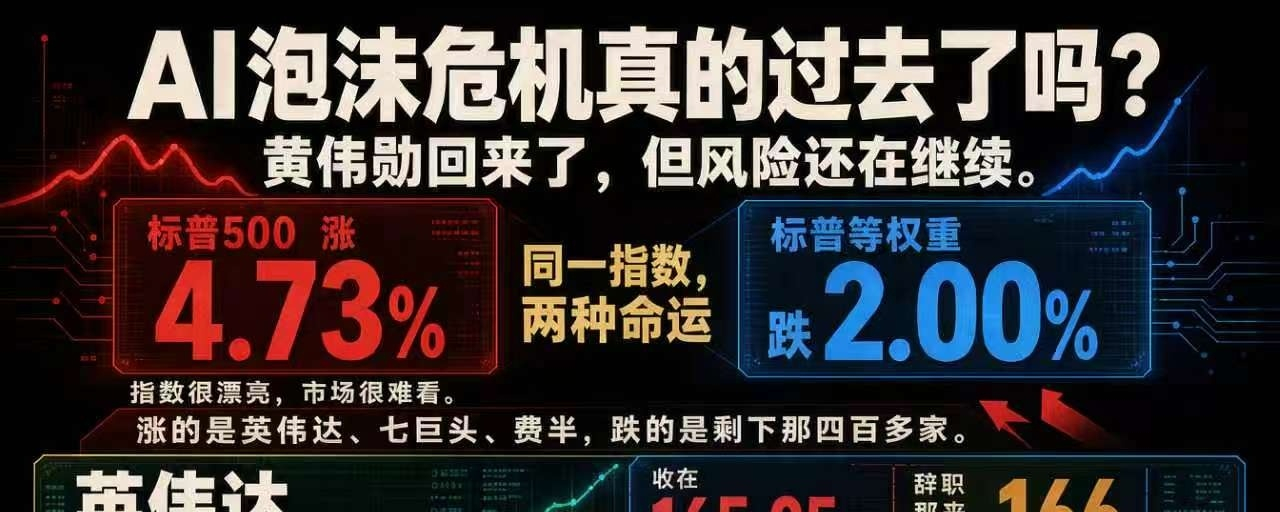


Jensen Huang returned to his loyal Nvidia.
So, is the AI bubble crisis really over?
Not really.
Look at yesterday’s indexes. The S&P 500 rose 4.73%; on the same day, the S&P 500 Equal Weight Index fell 2.04%.
Same index, two directions.
The gainers were Nvidia, up 31.48% (its biggest single-day gain since May 2003); the Magnificent Seven, up 8.2%; and the Philadelphia Semiconductor Index, up 14.03%.
The losers were the other 400-plus companies.
The index looks great. The market looks awful.
This isn’t a recovery. It’s seven companies propping up the index while everyone else falls behind.
Now look at where Nvidia closed: 165.05.
It closed at 166 the day he resigned.
In eleven days, $1.22 trillion in market value evaporated, then came right back, while the share price stayed put.
The only thing that changed hands was the stock—from panicked retail investors to those who dared to buy at 125.
When that wave of reports came out on October 28, it closed near 215; today it's at 165, still more than 20% off.
At 165, the price has only given back the shorts' profits from the past couple of weeks—and there's still some left.
This isn't turning the page. It's covering shorts.
If the risk had really passed, gold shouldn't be moving like this.
Gold +2.7%, silver +5.33%, the dollar index at 104.32, and the 10-year yield at 4.918%—higher than last Friday.
Oil is even stranger: tensions in the Middle East are heating up, yet it's down 3.88%.
The media says Libya's Sharara pipeline has been repaired, but the pipeline was designed to carry 350,000 barrels a day, and the repairs only add 100,000 barrels;
In today's tight market, that's a drop in the bucket.
Oil plunging as tensions heat up points to demand, not supply.
Gold up, silver up, the dollar strong, bonds down, oil down.
Put all five together, and there's only one explanation: money is still looking for somewhere to hide.
It doesn't look like risk appetite has returned.
The political side hasn't been settled either.
Schumer is still saying they should keep probing Nvidia's accounts and national security issues. The December 3 hearing hasn't happened yet.
That line in the board announcement—“after hearing from senior US government officials”—says it all. He didn't come back on his own.
He resigned eleven days ago, and just six days ago the chairman said on a call that he wouldn't return.
You call this governance? This is just someone up top giving the word.
There's another interesting detail.
Nvidia is the second-largest holding in Trump's personal stock portfolio, worth about $40 million, with a cost basis of $166 a share.
On the last trading day before the comeback, that investment was down 26%.
He came back, and that investment came back too.
So who wants Nvidia to fall the least? The answer is right there in the holdings.
And at this point, AI isn't about hardware anymore. It's about the profitability of large language model companies!
Just look at Anthropic's share price—it's being put to the test every day.
Rankings can be gamed, product launches can be hyped. Only a share price has to face a daily vote with real money.
Now that it's fallen back near its offering price, it shows no one has really put a bet on it. Saying it will win doesn't count for much.
The profitability of large language models still hasn't been proven.
This matters: capital doesn't need a script.
It only needs a real crisis: amplify fear at the bottom, shake out retail investors, then use a word from up top to scoop up the shares.
Go one level deeper, and it's about time.
Some say AI is different from real estate: the money comes first, then the work begins.
But AI funding is also borrowed layer by layer. It's not about how much money there is or how expensive it is; what matters is when it arrives.
During real estate's golden years, presale proceeds made up half of its financing. Once the three red lines were imposed and presales halted, short-term funding instantly turned into short-term debt financing long-term investments.
AI is the same: if regulation stretches out the timeline, or extra power and grid capacity are suddenly needed, any disruption throws the books out of alignment.
If land is delayed by six months, it's still the same land. If a house is delayed by six months, it's still the same house.
But what if a graphics card is put into production six months late?
In six months, the architecture, models, and inference engineering may have already moved on.
The chips are still there, but their value is gone.
That's why Jensen Huang came back.
Has the crisis passed or not?
Only the panic has passed.
The crisis is still on the books; people just don't want to look at it today.
The most important number to look at today isn't Nvidia's +31.48%.
It's the S&P 500 Equal Weight Index's -2.04%.