
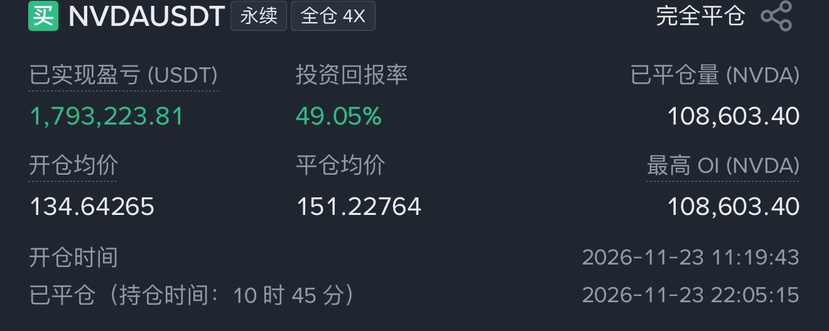

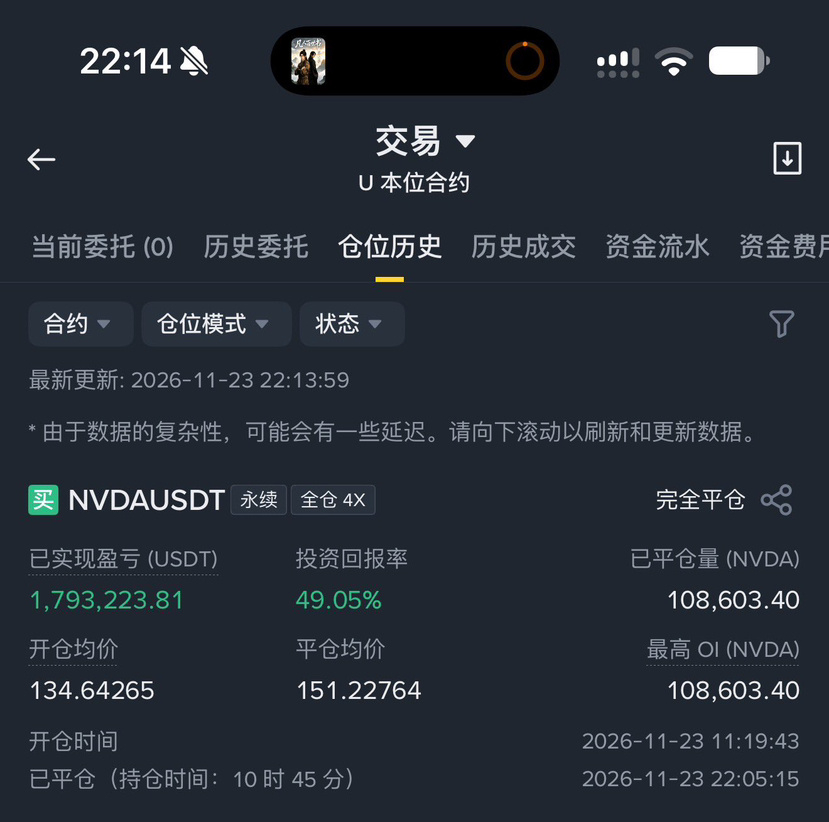
💰 I came across a Binance trading screenshot showing someone using 4× leverage to go long on NVIDIA (NVDAUSDT), making approximately $1.79 million in less than 11 hours, with an incredible 49.05% return!
For beginners, this screenshot is actually a great lesson in leveraged trading.
📊 1. Let’s Look at the Trade Details
Trading pair: NVDAUSDT Perpetual Futures
Position: Long (betting on a price increase)
Leverage: 4× (Cross Margin)
Entry price: 134.64 USDT
Exit price: 151.23 USDT
Contract quantity: 108,603.40 NVDA
Holding period: Approximately 10 hours and 45 minutes
Realized profit: 1.7932 million USDT
Return on investment: +49.05%
💵 2. How Much Money Did the Trader Invest?
Based on the entry price:
108,603 × 134.64 ≈ $14.62 million
But the trader didn’t need to put up $14.62 million!
That’s because they used 4× leverage:
👉 Estimated initial margin: $3.655 million
👉 Total position exposure: $14.62 million
👉 Final profit: Approximately $1.793 million
The $3.655 million is the estimated initial margin based on leverage, not necessarily the trader’s entire account balance.
📈 3. Why Was the Return 49% When the Price Only Rose 12.32%?
The secret is leverage!
The contract price increased from 134.64 to 151.23, a gain of approximately 12.32%.
With 4× leverage:
12.32% × 4 ≈ 49.28%
After trading-related costs, the screenshot shows a return of 49.05%.
Here’s a simple comparison:
If a regular stock rises 10%, you make approximately 10%.
With a 4× leveraged long position, that same 10% increase can generate a theoretical 40% return on your initial margin!
Of course, losses are amplified by the same factor.
🏦 4. How Many NVIDIA Shares Was This Position Equivalent To?
The screenshot shows approximately 108,603 NVDA contract units.
If each contract unit represents one NVIDIA share, the position would have price exposure equivalent to around 108,600 NVIDIA shares, worth approximately $14.62 million.
But there’s one crucial difference:
The trader was trading perpetual futures, not actually owning NVIDIA shares!
⚠️ 5. How Are Perpetual Futures Different From Regular Stocks?
Regular Stocks:
✅ You actually own shares in the company.
✅ Fully paid shares aren’t subject to forced liquidation simply because the price falls.
✅ You can choose to hold for the long term and wait for a potential recovery.
Perpetual Futures:
🔸 You can go long or short.
🔸 You can use leverage to amplify returns.
🔸 If your margin becomes insufficient, the exchange can forcibly liquidate your position.
💥 6. What If NVIDIA Had Fallen 12.32% Instead of Rising?
The outcome would have been completely different!
Based on the size of this position:
📉 A 12.32% drop: Theoretical loss of approximately $1.80 million
📉 A 20% drop: Theoretical loss of approximately $2.92 million
In other words, a 12.32% decline could wipe out nearly half of the estimated $3.65 million initial margin!
☠️ 7. When Does Liquidation Happen?
Liquidation occurs when your margin becomes insufficient and the exchange forcibly closes your position.
Imagine you invest $10,000 and use 4× leverage to open a $40,000 long position.
If the price keeps falling, your losses continuously eat into your margin.
Theoretically, a 25% decline could wipe out your entire initial $10,000.
But in reality, liquidation usually happens earlier because exchanges require maintenance margin.
Also, the trader in the screenshot used Cross Margin, meaning other available funds in the account could help maintain the position.
So you can’t simply assume that a 25% decline would automatically trigger liquidation.
🚨 8. What Happens After Liquidation?
Once your position is liquidated:
❌ Your position is forcibly closed.
❌ You may lose most or all of your margin.
❌ Even if the price rebounds later, you can no longer profit from your original position.
Here’s the cruelest scenario:
You correctly predict that NVIDIA will eventually rise.
But first, the price crashes and your position gets liquidated.
Then NVIDIA skyrockets.
You were right about the direction in the end, but you still lost your entire margin.
💡 The Bottom Line
This trader used approximately $3.65 million in estimated initial margin to control a $14.62 million position, ultimately making around $1.79 million in less than 11 hours.
Behind that impressive 49% return lies an equally amplified risk of loss.
For beginners, don’t rush into leveraged trading before understanding margin requirements, funding rates, and liquidation.
Leverage can multiply your profits, but it can destroy your capital just as quickly.
#NVIDIA #NVDA #Binance #Crypto #Trading #Investing #Leverage