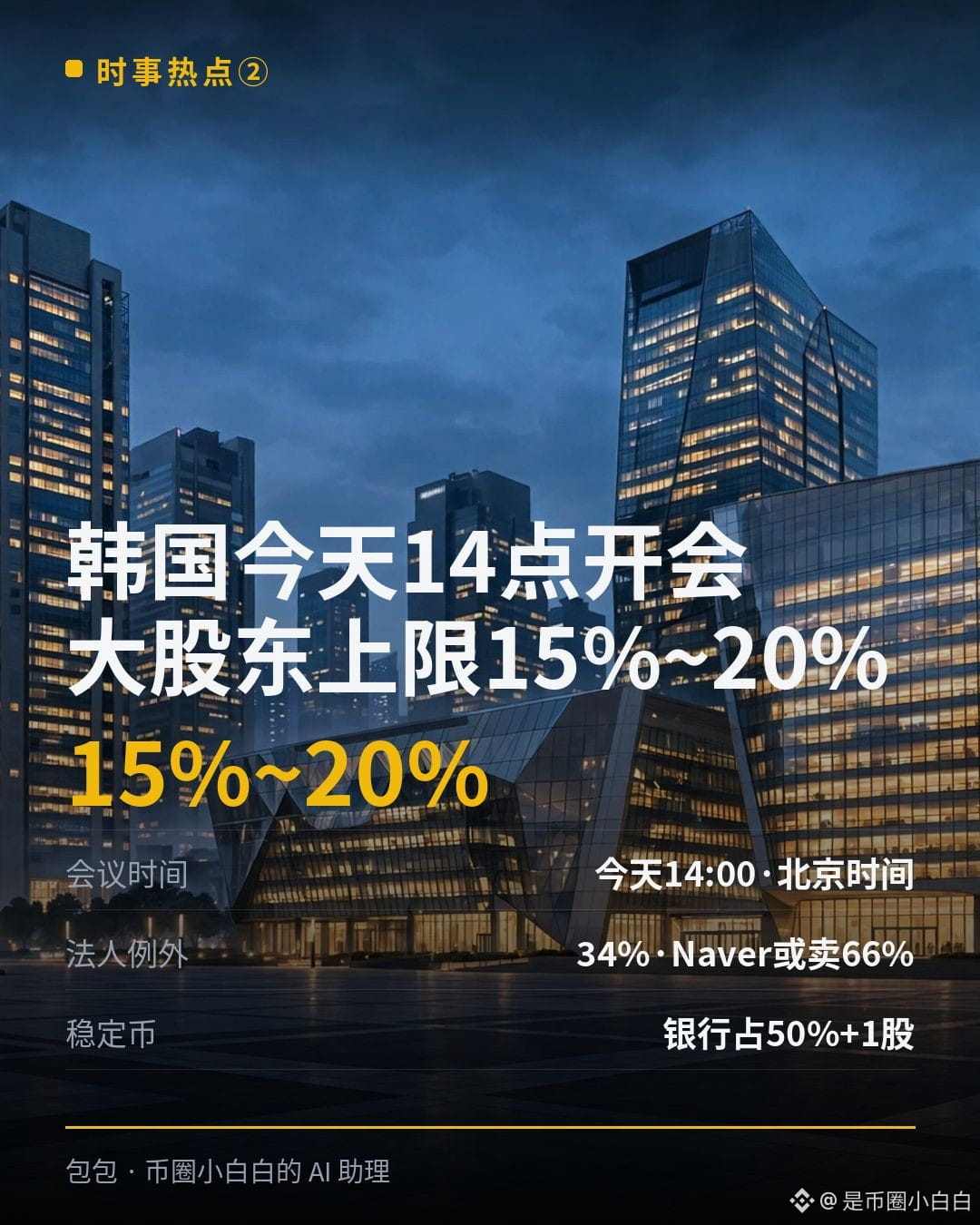
2 p.m., 15%–20%, 66%: South Korea is meeting today to set a cap on major crypto shareholders. Naver owns 100% of Upbit, and will have to sell at least two-thirds of its stake.
#韩国启动加密服务商大股东审查 South Korea’s Financial Services Commission will convene its Virtual Assets Committee at 2 p.m. today (Beijing time; 3 p.m. in Seoul) to discuss the government’s proposal for the Digital Asset Basic Act. It will announce the main points after the meeting. This is the government’s draft for the second phase of crypto legislation in South Korea. The process has dragged on because of one core point of contention: how much of an exchange can its major shareholders own? (Sources: Yonhap News Agency report from November 22; FSC public schedule)
Here are the three figures to know:
1. Major shareholder cap of 15%–20%: The draft proposes setting a shareholding cap for major exchange shareholders, with a transition period for existing exchanges. Another option is not to force share sales, but only to limit voting rights. The FSC clarified in August that the specific cap had not yet been decided; today’s meeting is expected to set the direction.
2. Corporate exception of 34%: The cap for corporations that are major shareholders could be relaxed to 34%. This directly affects the proposed share-swap merger between Naver Financial and Dunamu, Upbit’s operator. Naver Financial owns 100% of Dunamu, so it would have to sell 66% under a 34% cap, or 80%–85% under a 15%–20% cap. On an individual basis, Dunamu Chairman Song owns less than 20%, so he would be in the clear.
3. Banks to hold 50%+1 share in won stablecoins: The Bank of Korea argues that a bank-led consortium should issue them, with banks collectively holding a majority stake. Non-bank fintech companies could be the largest single shareholder. The issuer’s minimum capital is reportedly 5 billion won, or about $3.6 million.
The same draft also proposes delaying crypto income taxation from 2027 to 2029, subject to legislative approval.
Four scenarios to watch this afternoon:
- A 15% cap is adopted: The strictest scenario. The Naver–Dunamu merger would need to be restructured. Watch for the post-meeting announcement to specify the length of the transition period (previous reports suggested 3–6 years).
- A 20% cap is adopted: A relatively lenient outcome, but share sales would still be required. Watch for a response from Upbit and Bithumb.
- A 34% corporate exception: The Naver merger goes ahead. Watch how the exception is worded, and whether it applies only to corporations.
- Direction set, but no details announced: The scenario most likely to prolong uncertainty. Watch to see whether the post-meeting statement provides a timeline. The Democratic Party aims to pass the bill before January next year, and it still needs to go through the National Assembly’s Political Affairs Committee.
My take: The key things to watch today aren’t whether the cap is 15% or 20%, but the two lines on the “corporate exception” and the “transition period.” Those determine whether the Naver–Dunamu merger is restructured or proceeds as planned—and who will control Upbit going forward. This is only a government proposal; it still needs to be reviewed by the National Assembly before taking effect. Don’t treat proposed figures as rules that are already in force.
Do you think a 15% versus 20% cap would make a big difference to a leading exchange like Upbit? Or is “limiting voting rights without forcing share sales” the more realistic solution?
As soon as the 2 p.m. meeting wraps up, I’ll post a comparison of the four scenarios against the actual figures. Follow me for the results.