

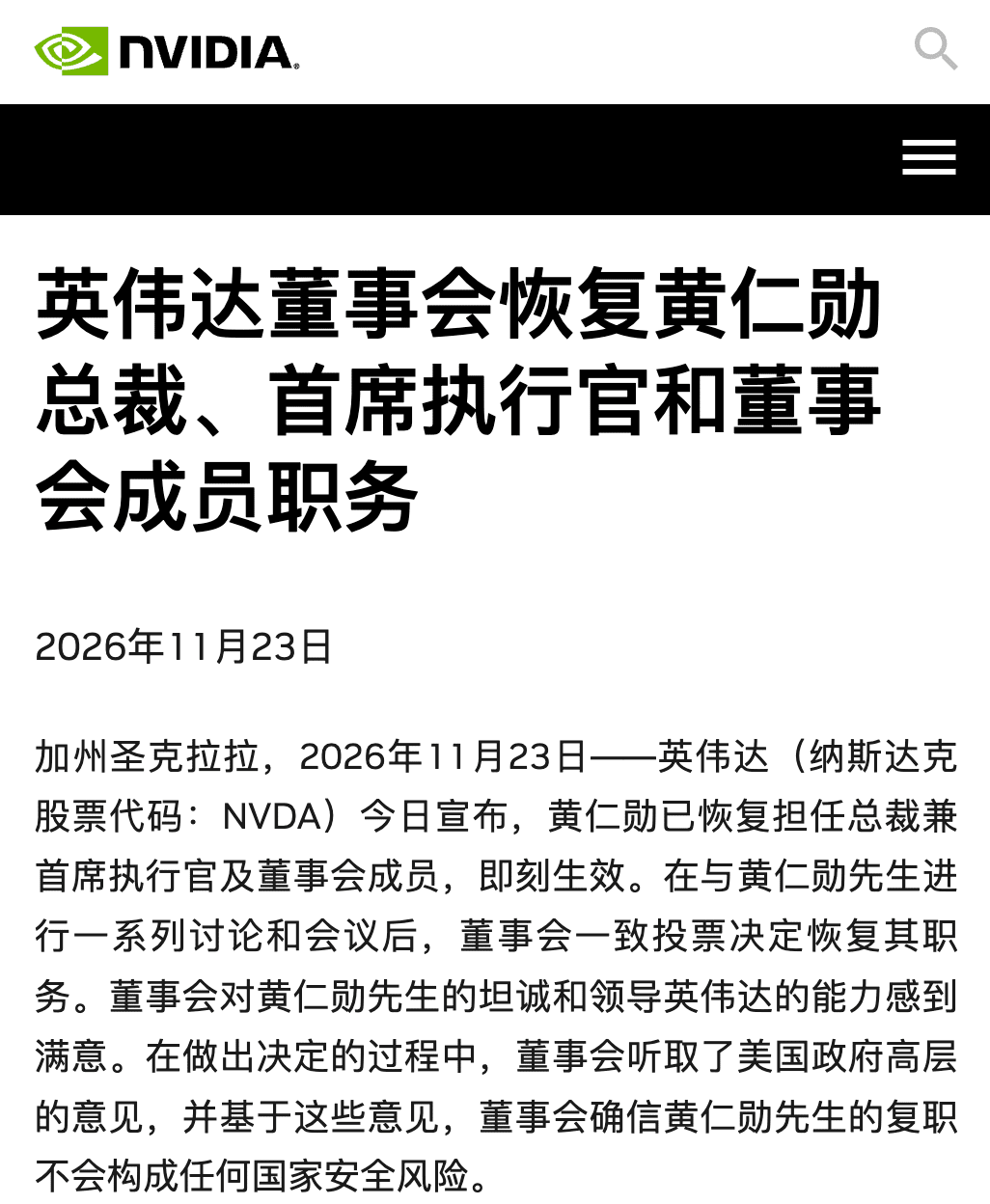
When a single resignation letter from an old man can send shivers through global capital markets, and then, just over ten days later, the return of that same old man sends the market surging—with Nvidia briefly jumping 35% intraday and adding nearly a trillion dollars in market value in one go, sparking a collective frenzy across the AI and semiconductor sectors—a dramatic saga of market swings unfolds like a short drama packed with twists. Once the excitement fades, it leaves the market with a sobering question: whose tragedy is this, really?
This was supposed to be a modern corporate giant, with a seasoned board, a robust governance structure, a steady technology roadmap, and a deep bench of management talent. A tech giant that supports the global AI computing ecosystem and affects countless companies across its supply chain should not, in theory, have its trillion-dollar fate so easily swayed by whether one person stays or goes. The company’s value should be rooted in its chip technology, supply chain, product development, and customer ecosystem—not tied to any one individual.
But reality is straightforward and harsh. When Jensen Huang stepped down, the market immediately began to panic: people feared the next generation of chips would face delivery disruptions, that the narrative of AI expansion would break down, and that the entire computing-power supply chain would lose its momentum. Investors rushed for the exits, and valuations plunged. When news of his return became official, panic instantly turned to euphoria. Money poured back in, and trillions in market value were regained in the blink of an eye. Wall Street overturned its previous valuation reports overnight, analysts hurried to raise their price targets, and the emotions of retail investors, institutions, and companies throughout the supply chain were all swayed by one man's comings and goings.
This is the tragedy of modern corporate governance. Vast boards of directors, internal controls, and management teams seem weak and powerless in the face of market conviction. The company has failed to build an autonomous system that can operate reliably without its founder. Everyone assumes that Nvidia's story only works as long as he is there. Once its central figure leaves, the vast business machine seems to lose its anchor. Institutional stability has lost out to an individual's aura.
This is also the tragedy of capital. The vast sums of money chasing the company are not pursuing genuine technological progress or sustained earnings quality, but the simple signal of whether “he is there or not.” Capital no longer patiently assesses the industry's long-term fundamentals; it has grown accustomed to betting on sentiment, narratives, and whether key figures stay or go. Gains and losses are no longer driven by gradual changes in fundamentals, but by the reversal of a personnel announcement. The evaporation and return of trillions in wealth are often just the result of a violent swing in sentiment.
It is also a tragedy for the AI industry. Today, global computing power is highly concentrated around the narrative of a single leading company and a single central figure. Confidence in the entire AI wave is closely tied to one company and one leader. The ecosystem looks prosperous, but beneath the surface lies a fragile dependence on a single point of failure. If that pillar wavers, the entire supply chain shakes with it.
Of course, we cannot deny Jensen Huang's role in shaping Nvidia. Years of planning, a precise bet on the AI sector, and the creation of a unique computing ecosystem have made him the architect of this business empire. It is only fair that the market places a premium on his abilities and strategic vision. But when that premium reaches the extreme and becomes “value exists as long as he is there; value collapses when he leaves,” it crosses the bounds of reason.
After all the commotion, the rise and fall of trillions in market value ultimately amount to a test of confidence. What does capital really need: a reliable industrial system, or an irreplaceable “key man”? When the fate of a giant company rests entirely on one person's staying in office, the euphoria conceals a shared concern about the capital markets, the industrial ecosystem, and corporate governance as a whole.
The heady rally will eventually come to an end. Once the tide goes out, truly resilient companies should be able to do this: with someone at the helm, they can ride the winds; without depending on any one person, they can still move steadily forward.#英伟达恢复黄仁勋CEO职务,市场吹响反攻号角 $BTC