

Inside the mobile payment revolution, the infrastructure making digital dollars usable, and the economic test that could define $CELO’s future.
Imagine receiving your salary in digital dollars.
The money arrives in seconds. The blockchain works perfectly. Your wallet displays the correct balance.
Then you walk into a shop, scan the merchant’s payment code, and discover your digital dollars cannot pay for anything.
The transaction succeeded. The payment experience failed.
That small distinction explains one of the most interesting opportunities in blockchain today.
For years, crypto networks competed over transaction speed, fees and technical performance. But ordinary people are rarely interested in which blockchain processes their money.
They care whether they can receive it, spend it, save it and move it without unnecessary obstacles.
This is where Celo's strategy becomes much more interesting than another Layer 2 growth story.
Celo is building payment infrastructure around the moments when cryptocurrency usually becomes inconvenient.
And in November 2026, several developments suggest that this strategy is moving beyond blockchain infrastructure toward something more ambitious: an interconnected financial network for people, merchants, developers and eventually autonomous software.
But there is a second question, one that deserves equal attention.
Can a network become essential to millions of people while creating sustainable economic value for its native token?
That is the real Celo story I want to examine.
1. The Invisible Payment Revolution
Celo originally launched as an independent Layer 1 in 2020. On March 26, 2025, it migrated to an Ethereum Layer 2 built using the OP Stack.
The technical transition matters, but not simply because it aligned Celo more closely with Ethereum.
It allowed Celo to concentrate on an increasingly specific mission: delivering low-cost, accessible financial services through applications people can use on their phones.
One of its most practical features is fee abstraction.
On many blockchains, moving a stablecoin requires maintaining a separate balance of the network's gas token.
That sounds minor until you consider a first-time user who has received digital dollars but cannot send them because they do not possess the correct cryptocurrency for transaction fees.
Celo addresses this friction by allowing approved stablecoins to pay network fees.
The user can concentrate on the money they are transferring rather than acquiring another asset.
This might not excite speculative traders.
For someone sending the equivalent of a few dollars, however, it can determine whether the payment happens at all.
The best financial infrastructure is not necessarily the infrastructure users understand. It is the infrastructure they can use without needing to understand it.
2. MiniPay: Distribution Is Becoming Celo's Competitive Advantage
Opera's MiniPay wallet is one of Celo's strongest examples of this philosophy in action.
According to Opera and Celo's November 19, 2026 announcement, MiniPay has surpassed:
20 million wallet activations, 600 million processed transactions, more than 70 countries and 77 Mini Apps.
Opera's Q3 2026 report also disclosed more than $2.3 billion in cumulative processed volume.
Those are important milestones, but they require careful interpretation.
A wallet activation is not necessarily a unique individual. A processed transaction is not automatically a merchant purchase. And cumulative volume does not establish the amount of revenue the network earns.
The more interesting development is what users can actually accomplish after opening the wallet.
MiniPay is evolving from a place to receive stablecoins into an environment where those balances can connect with payment cards, local merchants, digital services, savings applications and cross-border financial activity.
That changes the nature of its distribution advantage.
Instead of asking every developer to attract an entirely new audience, MiniPay can expose applications to an existing wallet ecosystem.
Consider another detail from Opera's Q3 update.
The language-learning Mini App Saluto reportedly attracted more than 50,000 users during its first week.
Language learning is not the typical example people associate with cryptocurrency.
That is precisely why it matters.
A blockchain ecosystem becomes more useful when applications no longer need to revolve around the blockchain itself.
The unresolved question is retention.
Do people repeatedly return to these applications because they deliver lasting utility, or because promotions and incentives encourage temporary activity?
That difference will determine the quality of future growth.
3. The Stripe Connection: Solving the Problem Before the First Transaction
Two November announcements deserve particular attention.
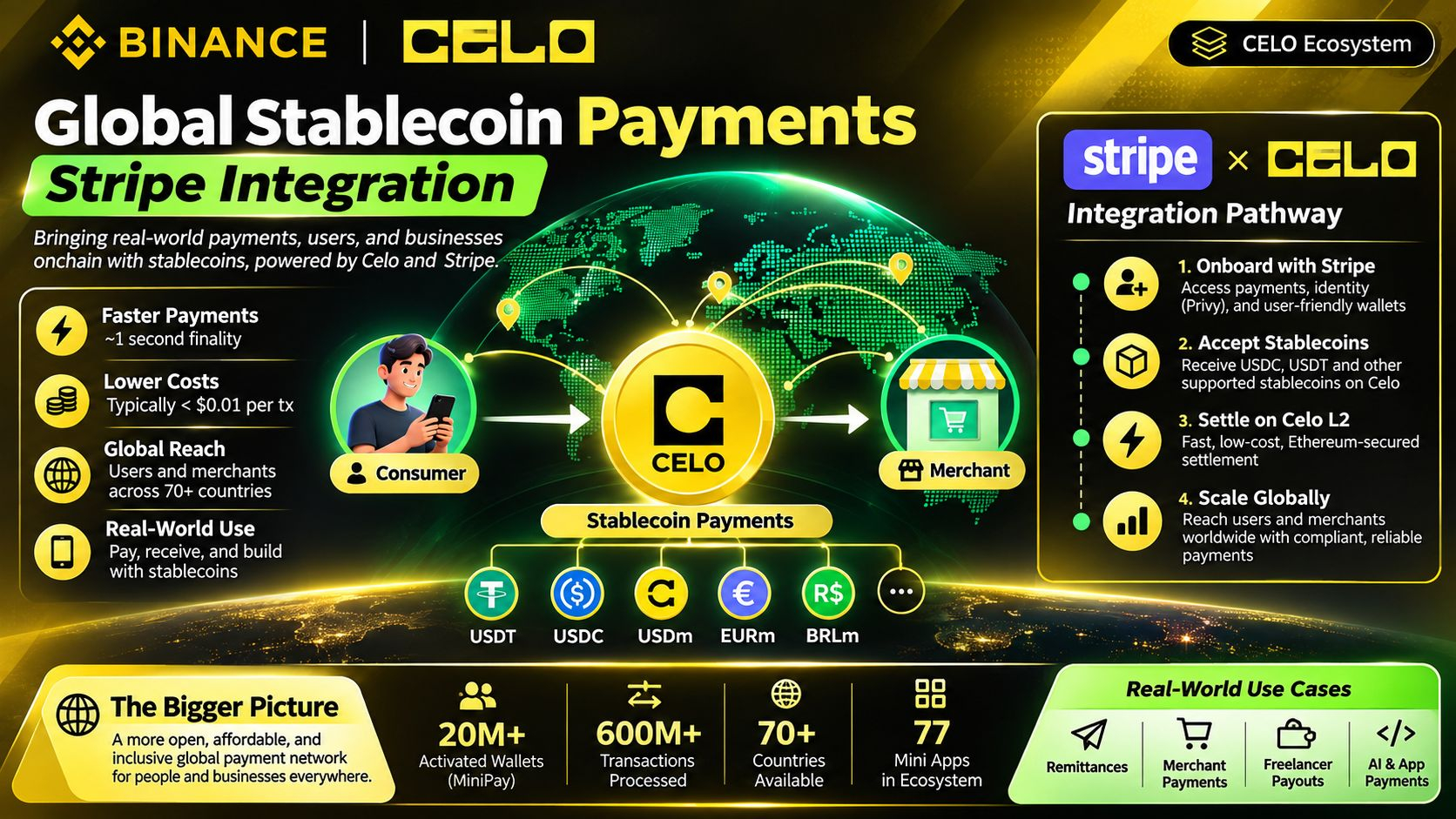
On November 12, MiniPay announced support for stablecoin deposits through Link by Stripe for eligible users in the European Union and United States.
Users can access supported payment methods, including cards, Apple Pay and Google Pay, subject to regional availability.
Seven days later, on November 19, MiniPay announced an upgrade to wallet infrastructure powered by Privy, which Stripe acquired in 2025.
The upgrade introduces simpler authentication possibilities, including email, social accounts and passkeys, while preserving MiniPay's self-custodial design.
Why does this matter?
Because getting money into a wallet can be just as difficult as transferring it once it is there.
A payment application cannot reach mainstream adoption if users abandon the experience during registration, verification or funding.
The Stripe-related integrations target these friction points directly.
They also illustrate a broader competitive shift.
The battle for stablecoin payments may be decided by onboarding, identity, liquidity and checkout convenience—not simply blockchain throughput.
However, integrating with Stripe-owned services should not be interpreted as an investment endorsement of CELO or proof that every MiniPay feature is available in every market.
The significance lies in the payment infrastructure and the opportunities it creates.
4. A QR Code Reveals the Next Opportunity
One of the most revealing examples in Opera's Q3 report is Sonny Pay.
Through this Mini App, supported MiniPay users can scan compatible local merchant QR codes in markets including the Philippines, Vietnam, Brazil, Argentina and Peru.
The user pays from a dollar stablecoin balance.
The merchant receives local currency through an existing payment network.
Consider what has happened.
The customer does not need the merchant to accept cryptocurrency directly.
The merchant does not need to redesign the checkout experience around a blockchain.
And the transaction connects a digital-dollar balance with a familiar local payment method.
This is a more useful measure of payment adoption than transaction speed alone.
The payment must work at both ends.
Of course, local currency settlement still depends on functioning partners, exchange liquidity, compliance arrangements and operational reliability.
But the underlying direction is compelling.
Celo's opportunity is not merely to persuade merchants to accept another digital asset.
It is to help stablecoin balances become compatible with payment systems merchants already understand.
For global workers, travelers and cross-border businesses, that distinction could be transformative.
5. November 18: The Governance Development That Deserves More Attention
While much of the public conversation focuses on wallet growth, a November 18 governance update revealed another important development.
Mento's stablecoin infrastructure has undergone a significant governance transition.
Following the approval of MGP-19, authority over the issuance of Mento's 15 stable assets and related infrastructure moved under Celo Governance.
The update also confirmed that approximately 33.94 million CELO, representing 90% of the remaining CELO held in the Mento Reserve, had been transferred to the Celo Community Fund.
The remaining 10% stays in the Reserve as a last-resort asset, staked as stCELO and removed from active rebalancing.
This matters for several reasons.
First, it consolidates accountability for an important part of Celo's local-currency stablecoin infrastructure.
Second, it strengthens the community's governance role over these assets.
Third, it creates an opportunity to evaluate reserve management and token treasury decisions more transparently.
But investors should understand what the transfer does not mean.
It is not equivalent to 33.94 million CELO being purchased on the open market.
It is not an automatic token burn.
And it should not be presented as immediate evidence of new demand for CELO.
It is a governance and reserve-allocation event.
That distinction is important because credible token analysis must separate treasury movements from genuine external buying.
For Celo, transparent governance could become a competitive asset, especially as local-currency stablecoins scale.
6. Why Local Currency Matters More Than Another Dollar Token
Most blockchain payment conversations focus overwhelmingly on the US dollar.
But global commerce operates across many currencies.
A Brazilian merchant may need reais. A Nigerian business may require naira. A customer in Mexico may prefer a payment denominated in pesos.
Celo's expanding stablecoin ecosystem reflects that reality.
The November Mento governance update described more than 33 stablecoins across the network.
Rather than depending on one issuer or one currency, Celo is working to support multiple stablecoin providers and improve the infrastructure connecting them.
That includes payment liquidity, foreign-exchange routing and local settlement.
The potential advantage is significant.
A global financial network should not require every participant to abandon their preferred currency.
Still, supporting multiple stablecoins is not the same as guaranteeing frictionless currency conversion.
Every asset has its own reserve structure, redemption terms, liquidity conditions and regulatory exposure.
The real benchmark should be whether users can move value reliably between currencies at competitive total costs.
Currency choice creates accessibility. Deep liquidity and trustworthy settlement create usability.
Both are necessary.
7. The Next Customer May Be Software
Celo is also exploring a payment category that looks very different from traditional consumer finance.
Autonomous AI agents.
An AI agent might need to purchase access to a database, pay for computing resources or use a commercial API.
Ordinary internet payment infrastructure often depends on accounts, subscriptions and human-managed billing systems.
Celo's x402 infrastructure offers another approach.
Using payment requests connected to HTTP, software can authorize and settle supported stablecoin payments as part of accessing digital services.
On October 27, Celo announced that its native x402 facilitator supported 10 stablecoins across eight currencies.
Earlier in October, Celo Core Co. launched buy, a marketplace where agents can discover more than 700 services.
These developments connect two apparently separate markets.
Human users need accessible payment infrastructure.
Software agents need programmable payment infrastructure.
Both may benefit from fast settlement, supported currencies and reduced transaction friction.
The shared opportunity is a payment network that can accommodate people and machines.
But commercial adoption must not be confused with technical availability.
Seven hundred listed services do not automatically mean seven hundred commercially successful services.
The questions worth asking are straightforward.
How frequently are agents making real payments? How much economic value is being exchanged? Are the transactions recurring, or primarily demonstrations?
Those answers will reveal whether agentic payments become a meaningful revenue stream.
8. The Numbers Tell Two Different Stories
This is the part of Celo's investment narrative that deserves the most discipline.
Independent blockchain data from growthepie provides a useful perspective.
Its November 22, 2026 snapshot reported approximately:
835,000 daily transactions.
448,900 daily active addresses.
$166.65 million in stablecoin supply.
$2,600 in daily user transaction fees.
The figures represent a dated snapshot, not permanent performance levels. Active addresses are also not equivalent to unique human users.
Nevertheless, the contrast is instructive.
The network supports substantial transaction activity while collecting relatively modest fees.
That is not automatically a weakness.
Low-cost payments are central to Celo's value proposition.
If the network exists to move small amounts affordably, maximizing the cost of each transaction would undermine its purpose.
Yet this creates an economic challenge.
Celo needs to generate enough sustainable value from high-volume, low-fee activity to support infrastructure, development and its token economy.
A thriving payment network and a thriving native token are related goals.
They are not identical.
9. How Does Real Payment Activity Benefit CELO?
Celo's CELOccelerate framework attempts to strengthen the relationship between network usage and token economics.
Its central idea is to direct net sequencer revenue toward the community after relevant operating costs.
Supported stablecoin-denominated fee revenue can be converted into CELO, with acquired tokens transferred to the Community Fund under the governing framework.
That creates a connection between actual network activity and token demand.
However, the mechanism must be understood correctly.
Gross transaction volume is not protocol revenue.
Gross fees are not net profit.
And CELO accumulated in a community fund is not automatically removed from circulation through burning.
Governance determines how those resources are ultimately allocated.
That flexibility can support ecosystem investment, but it also introduces questions about long-term supply management and value capture.
There is another consideration.
Opera's Q3 report disclosed approximately 386,000 CELO distributed to users through its rewards programme.
Incentives can help build distribution. They can also encourage activity that does not persist once rewards decline.
The strongest evidence of sustainable adoption would therefore be recurring organic usage alongside improving net economic performance.
This is the distinction I would focus on when evaluating CELO.
Not how often the token appears in a headline.
How effectively the network converts useful activity into durable economic value.
10. The Five Tests That Could Define Celo's Next Chapter
After reviewing Celo's ecosystem developments, I believe its progress can be measured through five practical tests.
First: Payment completion. Can people fund their wallets, send money, spend locally and withdraw value without unnecessary friction?
Second: Organic retention. Do users continue making payments after promotional rewards and onboarding campaigns end?
Third: Local currency liquidity. Can users access reliable conversions and settlement across different regions without excessive fees or slippage?
Fourth: Sustainable token economics. Does increasing economic activity generate measurable net revenue, transparent CELO acquisitions and productive community-fund allocations?
Fifth: Genuine agentic demand. Do autonomous payments grow beyond experimental transactions into recurring commercial activity?
These tests are connected.
A wallet that is easy to open but difficult to spend from has limited utility.
A network that processes enormous volume but captures little economic value faces a different challenge.
And a blockchain that succeeds only while incentives are generous has not yet established durable product-market fit.
11. What Could Go Wrong?
Celo's opportunities should not obscure its risks.
Stablecoin issuers carry reserve, redemption and regulatory risks.
Local payment integrations depend on third-party providers, geographic availability and reliable liquidity.
A low-fee business model needs enough sustained transaction activity to cover its costs.
Token incentives may produce attractive engagement numbers without equivalent lasting demand.
And programmable agent payments introduce questions around authorization, security and responsible spending.
These are not reasons to dismiss Celo.
They are the conditions against which its progress should be judged.
In fact, recognizing these limitations makes the adoption story more meaningful.
The ecosystem does not need perfect metrics to demonstrate progress.
It needs evidence that its infrastructure is solving increasingly important financial problems.
Final Perspective: The Winning Transaction Is the One Nobody Notices
I find Celo compelling for a reason that has little to do with speculative price targets.
Its ecosystem is attempting to make digital money useful in the places where conventional cryptocurrency experiences often fail.
MiniPay tackles access and distribution.
Stripe-related infrastructure reduces onboarding and funding friction.
Local-currency applications connect stablecoin balances with familiar payment methods.
Mento's governance transition reshapes how part of the currency infrastructure is controlled.
x402 expands the payment conversation beyond human users.
And CELOccelerate attempts to connect economic activity with the network's native token.
None of these developments alone proves that Celo will dominate global payments.
Together, however, they point toward a coherent strategy.
The most consequential payment networks may not be those that ask users to adopt an entirely new financial lifestyle.
They may be those that fit naturally into the financial activities people already perform.
Celo's most important transaction may not be its billionth transfer. It may be the ordinary purchase that succeeds because the user never had to think about the blockchain at all.
That is the opportunity.
The next challenge is proving that convenience, recurring demand and sustainable economics can grow together.
Because reaching millions of wallets is an achievement.
Becoming indispensable to the people behind those wallets would be something much bigger.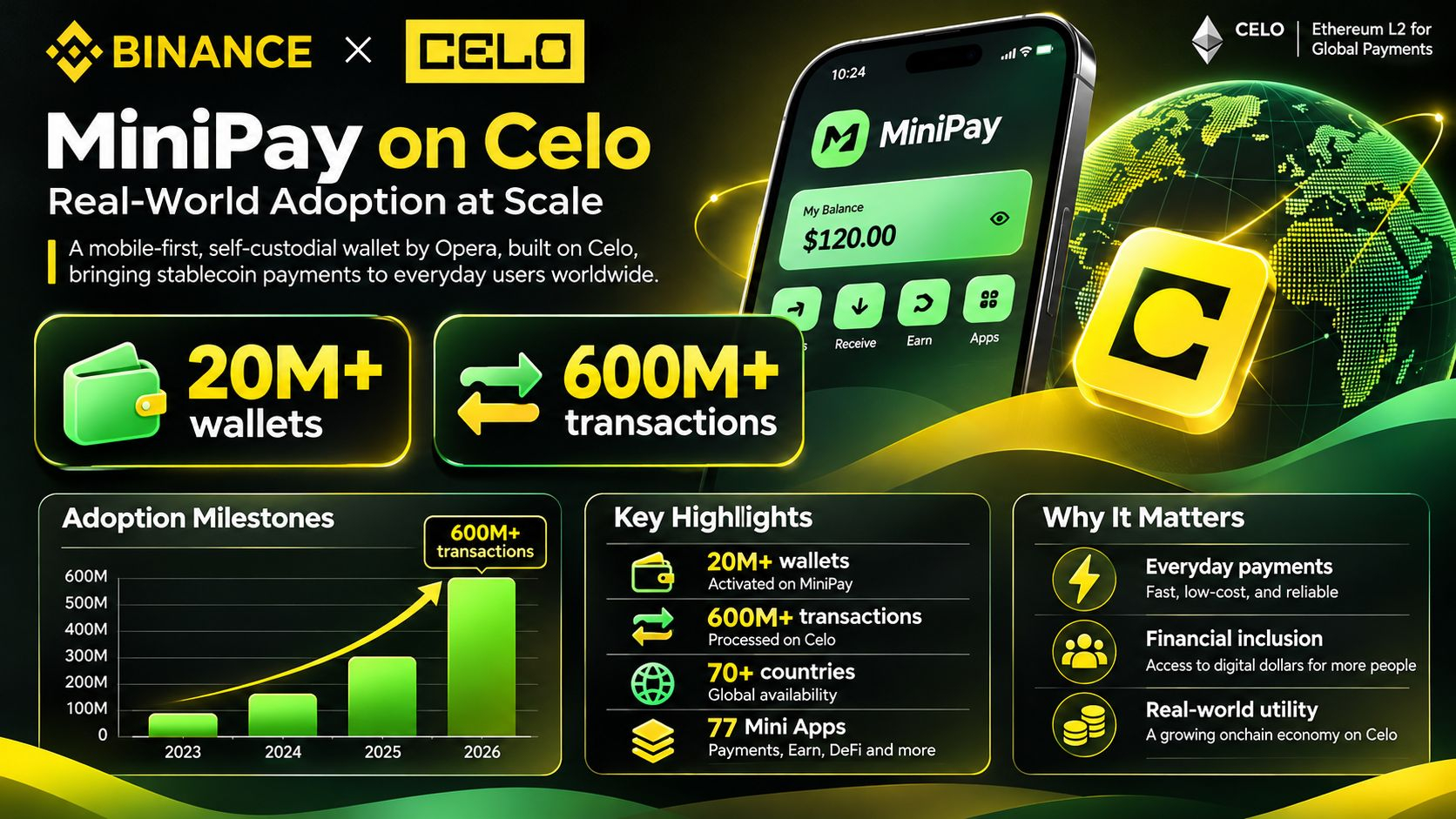
The future of payments won't be won at the blockchain confirmation screen. It will be won at checkout.
Research dated November 24, 2026. Network figures are historical snapshots; ecosystem adoption statistics attributed to Opera and Celo are organization-reported. This is independent educational research, not financial advice or a CELO price forecast.