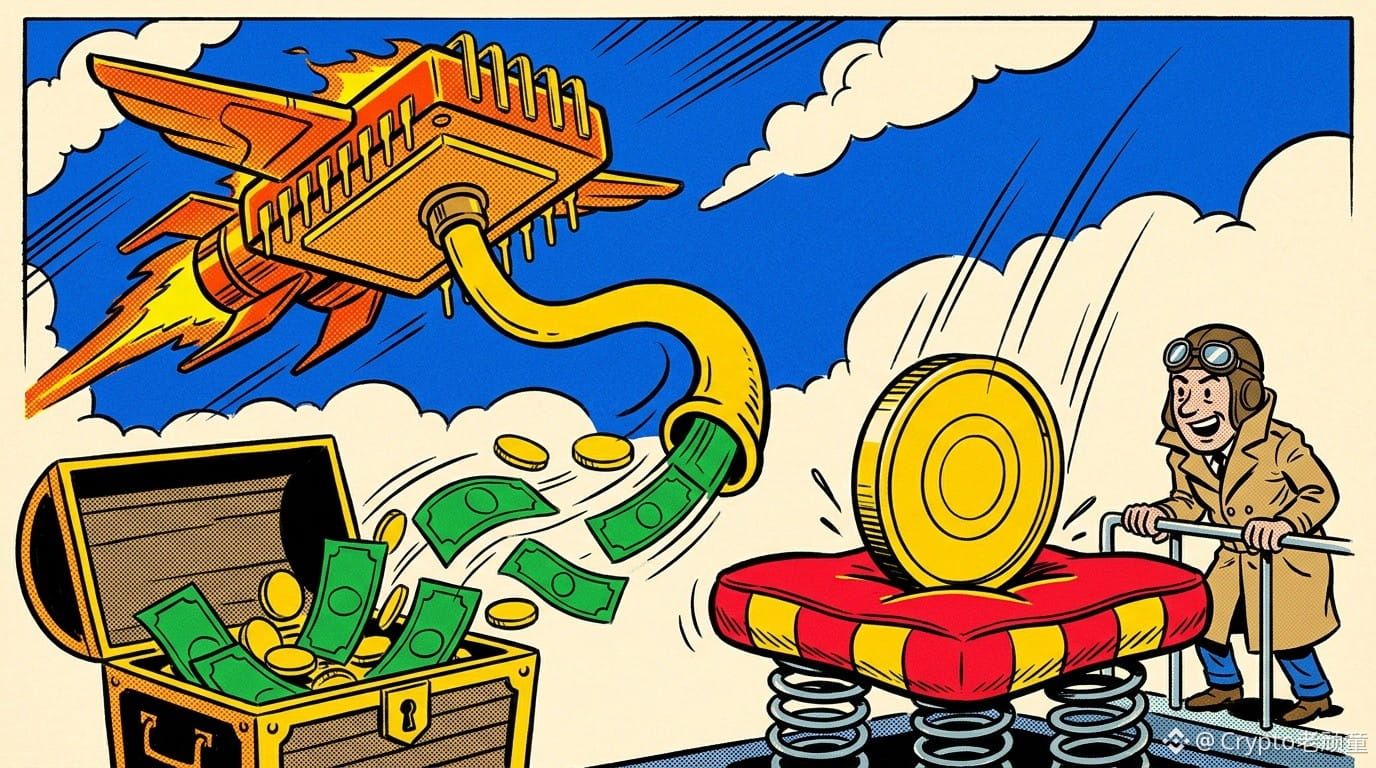
Before the U.S. market opened last night, Nvidia brought Jensen Huang back as CEO, and crypto prices surged along with it. Bitcoin briefly hit 64,600, smashing straight through the bearish defense line from the previous couple of days. I didn’t stubbornly stick to my view then—I went with the move and turned bullish, while saying I wouldn’t chase prices and would wait to buy the dip if it pulled back to 61,000–61,800.
It wasn’t until I checked the markets this morning that I realized what a party the U.S. market had last night: Nvidia surged more than 30% to 165, and the ETF that shorts it 2x lost over 60% overnight. The Nasdaq soared more than 6%, and A-share semiconductor stocks also got fired up in early trading. But crypto was another story. As soon as the U.S. market bell rang last night, $BTC opened high and then slid, giving back all its gains overnight and crashing to 61,200. Ethereum $ETH fell back to 1,710, and the broader market gave back another three or four points from last night’s highs. Even more surreal, the top altcoin by trading volume was tokenized Nvidia, $NVDAB , with nearly $250 million traded in a day. Hot money had all gone chasing chips; trading in major coins shrank to less than 40% of normal, with everyone in the room picking each other’s pockets.
The numbers make it clear. The Nasdaq has pulled back just over 10% from its high, while Bitcoin has already been cut in half and Ethereum has fallen 65%. Meanwhile, the 10-year Treasury yield is still hovering near 5%, siphoning away liquidity. There’s only so much money to go around, and with the chip behemoths next door feasting, it’s only natural for investors to treat crypto as an ATM. The foreign press had just been digging into how Jensen Huang manages employees by humiliating them, yet shareholders welcomed him back to drive up the stock all the same. That’s just how fickle the market is: if you can make people money, you’re a savior no matter how bad your temper; if you can’t move the market, even the loudest narrative is useless.
The most awkward part right now is that the 61,000 buy-the-dip zone I marked out last night has been hit head-on. Prices are drifting down on low volume, retail long/short ratios have squeezed to nearly 3x, and people overseas are all calling for 57,000. Reaching out to buy feels like catching a falling knife. Fortunately, the underlying picture isn’t quite so bleak: nearly $10 million in buy orders are stacked between 61,000 and 60,000, providing support, while the sell wall overhead at 62,600 is less than half that size. Call options are still 5 points more expensive than puts, and the biggest put position is also anchored at 60,000. People are talking about a crash, but big money is quietly laying a cushion at 60,000.
I’m sticking to the rules I set last night: I won’t flip bearish recklessly unless 60,000 breaks. I’ll place small buy-the-dip orders between 60,800 and 61,200, with a hard stop at 59,500 and an upside target of 64,500. The potential reward is twice the risk, so the loss is manageable. If it really breaks below 60,000, I’ll accept that the move was just a one-day fakeout, admit I was wrong, and exit cleanly.
……
I came across something amusing this morning: at an intersection 34 meters wide, the green light used to last only 12 seconds, so crossing the road felt like sprinting a hundred meters. After people complained, it was just extended to 28 seconds. Trading is the same—if there isn’t enough room, don’t dash into traffic to catch those dozen seconds of green. Wait until the light stays green long enough, then get moving. I’ll keep an eye on things through Tuesday morning, place my orders, then get on with the real work.