$QNT: Checking Your Intention: Are You Opening the Chart to Learn or to Feel Excitement?
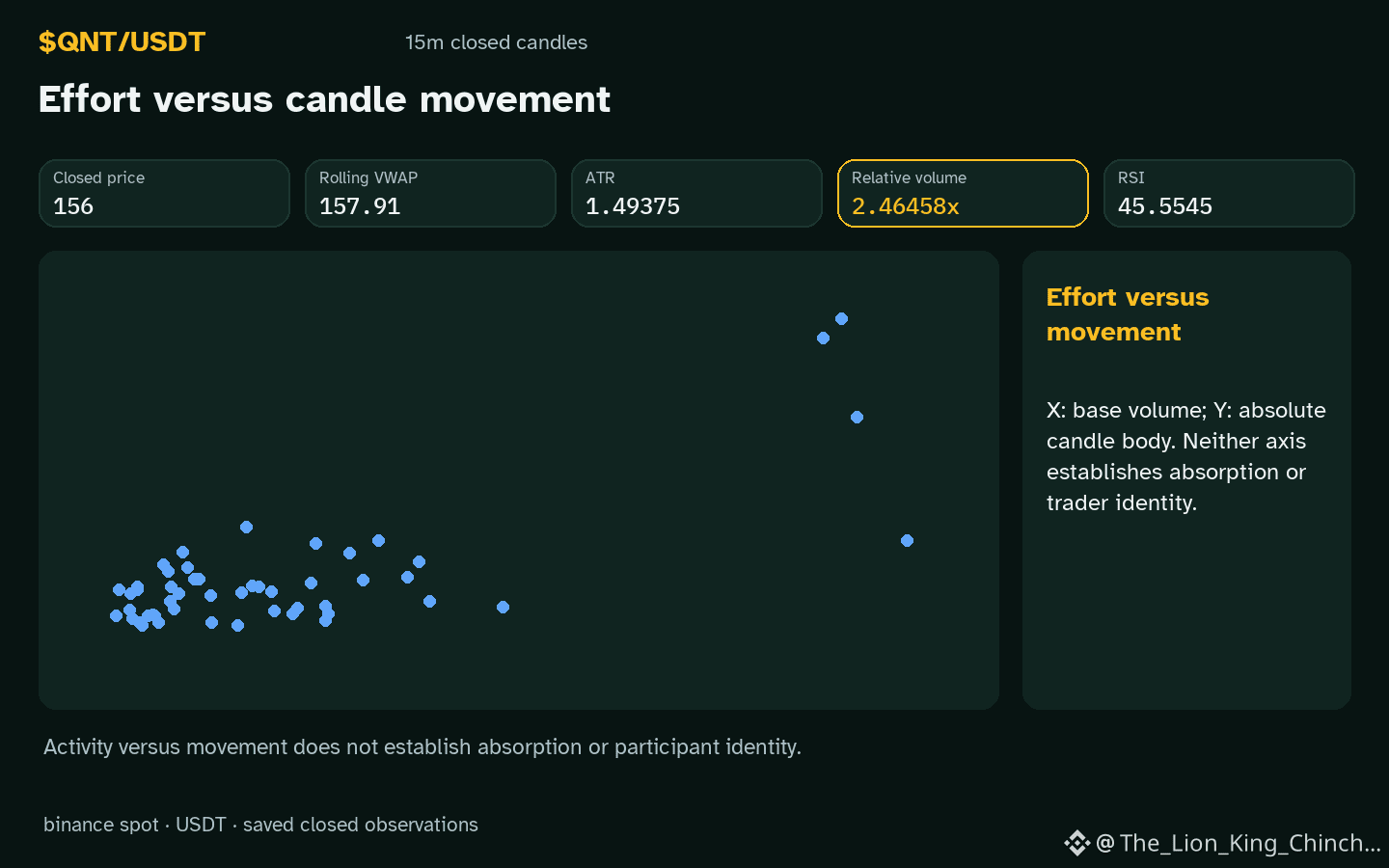
$QNT trades inside the recorded range with hourly direction up, yet volume sits above baseline. This tension asks whether intention drives analysis or impulse. Pre-session intention setting is a hypothetical mechanism. It suggests defining a learning goal before viewing price action prevents reactive decisions. The trade-off is entry quality versus chasing. If intent is 'observe structure,' a trader ignores the hourly up move. If intent is 'catch momentum,' the elevated relative volume 2.46x baseline may trigger action. A counterexample clarifies the idea. Assume a trader plans to wait for a break of 161.34. The current price near 156 offers no new structure. Writing 'I am here to note entry conditions' forces patience. Acting without intent leads to chasing the up candle. The self-check asks: did I define a specific observation or a desired feeling? Limits apply. Candles and volume do not prove causation. Relative volume is a base-volume ratio, not buying pressure. RSI 45.6 is an indicator reading, not a price bound. The mechanism relies on mental discipline, not chart geometry. To reassess, check closed candles later. If price stays inside 153.49 and 161.34, the intention to observe structure held. If it breaks 161.34 with sustained volume, reassess if the initial intent was to learn or to trade. Keep the distinction clear: the chart does not decide intent. The trader does. This framework separates preparation from reaction without inventing outcomes.
Probabilistic market research, not a recommendation or guaranteed return.
The comparison to keep in mind: $BTC has hourly direction up and volume not above its baseline; $MUBARAK has hourly direction up and volume above its baseline. This alone does not establish correlation.
#QNT #BTC #MUBARAK