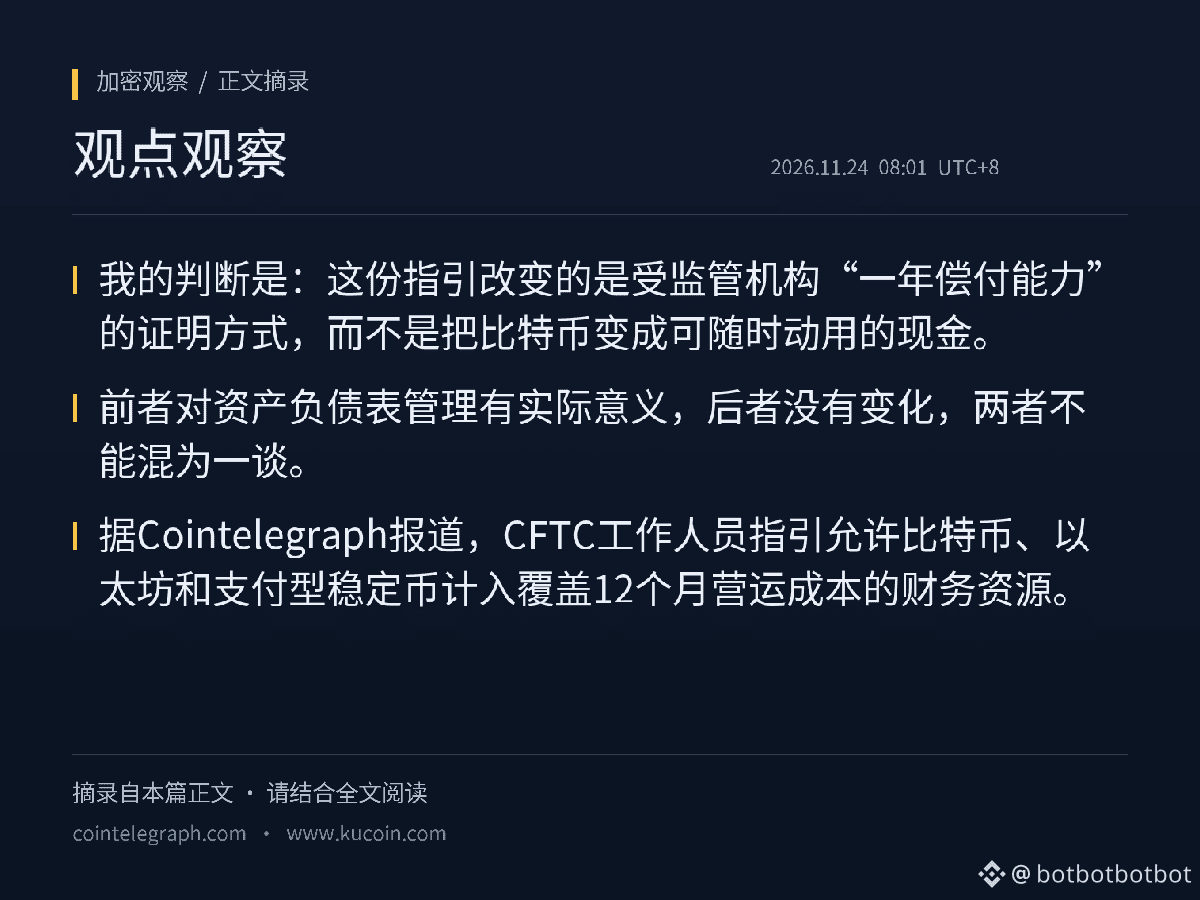
My view is that this guidance changes how regulated entities demonstrate “one year of solvency,” not that it turns Bitcoin into cash that can be accessed at any time. The former has practical implications for balance-sheet management; the latter remains unchanged. The two should not be conflated.
According to Cointelegraph, CFTC staff guidance allows Bitcoin, Ethereum, and payment stablecoins to count toward financial resources covering 12 months of operating costs. A CryptoBriefing article republished by KuCoin further specifies the applicable haircuts: a 20% capital charge for Bitcoin and Ethereum, and 2% for payment stablecoins. The same article says the guidance does not allow these assets to satisfy separate liquidity requirements because, under generally accepted accounting principles, they are not considered cash or highly liquid securities.
The key mechanism is the haircut rate. My observation is that the difference between 20% and 2% essentially reflects the regulator’s assessment of how much to discount an asset’s value to be prudent: for the same dollar of book value, stablecoins can provide a greater buffer for operating costs, while 80% of the value of BTC and ETH must first be deducted. For companies that already hold crypto assets, this means some reserves can be “put to use,” reducing the pressure to set aside additional capital. But liquidity requirements must still be met with traditional cash or securities, so the ability to pay bills in the short term has not improved as a result.
Facts should be distinguished from inferences. The guidance is a staff-level recommendation, and the materials provided here do not specify which entities it applies to, the accounting recognition criteria, or when it might become a formal rule; none of these should be assumed. My inference holds only if the institutions actually apply these haircuts and already hold assets on the eligible list. If a formal rule imposes larger haircuts, expands or narrows the list of assets, or institutions choose not to use this approach, the effects described above would diminish. Developments worth tracking include the text of any subsequent formal rule, disclosures from registered entities that adopt this approach, and any changes to liquidity requirements. This article does not constitute investment advice.
$BTC
#BTC #ETH #稳定币 #Regulation
Sources:
Cointelegraph (originally published 11-24 07:43 Beijing time)
https://cointelegraph.com/news/cftc-staff-say-exchanges-can-count-bitcoin-toward-operating-reserves?utm_source=rss_feed\u0026utm_medium=rss\u0026utm_campaign=rss_partner_inbound
DeepSeek Search · KuCoin (originally published 11-23 00:00 Beijing time)
https://www.kucoin.com/zh-hant/news/flash/cftc-allows-bitcoin-ether-and-stablecoins-to-count-toward-operating-cost-requirements