Artificial intelligence against the most dangerous crypto attacks: Has tracking stolen funds become faster than the attackers can move?
Chainalysis revealed that its AI-powered investigative tool helped track billions of dollars stolen in the Binance hack across nearly a dozen blockchain networks, while the attackers relied on automated transfers and bridges to move the funds.
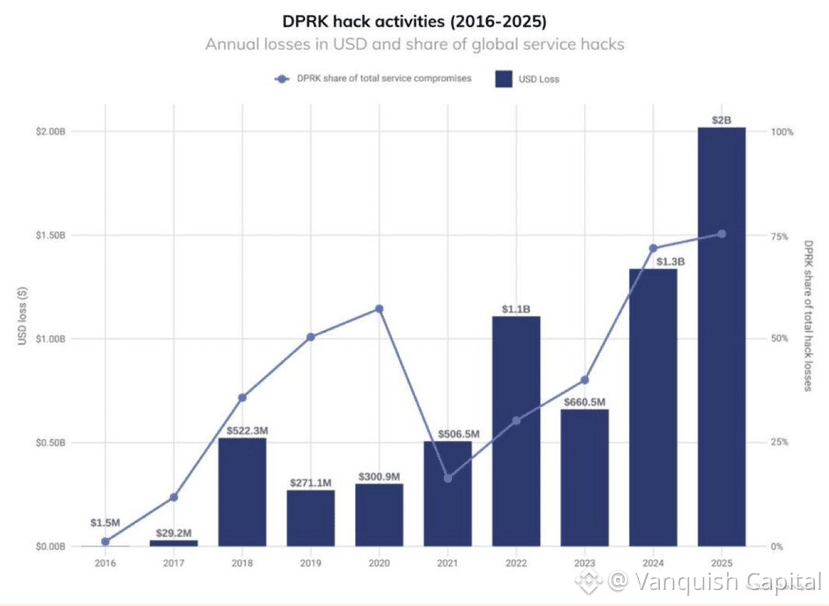
The figures from 2016 to 2025 tell the story of a notable rise in North Korean hacking activity and its share of global hacking losses:
Annual losses began at $1.5 million in 2016.
They rose to $29.2 million in 2017, then surged to $522.3 million in 2018.
They fell somewhat to $271.1 million in 2019, then reached $300.9 million in 2020.
They climbed again in 2021, reaching $506.5 million, then hit $1.1 billion in 2022.
Losses totaled $660.5 million in 2023, then rose to $1.3 billion in 2024, reaching $2 billion in 2025, with a marked increase in their share of total hacking losses.
This race between automated tools that move funds across networks and AI-based analytical systems raises a fundamental question about the future of digital asset security: