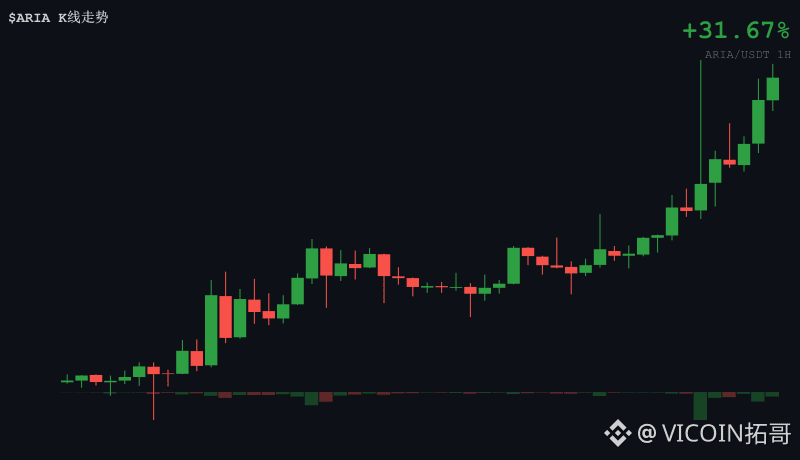
$INX is up 29.64% over the past 24 hours, with the price reaching $0.004146 and trading volume surging to $27M. Many people are pointing to these figures and saying, “Money is flowing in, and a trend is taking shape.” Let’s break down that claim. The most widely circulated version goes: trading volume has jumped to $27 million, which means a major player is buying up tokens, so just follow the move and go long. That conclusion doesn’t hold up, for two reasons. First, both the 24-hour high and low are listed as $0.00. This isn’t a case of the data provider cutting corners; rather, this asset lacks reliable order-book depth records on some market data sources, so price discovery itself is incomplete. In a market where the price can barely be recorded continuously, $27M in trading volume reflects more turnover friction than one-way accumulation. Second, a 29.64% gain paired with a high-volatility label means that percentage move was made on a low-liquidity base. It wasn’t steadily pushed up through a deep order book, and the two are not comparable in quality.
First, let’s look at where the money is flowing. At the same time, in U.S. equities, Belden rose 9.4% on the back of Nvidia and the AI hardware supply chain, while SBC Medical gained 12.6% without even a company news announcement. This shows that risk appetite is indeed rising, and investors are willing to pay a premium for a compelling narrative. But for that dynamic to carry over to a highly volatile token like INX, it has to pass through several stages: sentiment comes first, liquidity follows, and price validity comes last. So far, only the first stage has taken place. Equating “market sentiment is strong” directly with “a major player is building a position in INX” straightens out a causal chain that is actually quite indirect.
A more accurate way to think about it is this: INX’s current rise looks more like a sentiment-driven pulse in a shallow market than a verifiable, fund-driven trend. The basis for that assessment isn’t the size of the gain, but whether the price can form a continuous trading range around $0.004 with recorded highs and lows. Here’s what to watch: over the next 48 hours, if valid 24-hour high and low figures start appearing for INX and trading volume doesn’t shrink below $10M, that would indicate the order book is getting deeper and price discovery is starting to work. If the gain fades but the high and low remain blank, then this was just a bout of turnover, not a trend. Do you agree?