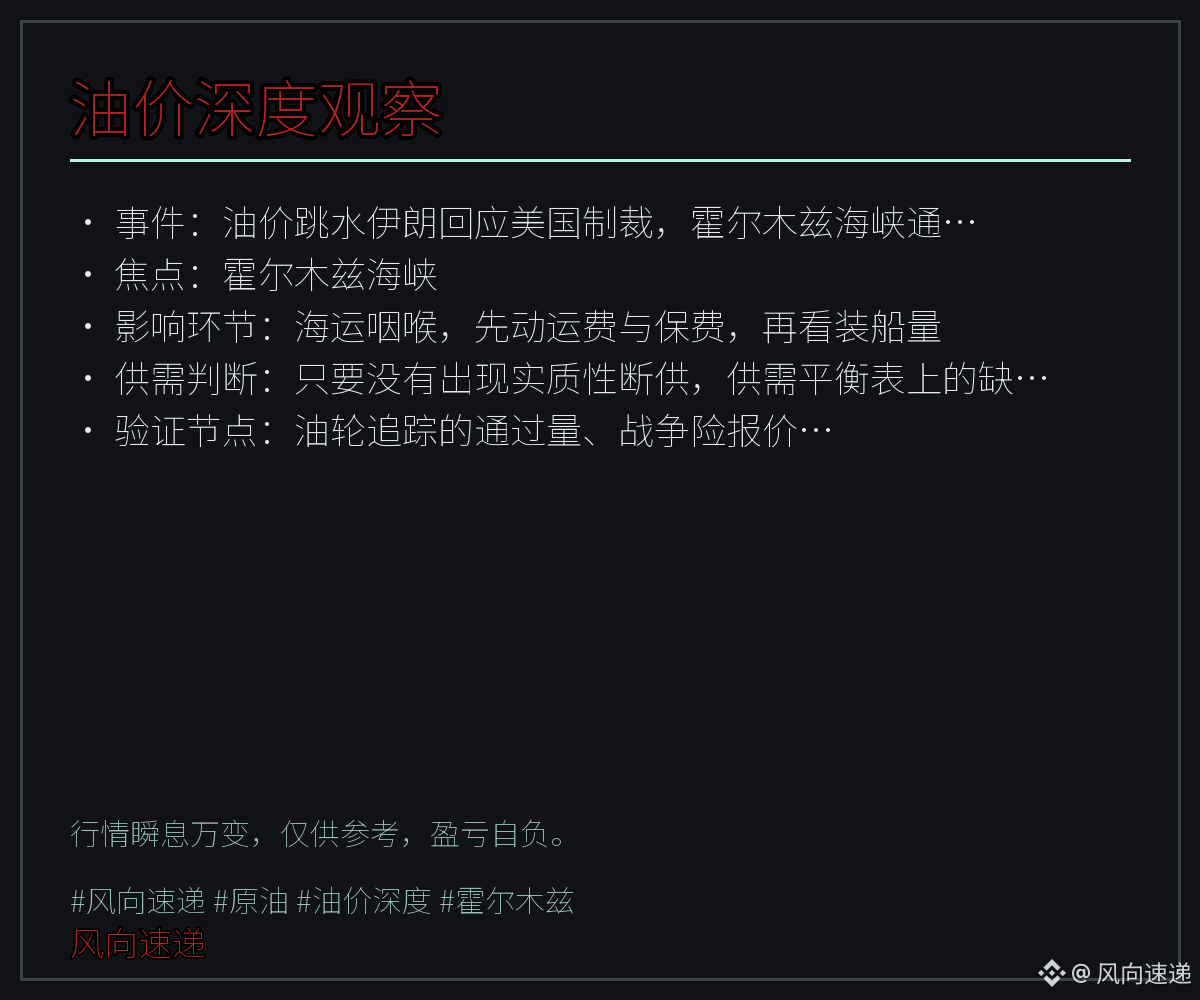
Oil Price Deep Dive
【Key Events】
Oil prices plunged as Iran responded to US sanctions. Transit through the Strait of Hormuz depends on the US honoring its commitments; no decision has yet been made on withdrawing from the nuclear treaty (8 hours ago)
【Who Is Influencing Oil Prices】
Iran is tightening its energy trade rules. The Strait of Hormuz carries about one-fifth of the world’s seaborne crude oil. If Red Sea and Suez Canal routes are diverted around the Cape of Good Hope, voyages from the Middle East to Europe take more than ten extra days.
【Transmission Mechanism】
If passage through the Strait of Hormuz is restricted, shipowners will reroute vessels, extending voyages and driving up war-risk insurance premiums, which in turn raises landed costs.
When this feeds into crude pricing, the market typically factors in a risk premium first, then assesses whether actual loadings and transit volumes have truly declined.
【Supply, Demand and Pricing】
As long as there is no actual disruption to supply, any shortfall in the supply-demand balance will be limited, and the price reaction will be felt more in the forward curve and regional price differentials.
WTI is currently trading around $80.69, with a 24-hour change of -3.26%. Volatility has increased, indicating that this kind of risk is being priced in quickly. Next, it will be important to see whether actual supply-and-demand data bears this out. Risk premiums often build quickly and unwind just as fast; their staying power depends on whether ships are subsequently damaged or transit data continues to decline.
【What to Watch Next】
Keep an eye on tanker-tracking data for transit volumes, war-risk insurance quotes, and changes in the Brent-Dubai crude spread.
【What Would Invalidate This Thesis】
If transit quickly returns to normal and premiums fall, the previously priced-in risk premium will typically gradually dissipate.
Markets can change in an instant. For reference only; trade at your own risk.
#风向速递 #原油 #油价深度 #Hormuz