
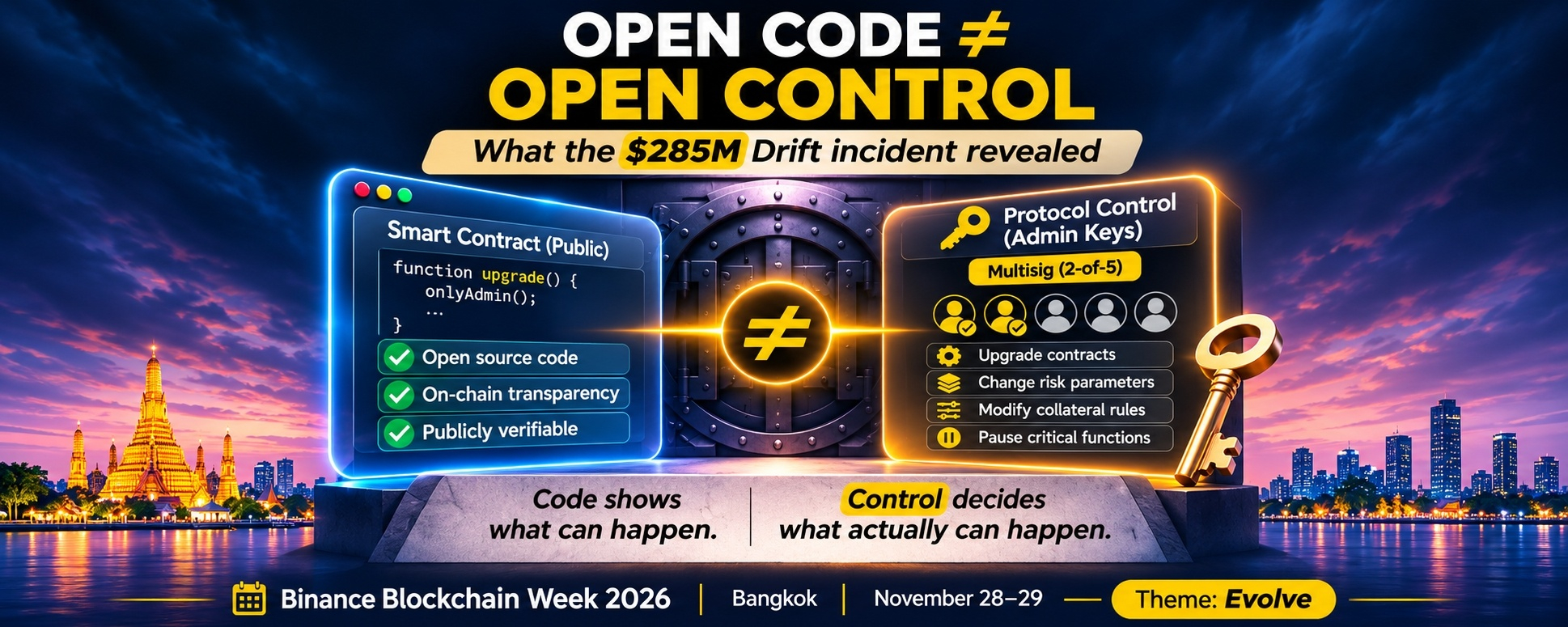

Open Code Doesn't Mean Open Control: What the $285M Drift Incident Revealed
If a DeFi protocol is genuinely decentralised, who can change its rules when something goes wrong?
I've been thinking about this question more seriously after reading the investigations into the April 1 Drift Protocol incident on Solana.
Approximately $285 million was drained from the protocol. What makes this incident particularly worth examining is that the attack wasn't simply a case of someone finding a bug in a smart contract.
It involved social engineering, pre-signed administrative transactions, multisig permissions, a change in security safeguards and a fabricated collateral asset.
For me, that's where the bigger discussion about decentralisation begins.
What Actually Happened at Drift?
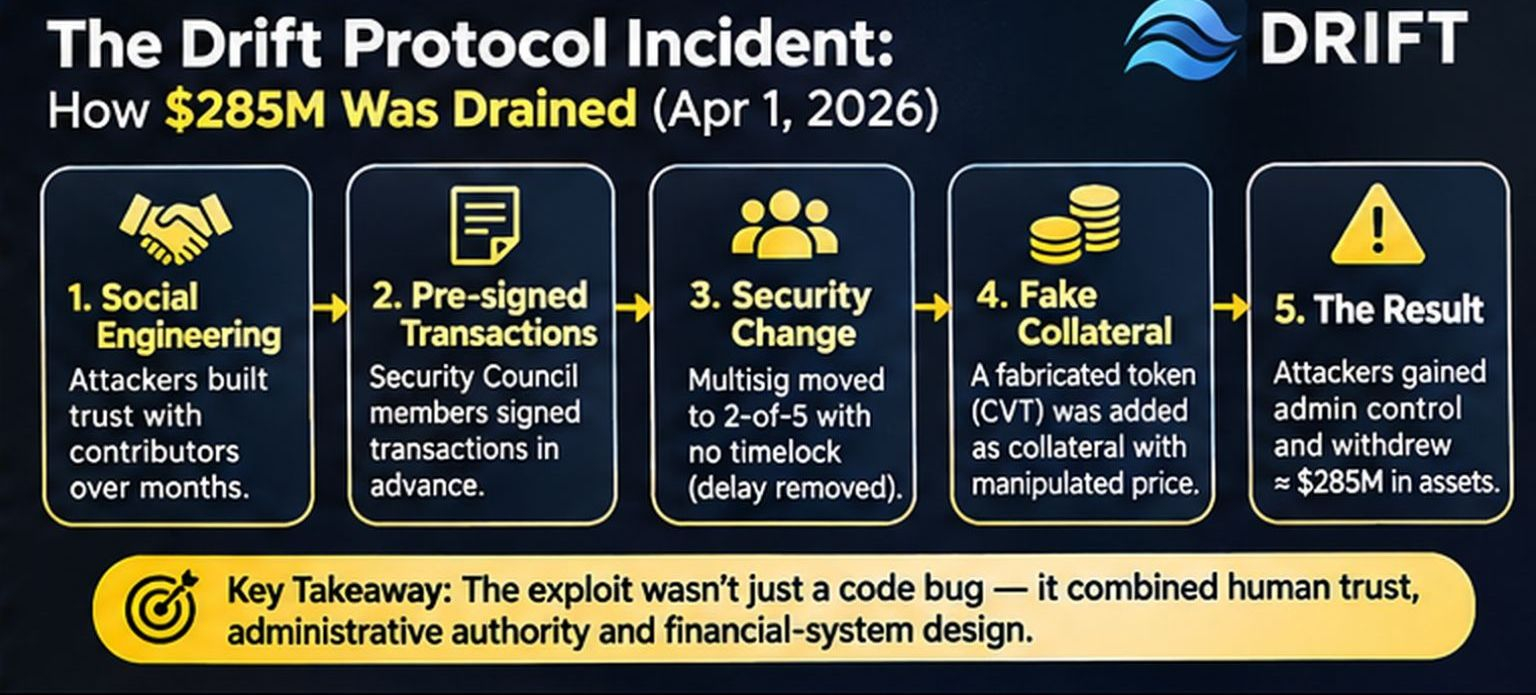
According to Chainalysis' reconstruction of Drift's investigation, the attackers spent months building relationships with contributors, posing as legitimate industry participants.
They eventually persuaded Security Council members to sign transactions in advance without fully understanding their underlying effects.
Solana's durable nonce mechanism allowed those transactions to remain valid for later execution.
On March 26, Drift migrated its Security Council to a new 2-of-5 multisig configuration with zero timelock, removing the delay that could have provided an opportunity for detection or intervention.
On April 1, the pre-signed transactions were executed, transferring administrative control to the attackers.
Once they had that control, they introduced a fabricated token called CarbonVote Token (CVT) as collateral. Its price had been artificially manipulated, allowing the attackers to use worthless collateral to withdraw real assets from the protocol.
Approximately $285 million was lost.
The details are disturbing, but the lesson is bigger than the amount involved.
The attack exploited a combination of human trust, administrative authority and financial-system design.
The Problem With Treating Decentralisation as a Label
I think crypto sometimes treats decentralisation as a binary concept.
A project is either decentralised or centralised.
But actual control can be more complicated.
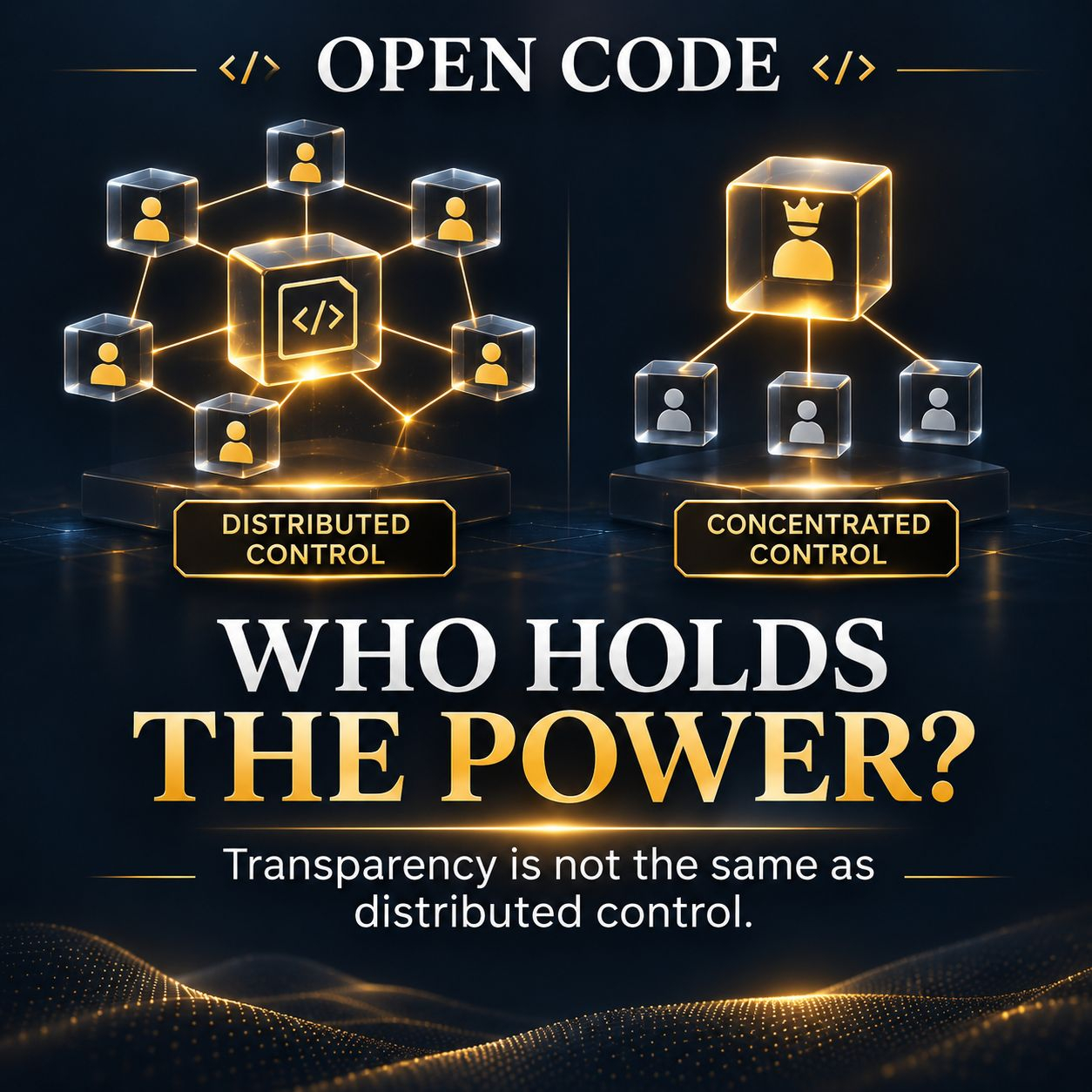
A protocol may have publicly accessible code, community governance and on-chain transactions, while a relatively small group still holds the authority to change important settings.
That doesn't automatically make the protocol bad or dishonest.
However, those permissions are part of its architecture, and users should understand them.
Who can upgrade contracts? Who controls administrative keys? Who can modify collateral parameters? Are important changes subject to a delay? Can emergency safeguards be altered?
These are questions about the distribution of power.
And they matter just as much as the project's decentralisation claims.
What Regulators Are Looking At
This isn't merely a discussion among crypto commentators.
The FATF's July 21, 2026, report on regulatory challenges from decentralised finance emphasises a functional, risk-based approach to identifying control in DeFi arrangements.
The report discusses factors such as control over protocol functions, governance, technical permissions and the ability to influence how an arrangement operates.
IOSCO's December 2023 recommendations similarly emphasise identifying the individuals or entities exercising control or sufficient influence over DeFi products and services.
The important idea behind both approaches is to look at how a system actually works rather than relying exclusively on the decentralisation label. That distinction is worth remembering when researching any protocol.
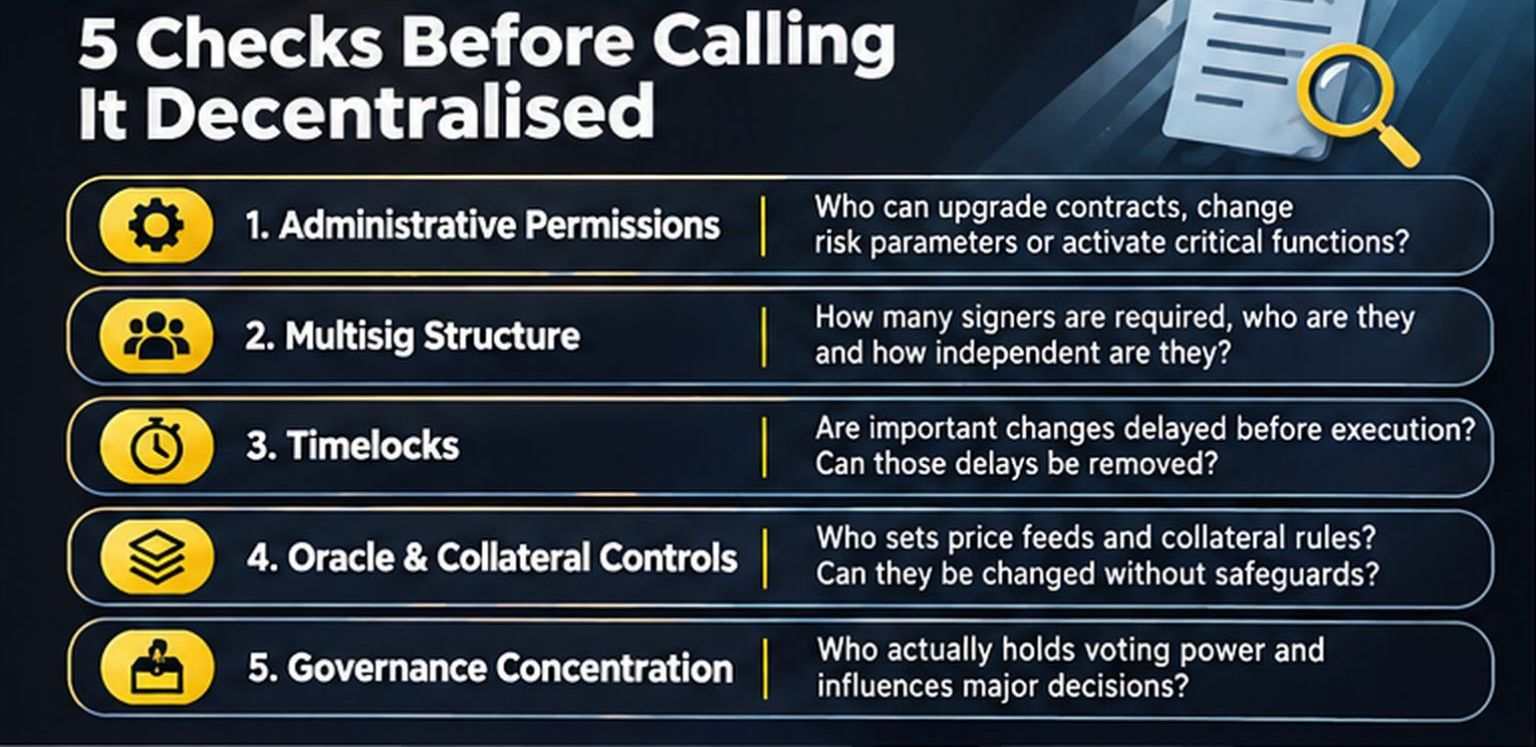
Five Things I'd Examine Before Calling a Protocol Decentralised
1. Administrative permissions
Who can upgrade contracts, change risk parameters or activate critical functions? Read the permissions rather than relying on the project's description.
2. Multisig structure
How many signers are required? Who are they? How independent are they? What exactly are they approving?
A multisig can distribute authority, but its effectiveness also depends on the people, processes and safeguards surrounding it.
3. Timelocks
Are important changes delayed before execution? Can those delays be removed? Is there a clearly documented exception mechanism?
A timelock doesn't guarantee safety, but it can provide a window for scrutiny and response.
4. Oracle and collateral controls
Who determines which assets are accepted as collateral and how their prices are calculated? Can these parameters be changed without adequate safeguards?
The Drift incident makes this question particularly difficult to ignore.
5. Governance concentration
Who actually holds voting power? How much influence do large holders, delegates or specific entities have over major decisions?
A DAO structure doesn't automatically mean decision-making is broadly distributed.
I Don't Think the Answer Is Simply More Centralisation
This is where I disagree with the idea that every major incident should lead to more centralised control.
Decentralisation exists for important reasons. It can reduce dependence on a single authority, make systems more transparent and allow users to interact without relying on traditional intermediaries. But removing intermediaries doesn't automatically eliminate trust. Sometimes it changes where trust is placed.
Users may still depend on developers, multisig signers, oracle providers, governance participants, infrastructure operators or legal arrangements surrounding the protocol.
The challenge is to make those dependencies visible, minimise unnecessary concentration and build safeguards that don't quietly create unlimited authority.
That's a more meaningful discussion than simply asking whether a protocol calls itself decentralised.
What Evolve Should Mean for DeFi
As Binance Blockchain Week 2026 approaches in Bangkok on November 28–29, under the theme Evolve, I think conversations about the future of blockchain should include questions about governance, permissions, security architecture and accountability.
The industry has already demonstrated that it can build increasingly sophisticated financial infrastructure.
Now, I'd like to see more attention given to how that infrastructure distributes power, handles exceptional situations and communicates its risks to users.
Because the more financial activity a protocol attracts, the more important its underlying governance and security decisions become.
Open code is valuable. But understanding who has the power to change that code is equally important.
That's the distinction I'd encourage anyone researching DeFi to examine. And I'd genuinely like to hear different perspectives:
What matters more when evaluating a DeFi protocol: the openness of its code, or how widely the power to change that code is distributed?
Can both be achieved without compromising either?#EvolveAtBinanceBlockchainWeek #Binance #defi #blockchain #Web3
Educational content only. Not financial advice.