


A lot of people were watching tonight's market with bated breath. $BTC Bitcoin surged past $63,000, $ETH and ETH shot up from below $1,700 to above $1,800. The 24-hour gain was about 4%, and more than 100,000 traders across the market were liquidated. The cries of "the bull market is back" in people's social feeds spread even faster than prices rose.
But don't rush to add to your position just yet. Looking at the data, this is a weak rebound—not confirmation of a trend reversal.
I. First, the data: $ETH Where do things stand now?
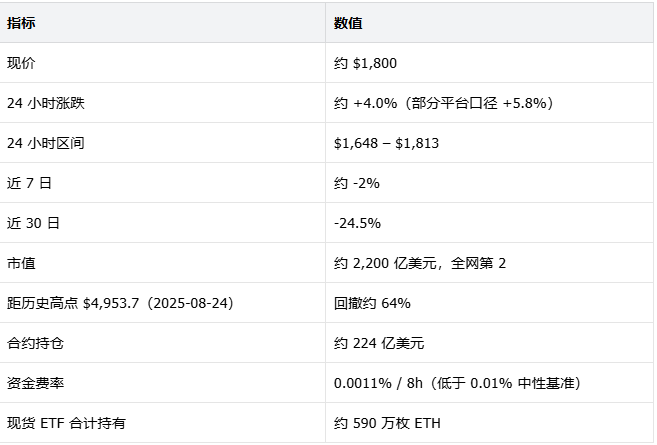
In a nutshell: The price has climbed 17% from its panic low of 1,538, but it has yet to recover from that 24.5% plunge over the past 30 days.
The funding rate is 0.0011%, below the neutral benchmark of 0.01%, suggesting this rally wasn’t driven by a pile-up of highly leveraged longs—long positions aren’t crowded, which is a rare positive sign.
## 2. Why is it rising tonight? Three drivers
1) A short squeeze after being deeply oversold
On November 20, ETH fell 7.64% in a single day, hitting a low of $1,581.5; on November 21, it dropped further to $1,538. After two long lower wicks, leveraged shorts piled up at the lows. Once the price started moving, short covering became the fastest source of buying. These rebounds tend to be “fast and steep, with volume concentrated in the first two hours.”
2) A broad recovery in risk appetite
On the evening of November 23, risk assets strengthened across the board: spot gold rose 3.87% to $3,671 per ounce, silver gained 6.12% to $43.7 per ounce, Brent crude fell below $90, and Nvidia-related tokens rose more than 22% in a single day (the news was that Jensen Huang had resumed his role as CEO). Crypto isn’t moving independently; the broader market’s risk appetite is lifting it.
3) An extreme sentiment reversal
More than 100,000 traders across the market were liquidated within 24 hours, mostly on short positions. When the market is overwhelmingly bearish, a “short squeeze” is almost inevitable. That’s also why ETH’s rebound from its low is significantly larger than what fundamentals could explain over the past two days.
## 3. Don’t rush to call a reversal: three concerns
1) Institutions are still pulling out—for the eighth consecutive week
Last week (11/16–11/20), spot Ethereum ETFs saw $314 million in net outflows, marking the eighth consecutive week of outflows. BlackRock’s ETHA alone saw $230 million in outflows for the week, while Grayscale’s Ethereum Mini Trust (ETH) saw about $22.7 million in outflows. Looking at the monthly figures, spot ETH ETFs saw $1.607 billion in net outflows across the market in October. ETHA alone accounted for $1.42 billion, nearly 90% of the total.
ETFs are the most important source of incremental capital for ETH in this cycle. Eight consecutive weeks of outflows mean this rebound is a leveraged recovery driven by existing capital, not a return of new capital. A genuine reversal signal will require daily ETF net inflows to turn positive again and remain so for several days.
2) The upgrade timeline is slipping
The Glamsterdam upgrade, originally scheduled to launch in Q4 2026, may now be delayed until as late as May 2027, according to the latest discussions. The reason is smart contract compatibility issues with the gas pricing changes in EIP-8037 and EIP-8038, which have already delayed the Hoodi testnet fork. Under the current specifications, the mainnet could be activated no earlier than mid-January 2027.
For the price, an upgrade isn’t an immediate cash flow, but it is a “time anchor for the narrative.” Pushing that anchor back by six months gives investors one less reason to position early.
3) ETH is underperforming BTC
ETH/BTC is currently around 0.028, almost unchanged over the past 24 hours. In a genuinely strong ETH rally, the exchange rate should rise in tandem. Its lack of movement suggests ETH is being carried along by the broader market rather than actively attracting capital.
## 4. Key price levels: Where is the line between bulls and bears?
Resistance above
$1,800–1,813: A psychological threshold + the 24-hour high. Whether it can hold tonight will determine if this move is a “one-day wonder” or a “weekly-chart-level recovery”
$1,866: The 7-day high. Only a break above this level would signal a break in the short-term downtrend
$2,000: A major round-number level. Once strong support, it is now the toughest ceiling
Support below
$1,718–1,720: The first line of short-term support, tested several times
$1,695–1,680: The 4-hour SMA20 is around $1,684. A break below this level would invalidate the rebound structure
$1,650–1,630: Secondary support zone
$1,579–1,538: The panic lows of November 20–21, and the most important mid-term line of defense
Three scenarios
Hold above $1,813 and retest $1,718 without breaking below → short-term strength, with $1,866 as the target, then $2,000
Repeated swings between $1,780–1,820 → the most likely scenario; wait for ETF data and next week’s macro events to set the direction
Break below $1,680 with a weak rebound → the rally is over; retest $1,630, and if that fails, look toward $1,538 again
## 5. My view
I’d characterize this rebound as an 80% technical recovery and a 20% improvement in fundamentals.
What’s supporting it: a short squeeze, a return of risk appetite, and uncrowded funding rates. What’s limiting it: eight consecutive weeks of ETF outflows, a delayed upgrade, and a weak ETH/BTC exchange rate. The balance of bullish and bearish forces looks more like “it bounced because it had fallen too far” than “it’s rising because things have improved.”
So my approach is: don’t chase the rally; wait for two confirmations.
Watchlist (ranked by importance)
Whether daily net inflows into spot ETH ETFs turn positive and stay that way for at least 3 consecutive days
Whether the ETH/BTC exchange rate can hold above 0.030
Whether a clear date for Glamsterdam can be announced before December
Whether there is sufficient buying volume to support a retest of $1,718
Only when two of these four conditions are met is it worth moving from “watching” to “participating.” Until then, every surge above $1,800 looks more like an opportunity for trapped holders to sell.
Risk disclaimer: The content above is market analysis based on publicly available market data and personal opinions. It does not constitute investment advice.