


Chainlink has spent years becoming the infrastructure that DeFi applications use to get reliable market data.
Now the company behind much of that development is working with banks, asset managers, and financial institutions that want to move traditional assets onto blockchains.
That's a much bigger market than the one Chainlink originally served.
But I've been looking at something more specific.
How much LINK does all that adoption actually require?
The latest numbers are worth examining.
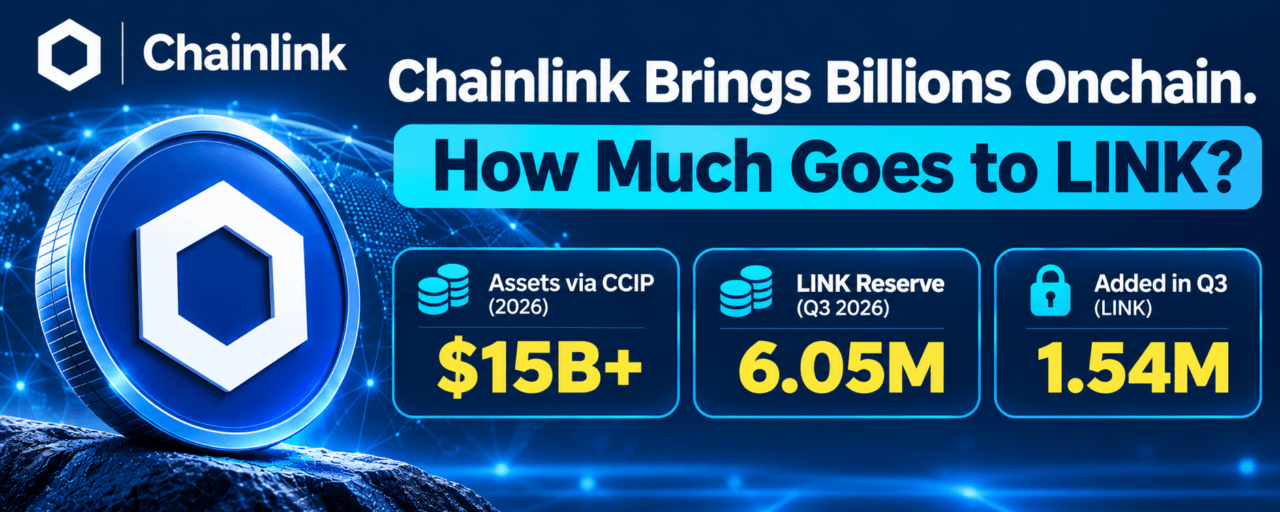
In its Q3 2026 review, Chainlink reported that more than $15 billion in token value had migrated to its Cross-Chain Interoperability Protocol, or CCIP, during 2026.
That includes major wrapped Bitcoin assets such as WBTC and cbBTC, along with other tokenized assets.
It's a substantial amount of value moving onto infrastructure that uses Chainlink.
But here's the distinction I'd make.
$15 billion in assets using CCIP doesn't mean Chainlink earned $15 billion in revenue.
And it certainly doesn't mean $15 billion was spent buying LINK.
The figure reflects assets adopting the infrastructure, not fees paid for its services.
That difference is important.
Chainlink's newer economic model is designed to connect service usage with token demand.
Through Payment Abstraction, customers can pay for certain Chainlink services using supported assets or traditional payment methods.
The system converts qualifying revenue into LINK.
Those tokens can then accumulate in the Chainlink Reserve.
By the end of Q3 2026, the Reserve held approximately 6.05 million LINK.
About 1.54 million LINK had been added during the quarter.
That gives investors something concrete to measure.
There's actual accumulation taking place.
But the Reserve shouldn't be confused with a token burn.
LINK entering the Reserve still exists. The tokens are held to support the network's long-term economics, rather than being permanently removed from total supply.
And holders don't receive a direct dividend from those purchases.
I find the model interesting because institutional customers don't necessarily have to manage LINK themselves for their service payments to generate token demand.
A bank could pay for infrastructure in its preferred currency while Payment Abstraction handles the conversion behind the scenes.
That's potentially useful as traditional financial companies begin using blockchain technology.
Chainlink also launched CCIP 2.0 in September.
The upgrade gives institutions more control over cross-chain transfers, including additional verification and configurable compliance requirements.
Those features matter when you're dealing with regulated financial assets.
Banks can't necessarily move customer assets across public blockchains using the same assumptions as an ordinary DeFi trader.
But institutional partnerships still need careful interpretation.
An announced integration might start with a limited service or a pilot. It doesn't automatically mean the partner is generating substantial recurring fees.
And even when services go live, we need to know how much revenue Chainlink retains and how much eventually converts into LINK.
There's another side to the tokenomics.
LINK has a maximum supply of 1 billion tokens.
DeFiLlama recorded approximately 766.85 million in circulation on November 23.
That leaves a portion outside circulation, though releases depend on transfers from designated non-circulating wallets rather than a simple monthly vesting calendar.
Staking also creates demand for LINK.
More than 42 million tokens are committed through Chainlink's staking system, according to its economics dashboard.
But staking rewards and Reserve accumulation serve different purposes.
One supports network security incentives. The other accumulates tokens using qualifying revenue.
Neither automatically guarantees price appreciation.
For me, the useful comparison is how quickly Chainlink Reserve holdings grow relative to supply entering circulation.
I'd also watch actual CCIP fee revenue, enterprise payments, and whether large institutional integrations move beyond announcements into regular production usage.
Chainlink has already made considerable progress in getting its infrastructure adopted.
The next thing I want to see is how much recurring economic demand that infrastructure can create for LINK.
