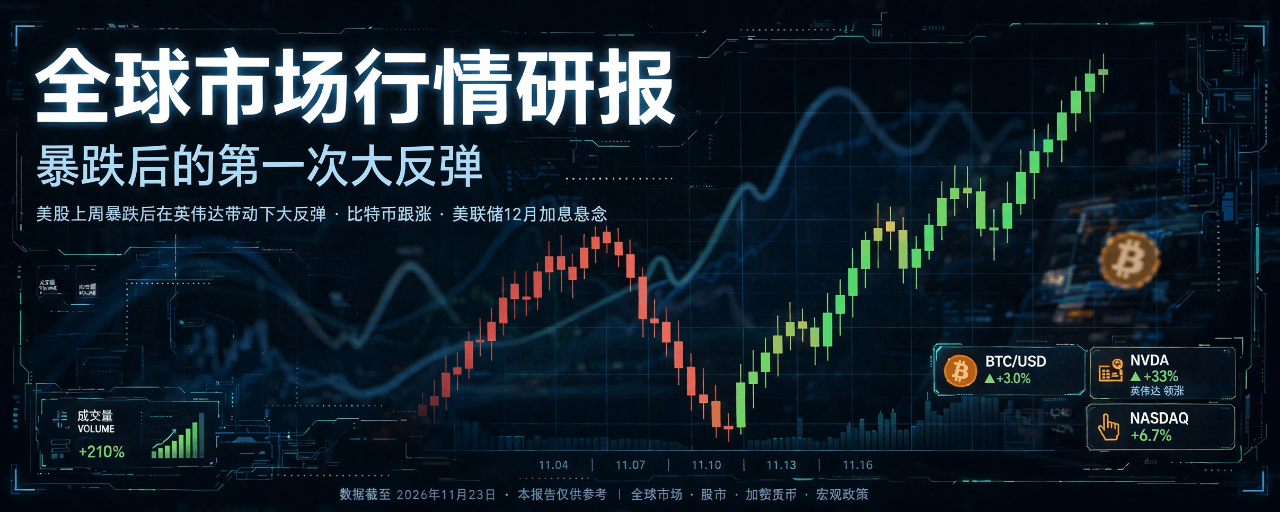

2026-11-23 (Monday) U.S. market intraday | Bottom line: This is an oversold bounce after last week’s historic sell-off. The rally is led by a pullback in risk premiums, not confirmation of a trend reversal.
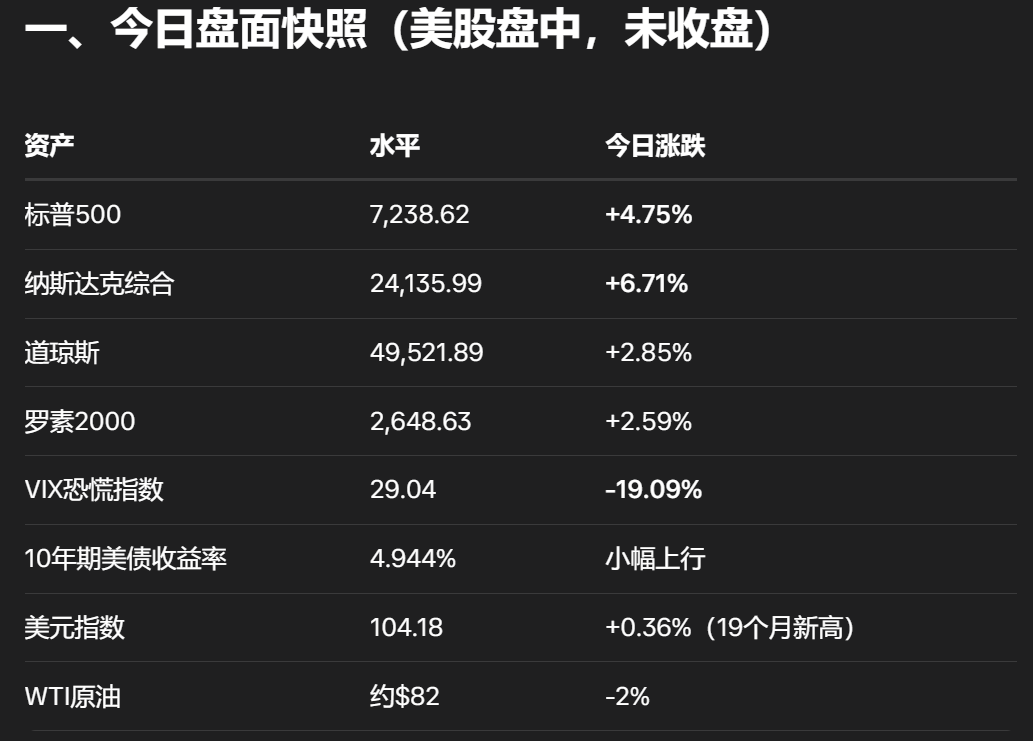
Nvidia alone contributed 2.46 percentage points of the S&P 500’s gains and 2.95 percentage points of the Nasdaq 100’s gains. Rather than a broad market rally, today’s move is better described as Nvidia lifting the indexes, with other sectors joining the recovery.
Sector breakdown: Technology (XLK) surged 9.58%, leading by a wide margin, followed by consumer discretionary (+4.07%), industrials (+3.35%), and financials (+1.87%). This is a classic risk-on rotation: cyclical and growth sectors, indiscriminately sold last week, are leading the rebound, while defensive sectors are underperforming.
Individual stocks: Nvidia +32.8%; AI compute rental providers CoreWeave and Nebius each rose 28%—the highly leveraged neocloud stocks that fell hardest last week rebounded the most, confirming the chain reaction from easing concerns over Nvidia financing support. Alphabet rose 6–7%, Caterpillar 7%; all of the Mag 7 closed higher; Anthropic rebounded about 4%.
II. First, Let’s Be Clear: What Is Recovering Today?
Last week was historic: the S&P 500 fell 8.61% for the week (its worst performance since April 2025), the Nasdaq fell 10.02% (its worst since March 2020), and the Dow fell 8.02%. All three major indexes entered correction territory, and the VIX surged above 40 for the first time since April 2025.
But the fundamentals haven’t actually collapsed: earnings season just ended with profits growing more than 30% for a second consecutive quarter. In other words, last week’s decline was in valuation multiples and positioning, not earnings. Those are also what bounced back today.
Breakdown of today’s rebound drivers (ranked by contribution):
Huang’s reinstatement (largest contribution): the board unanimously reinstated him as CEO, and senior U.S. officials confirmed there was no national security risk, removing the biggest single tail risk for the AI trade
The weekend policy mix: Trump’s comments, Bessent drawing a line on sales of computing power to China and warning the Fed against over-tightening, and several Asia-Pacific markets stepping in to support markets—the futures had already risen 2.6% before the reinstatement announcement
Short covering: hedge fund single-stock short volume hit a record since 2022 last week, while the fear index also reached a record. Positioning was extremely crowded, so the reversal triggered a short squeeze
Oversold technical buying: after seven consecutive weeks of declines and indexes entering correction territory, discounted valuations triggered dip-buying (Morgan Stanley and RBC both said the bad news was already priced in)
III. Crypto: Following the Rally, but Clearly Weaker Than U.S. Equities
This was the most notable divergence today:
Bitcoin first fell to $55,130 on Saturday (its lowest since September 2024 and 56% below its all-time high), then rebounded above $61,000 over the weekend. It is now around $62,777, up 2.98% today, after reaching an intraday high of $64,603.
But all the structural indicators are weak: spot ETFs have seen net outflows for a fourth consecutive week, with total outflows of about $3.0–3.5 billion in November. BlackRock’s IBIT recorded a record single-day outflow of $541 million; the Fear & Greed Index is at 9–11, indicating extreme fear; and BTC dominance is 59%, suggesting investors only dare to take shelter in Bitcoin while altcoins are being ignored
The total stablecoin market cap has fallen to $284.2 billion, shrinking 6.15% over 30 days—the pool of capital in the market is still getting smaller
Technicals: BTC has fallen for seven straight weeks and is trading below its 200-day moving average, with the RSI deeply oversold at around 26.6. The first resistance zone is $62,000–65,000; below the previous low of $55,000–56,000, the next downside target is $53,000
Interpretation: today’s crypto rebound reflects spillover from improved risk appetite in U.S. equities, short covering, and oversold dip-buying (perpetual funding rates are slightly positive and CVD has turned positive, indicating tentative buying). But ETF flows haven’t turned around, and no new money has entered. A shift in ETF flows from outflows to inflows would be the signal that “the rebound has real buyers.” Until then, crypto’s rebound is a tier below that of U.S. equities.
IV. What Hasn’t Changed: None of the Macro Headwinds Have Gone Away
This is the most important section for judging how long the rebound can last:
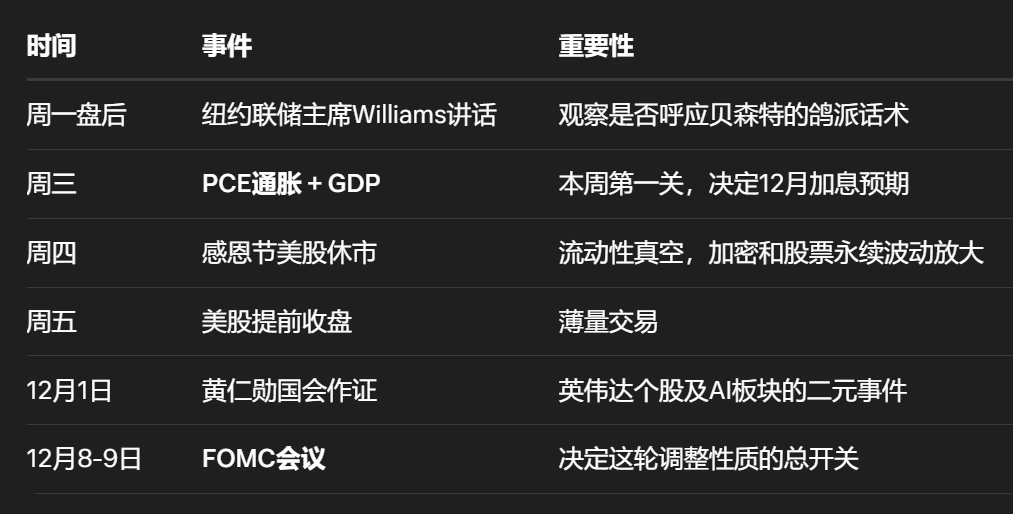
Fed: CME FedWatch still shows about a 96% probability of a 25 bp rate hike in December; the Fed meets December 8–9. Bessent’s weekend “don’t over-tighten” comment was just rhetoric. Goldman Sachs has already warned against treating a change in rhetoric as a genuine policy shift
Inflation gets its test this week: the PCE price index (the Fed’s most closely watched inflation gauge) and GDP are released Wednesday, before Thanksgiving—this is the real test of the week, more important than Huang’s reinstatement
Yields are still stuck at elevated levels: 4.94% for the 10-year and 5.32% for the 30-year. The cost of money hasn’t gotten cheaper, and the ceiling on growth-stock valuations remains in place
Only half the Nvidia bombshell has been defused: the SEC investigation continues, and congressional testimony is set for December 1. Any damaging testimony could reverse today’s gains just as quickly
V. This Week and What Lies Ahead
VI. Three Possible Scenarios
Base case (the rebound continues, but with bumps; most likely): PCE comes in no hotter than expected, the VIX gradually falls below 25, and Nvidia holds on to most of today’s gains. The market makes a choppy recovery, retracing about half of last week’s losses, while crypto follows with diminishing momentum. Every trigger depends on “nothing going wrong,” which makes this scenario the most fragile.
Bullish scenario: PCE cools and Williams strikes a dovish tone, prompting the market to lower the probability of a December rate hike (down from 96%); yields fall and ETF flows turn positive. The rebound would then become a trend reversal, the Nasdaq could recover its correction losses, and BTC could hold above 65,000.
Bearish scenario: PCE comes in hotter than expected, the December 1 testimony reveals damaging information, or the SEC investigation escalates. The mirror image of today’s rally: stocks that surged on the news would fall back just as quickly. And with Thanksgiving-week liquidity thin, losses would be amplified. Last week’s lows (S&P 6,910, BTC $55,130) are the bulls’ last line of defense; a break below them would mean a second test of the lows.
VII. Conclusion
Today’s market action: an oversold rebound driven by policy and news, of middling quality. The drivers of the rally—risk-premium compression, short covering, and dip-buying—all hold up, but none represents “new money entering on the basis of new information.”
A reversal requires four confirming signals, all of which are necessary: the VIX stays below 25, Nvidia holds its gains this week, BTC ETFs turn to net inflows, and the probability of a December rate hike falls significantly after PCE. So far, only the price action itself has materialized; the rest have yet to appear.
The next two days’ price action and volume in Nvidia will determine the balance between bulls and bears: if it trades sideways on declining volume in the 165–172 range and fails to break above 171.5, that would indicate profit-taking is absorbing the news-driven gains and the bearish case is regaining the upper hand. If it holds above 172 on strong volume, the short squeeze enters its second phase, with momentum-chasing flows pushing the rebound toward the 200-day moving average. In markets like this, the second wave of a news-driven move is often even less rational than the first.