


There won’t be a financial crisis in 2026 or 2027, at least.
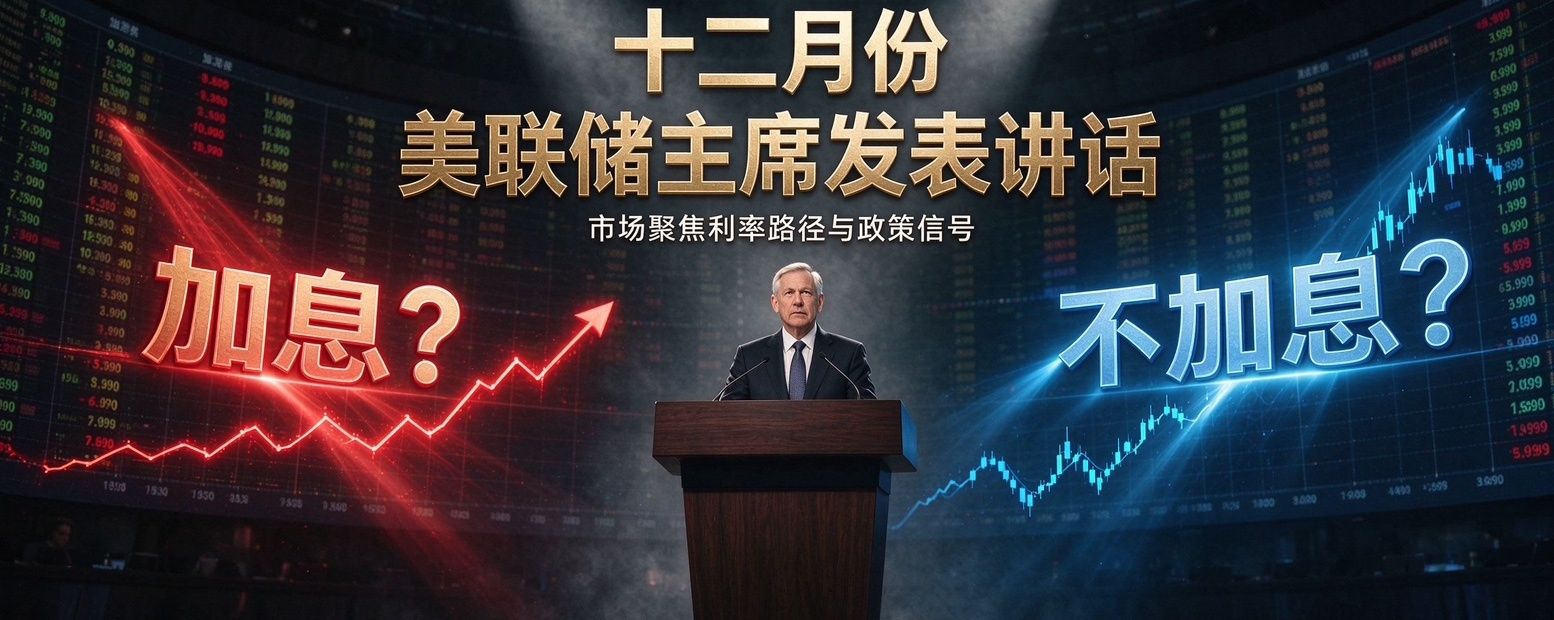
The root cause of the current stock market plunge is the liquidity crunch triggered by Fed rate hikes. As long as the Fed turns dovish at its December policy meeting, the market will rebound.
So will the Fed turn dovish in December?
It’s almost a sure thing.
The 25-basis-point rate hikes in September and December weren’t really because the Fed was eager to raise rates. They happened purely because the market had already priced in Fed rate hikes. To preserve its credibility, the Fed was forced by circumstances to follow through.
Warsch is fundamentally a dove. His purpose in raising rates is to cut them later. The reason is simple: only by establishing the Fed’s credibility can it have more room to maneuver going forward.
Is the Fed afraid of a financial crisis?
Yes.
But what it fears even more is the United States losing the U.S.-China AI race outright.
Just look across the Pacific from the perspective of America’s top political figures and you’ll understand: that country on the other side is ahead of the United States in almost every respect—electricity, infrastructure, manufacturing, applications, and more.
The United States has only two advantages: first, its large AI models, which are a year ahead of its rival; second, lithography machines and chips, which have the other side by the throat and will take them another two to three years to catch up on.
The window of opportunity left to the United States is already very short. America can no longer withstand another financial crisis and economic recession!
In the past, the reason the United States could pick itself up after every financial crisis and economic recession wasn’t that White House politicians were especially skilled at political maneuvering, nor that the Fed chair’s aggressive rate hikes and cuts were especially clever. It was simply that America was then in an upswing in its national fortunes: when the time is right, heaven and earth lend their strength, and there is enormous room for error. Back then, you could have put a dog in the White House as president or in the Fed chair’s seat, and America would still have kept running just fine!
But times have changed.
The trend of the East rising and the West declining is already very clear!
Goldman Sachs predicts that China’s debt cleanup should be completed around 2029. By then, domestically made alternatives for lithography machines, chips, and other technologies will also be coming into their own. The Chinese government will be able to go all in on AI, use it to empower every industry, and roll out application after application. New quality productive forces will be comprehensively boosted, and the United States will lose outright!
Warsh understands this, Trump understands it, Musk understands it, Wall Street understands it, and so do people like Jensen Huang, Dalio, and Altman. Even most people online in both countries understand it!
Yes, on the surface, people like Dalio and Rubio seem to be on opposing sides from Jensen Huang and Musk. But fundamentally, they’re on the same side: they all want to control chip pricing and keep pushing AI forward.
That’s why they will never allow AI to fail, and even less so a financial crisis!
The only people still lost in imperial fantasies, thinking America can weather another financial crisis, are probably a tiny number of self-serving Republican establishment figures and left-wing Democratic politicians.
But most American politicians and capitalists are bad, not stupid!
So this AI revolution really, really matters to the United States. It’s no exaggeration to say that the December policy meeting could determine America’s national fortunes for the next hundred years.
The technological singularity in AI has, in fact, already arrived. That’s the fundamental reason the U.S. stock market gives those two AO companies such high valuations.
The market almost universally believes that if those two AO companies achieve general AGI, a technological explosion will follow right away. Revenue and demand for AI applications simply won’t be problems.
A Bilibili creator gave an example that I think is very apt: the United States and China are now racing on two runways at an airport. Although the United States is temporarily ahead, China still has a chance to catch up.
But if the United States achieves general AGI, it would be like America getting onto a plane: one step ahead, and then ahead at every step. China could only watch from behind, never able to catch up again.
As an aside, this is also Tencent’s predicament right now. It mistakenly thought that its huge scale and strength meant it could overtake others through copying and acquisitions. But it didn’t expect to be left behind by the times in just a year, with the possibility of being disrupted looming at any moment.
Because human-led AI development is predictable, under this scenario the United States and China could be locked in great-power competition for more than a decade.
But AI developing AI is almost completely unpredictable, and the winner could very well be decided within three years.
Because AI is incredibly, incredibly good at solving technical problems! This is something ordinary people have all underestimated, but America’s top figures and the U.S. stock market believe in it and value it more than anything.
So I’ll venture a prediction: after the Fed raises rates in December, it will most likely turn dovish. Once the hike is implemented, the bearish news will be behind us and turn bullish. The window of opportunity for everyone to buy the dip really is very short.