


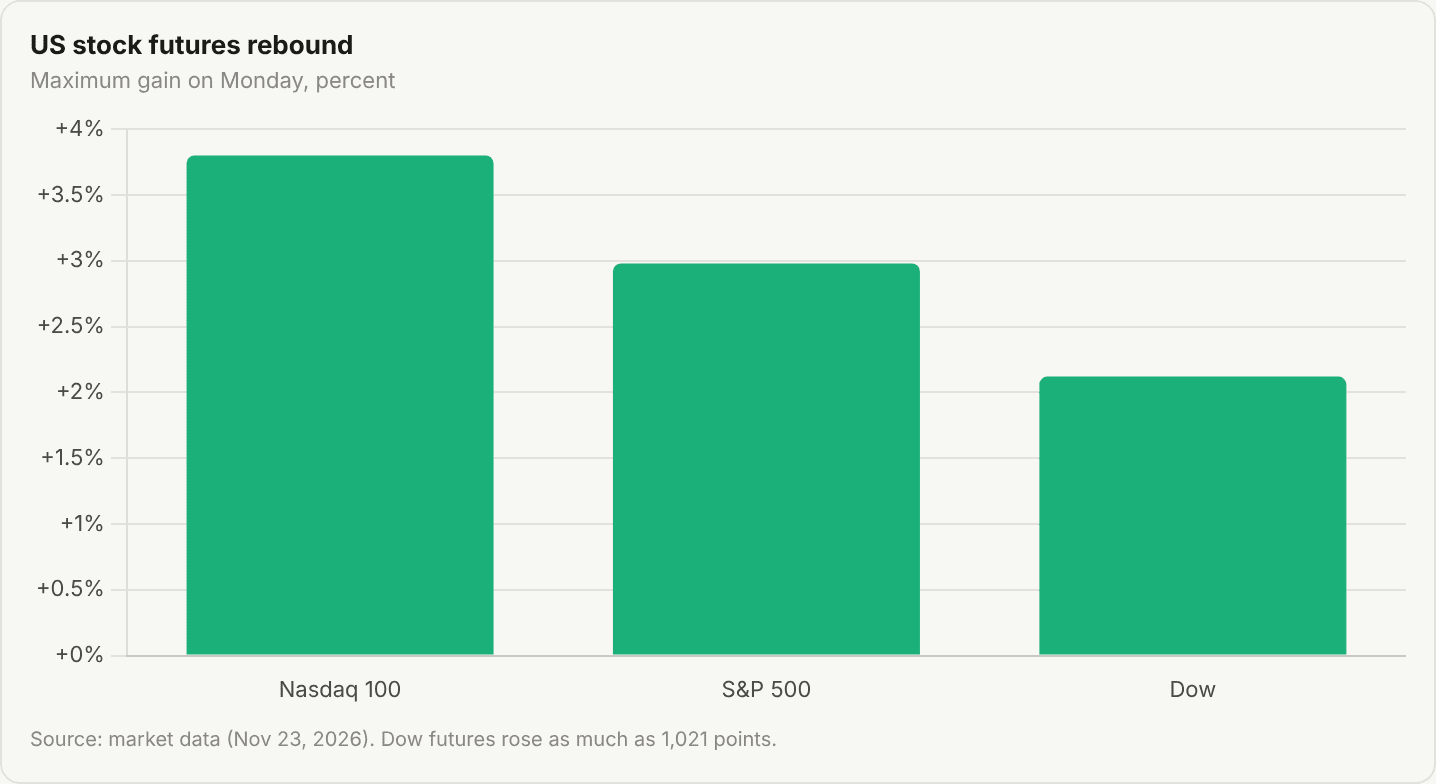
US stock futures rebounded sharply on Monday, November 23, after the Nasdaq's worst week since March 2020. Nasdaq 100 futures rose as much as 3.8%, S&P 500 futures up to 2.98% and Dow futures up to 2.12%, or 1,021 points. Nvidia led AI stocks higher, gaining more than 9% in premarket trading after falling 14% on Friday to $125.53. Asian markets were split: South Korea's Kospi fell 3.3%, while China's main A-share indexes recovered from early losses to close higher.
AI Stocks Lead US Premarket Rebound
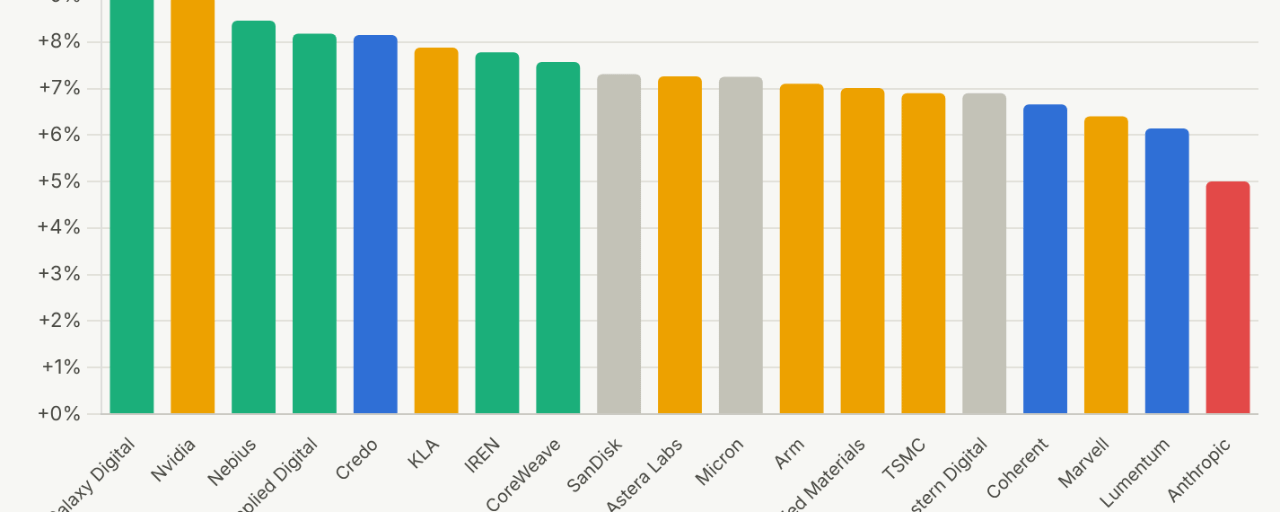
Gains spread across the AI supply chain. Among neocloud stocks, Galaxy Digital rose 9.60%, Nebius 8.46%, Applied Digital 8.18%, IREN 7.78%, CoreWeave 7.57% and Cipher Digital 7.08%.
Chipmakers followed. KLA rose 7.88%, Astera Labs 7.26%, Arm 7.10%, Applied Materials 7.01%, TSMC 6.90%, Lam Research 6.89% and Marvell Technology 6.40%. In memory and storage, SanDisk gained 7.31%, Micron 7.25% and Western Digital 6.90%. Optical networking stocks Credo, Applied Optoelectronics, Coherent and Lumentum rose between 6.14% and 8.15%.
Anthropic rose more than 5% premarket after falling 8.5% on Friday to $88.91. That left it just above its $83 IPO price, a day after its record debut.
Barclays Calls the Selloff a Correction, Not a Crash
Barclays said the recent global tech selloff is a correction, not a sign that the AI trade is collapsing. "Despite these movements in recent weeks, we believe concerns about the demise of AI deals are significantly exaggerated," the bank wrote.
Barclays said investors are less worried about AI monetization than about the effect of AI on traditional businesses. It said the global economy remains robust, forecasting growth of 3.4% in 2026, nearly matching last year, and 3.2% in 2027. The bank kept its overweight position on global stocks relative to bonds.
Kospi Falls 3.3% Despite Government Pledge
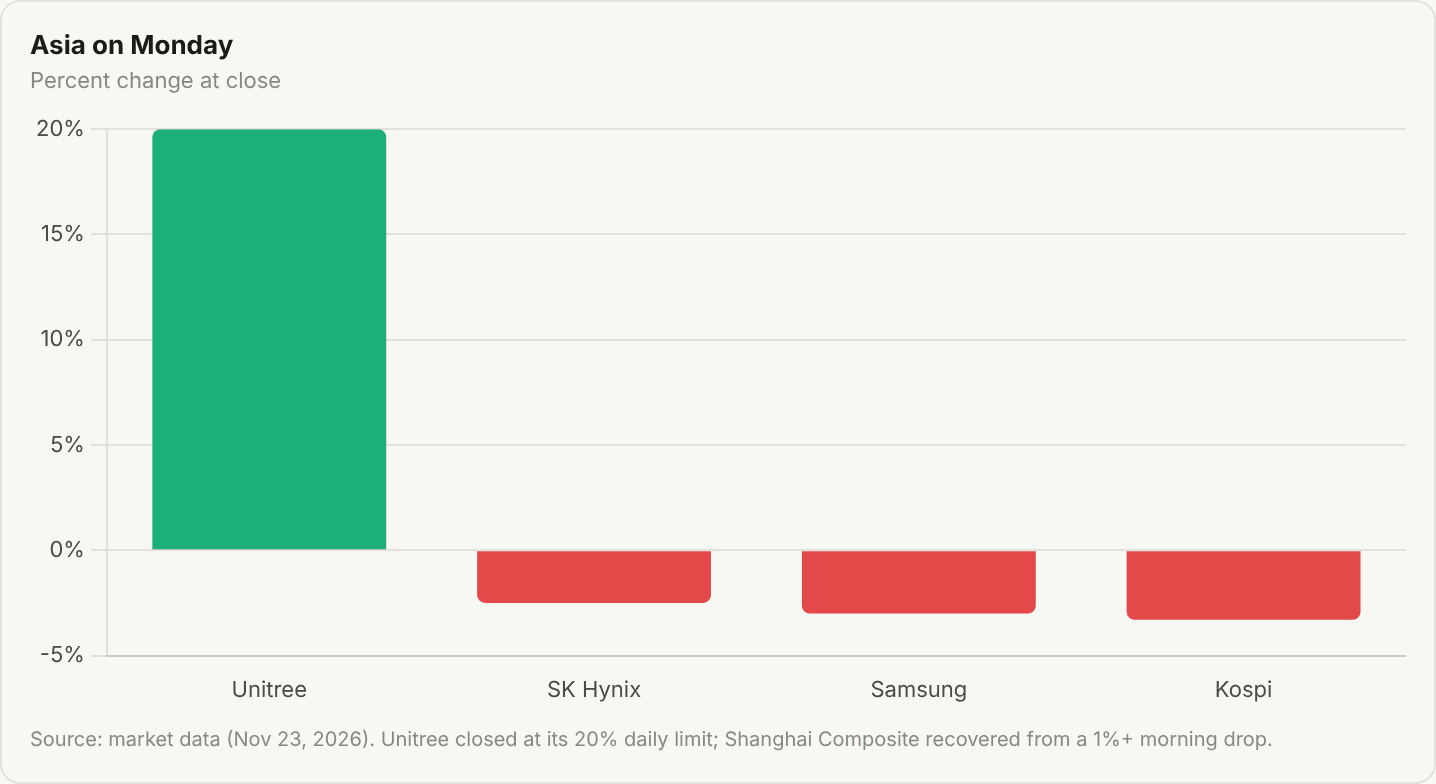
South Korea's Kospi closed down 3.3% at 4,708.51, its lowest close since January 13. Samsung Electronics fell 3% and SK Hynix 2.5%. Declining stocks outnumbered gainers 824 to 71, and foreign investors were net sellers of 247 billion won.
South Korean authorities said on Sunday they would immediately use a market stabilization fund if conditions worsened, and Finance Minister Lee Hyung-il repeated the pledge on Monday. A spokesperson for the presidential office said the volatility is "to some extent, related to the performance of the US stock market."
China's A-Shares Turn Positive as Unitree Hits Daily Limit
In China, all three major A-share indexes turned positive after the Shanghai Composite fell more than 1% in the morning. More than 4,300 stocks rose. Film and television, humanoid robots, precious metals and co-packaged optics stocks led the gains. Robotics maker Unitree surged 20% to its daily limit, giving it a market value of 286.36 billion yuan.
Goldman Cuts Samsung and SK Hynix Targets
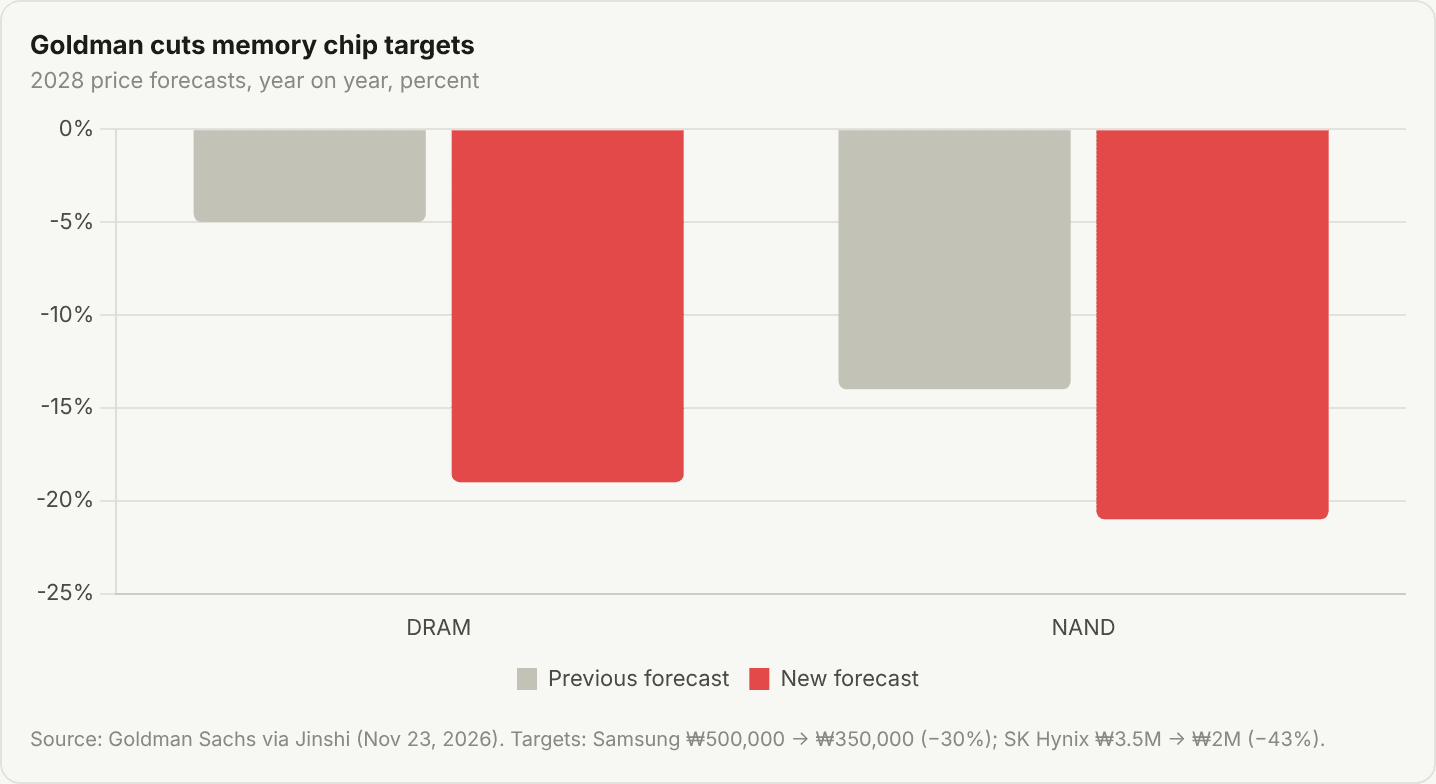
Goldman Sachs lowered its price targets for Samsung Electronics and SK Hynix because it expects weaker memory prices in 2028. It now forecasts DRAM prices to fall 19% year on year in 2028, compared with a 5% decline before, and NAND prices to fall 21%, compared with 14%. Goldman cut its Samsung target to 350,000 won from 500,000 won and its SK Hynix target to 2 million won from 3.5 million won.
ARK Buys $146 Million of Anthropic, Sells Nvidia
Cathie Wood's ARK Invest bought about 1.64 million Anthropic shares across its ETFs on Thursday and Friday, worth about $145.9 million. Over the same week, it sold about $89.4 million of Nvidia stock.
ARK also cut its crypto staking exposure. It sold about 1.05 million units of the 3iQ Solana Staking ETF (SOLQ.U), worth about $5.8 million, and about 1.45 million units of the 3iQ Ether Staking ETF (ETHQ.U), worth nearly $9 million. Both funds are down about a third over the past month. On the buying side, ARK added about $24.7 million of Block and $10.4 million of Circle.
SOXL Needs a 758% Gain to Return to Its High
Monday's rebound in chip stocks did little for investors who bought leveraged semiconductor ETFs at their highs.
The unleveraged iShares Semiconductor ETF (SOXX) fell 44.1%, from a split-adjusted high of $218.60 on June 22 to $122.20 on November 20. It has since rebounded 5.8% to $129.27 and needs to rise another 69.1% to regain its high.
The 3x leveraged Direxion Daily Semiconductor Bull 3X ETF (SOXL) fell 90.1%, from $302 to $29.82. It has rebounded 18.1% to $35.21, more than three times SOXX's gain. That still recovers only about 2% of its loss from the peak, so it needs to rise 757.7% to return to $302.
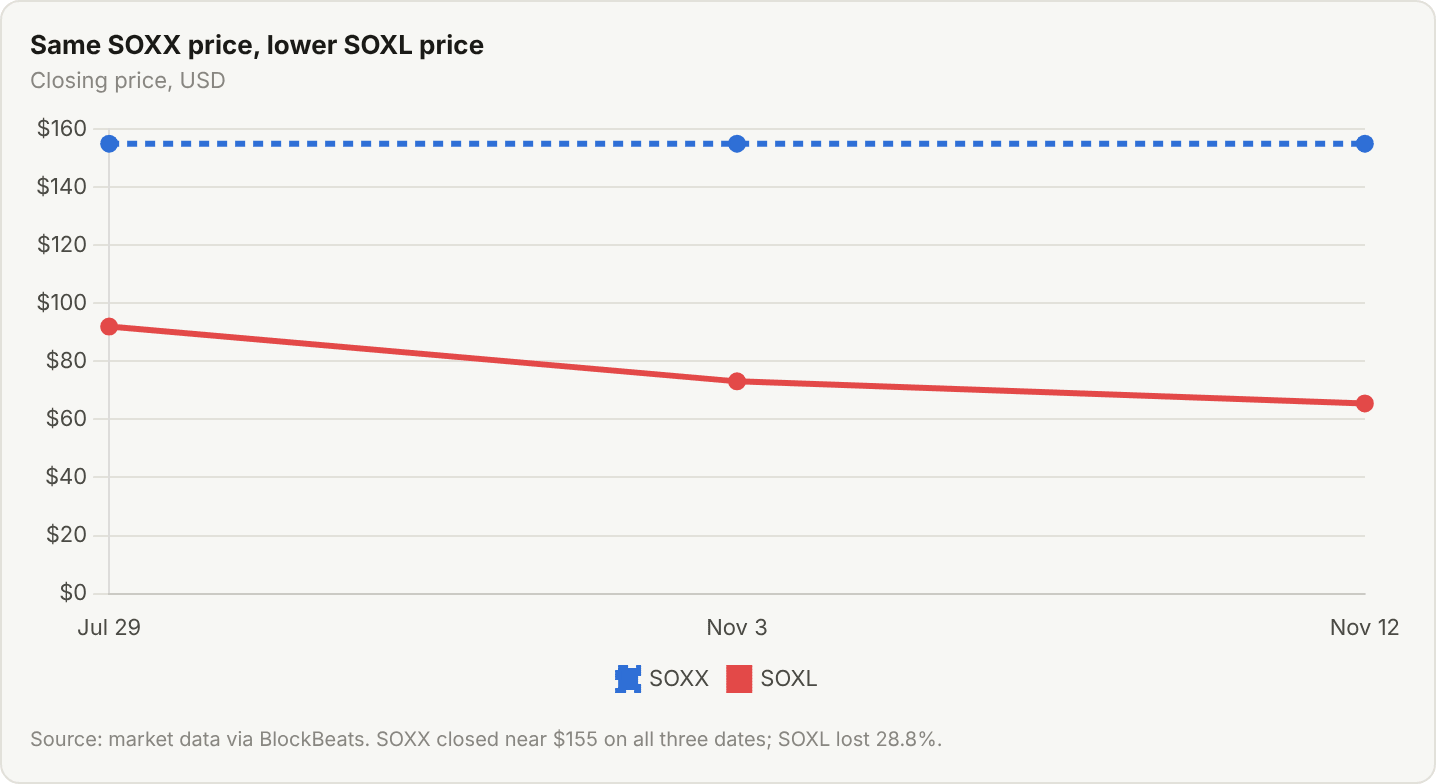
The gap comes from volatility decay. Leveraged ETFs reset their exposure every day, so in a choppy market they lose value even when the underlying index ends up where it started. SOXX closed near $155 on July 29, November 3 and November 12. On those same days, SOXL closed at $91.99, $73.12 and $65.53, a 28.8% drop despite an unchanged index.