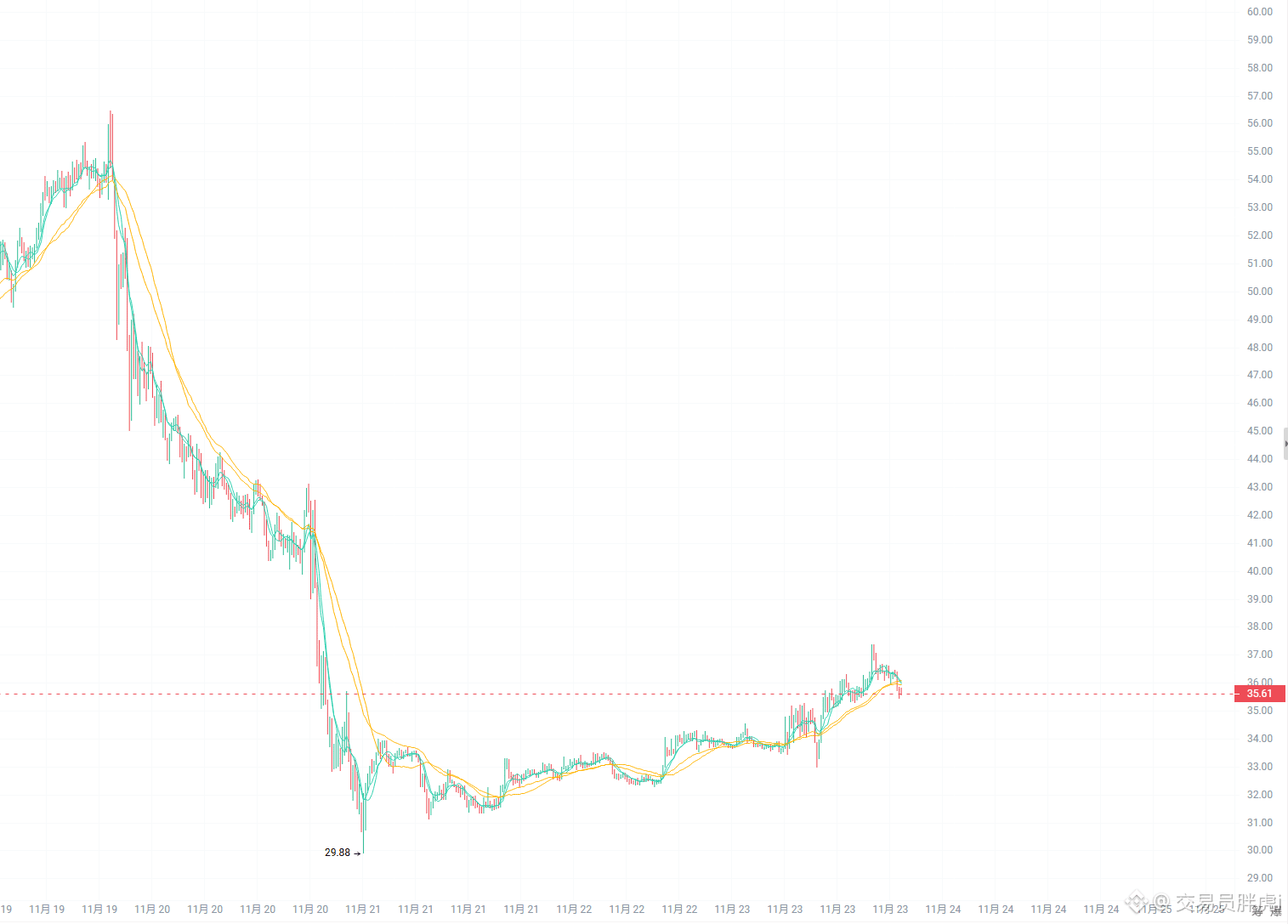
SOXL fell to 29.88. Is it time to buy the dip?
First, let's see what this chart is telling us.
After peaking at 55.6 on November 19, it plunged all the way down, with hardly any meaningful bounces along the way. On November 21, it hit 29.88—a drop of nearly 46%. This wasn't a pullback; it was a near-halving.
But what really matters is what happened over the next two days.
After hitting 29.88, the price didn't make a new low. Instead, it spent two full days moving sideways in the 30–33 range. The candlestick bodies got smaller and smaller, while the moving averages gradually flattened out and converged after being bearishly aligned. Then, starting on the evening of November 22, the price began to climb, bit by bit: 32→33→34→35, forming a very clean upward channel. The short-term moving averages have now crossed above the long-term ones.
The price is now at 35.61, right in an awkward spot.
Above, 36–37 is the high zone from this two-day rebound. Beyond that, 40, 42, and 45 are all levels where investors got trapped on the way down. Below, 34–35 is both the support zone from these past two days and where the moving averages have converged.
So, is it time to buy the dip? My answer: not at this level.
The reason is simple—you've already missed the best entry. The 29.88-to-32 stretch was the dip-buying zone. The price has now rebounded nearly 20% from the bottom, so chasing it here means buying into the third leg of the rebound.
If you want to trade it, there are two approaches:
First, wait for a pullback. If 34–35 holds and moving-average support remains intact, you could try a small long position, with a stop-loss below 33.
Second, wait for a breakout. If the price breaks above 37 on strong volume, that would suggest this rebound is more than just a dead-cat bounce, opening the door to 40. There's no harm in waiting until then to buy.
What's the biggest risk? Getting stuck at this level—not sure whether to get in or get out. You sit out a 20% gain, then rush in as soon as it looks ready to break out, only to get caught in a pullback.
After a 46% drop, the first rebound is often the strongest. The second leg is where things start to get choppy. SOXL's first leg, from 30 to 35.6, is already over.
Whether it can keep going depends on whether it can break through 36–37 on strong volume. If it can't, a pullback to 33 is likely.
My approach: don't chase. Wait for a pullback to 34–35 before considering an entry. If it breaks below 33, get out.
Do you think this is a reversal after finding a bottom, or just a pause in the downtrend? Let's discuss in the comments.