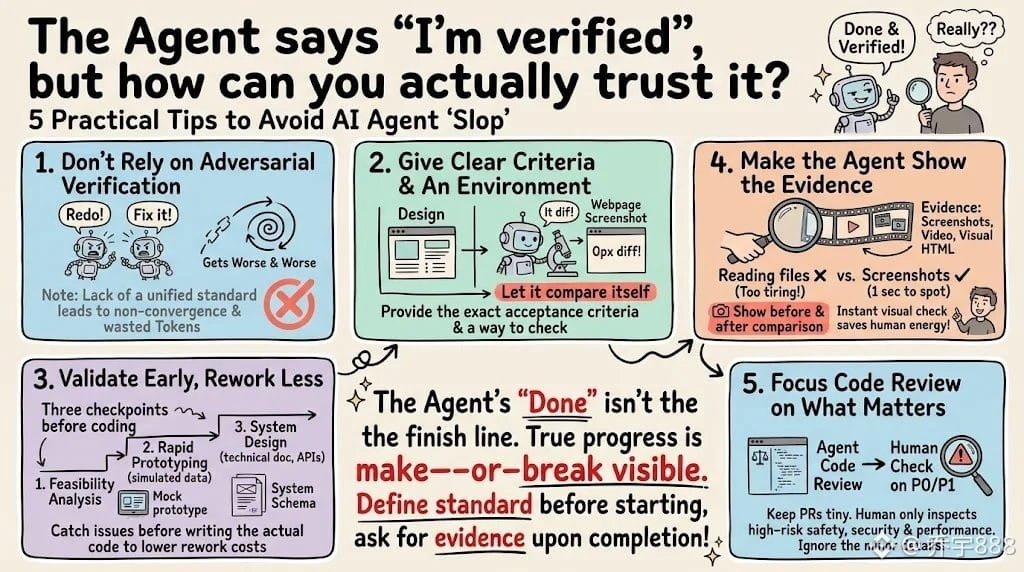
A post on X with 32,000 views discussed the easiest traps to fall into when using an Agent to get work done: it says “It’s verified,” you trust it, and only after launch do you discover it wasn’t done properly at all. The post was by Baoyu (@dotey), who has 270,000 followers. It was published on November 22 and got 338 likes, 144 replies, and 450 bookmarks.
He summed up five lessons about verification. I think the core idea is this: an Agent saying “It’s done” can’t be the final verdict—you need to turn that into something you can inspect.
First, don’t have several Agents check one another. Adversarial verification often makes things worse with every revision, and burns tokens, because there’s no shared acceptance standard. Second, make the acceptance criteria clear before starting, then give it an environment where it can verify its own work. For example, if it’s building a page, require screenshots compared against the design mockup, with not a single pixel out of place. Third, the earlier you verify, the cheaper it is: check feasibility, the prototype, and the system design before getting started. Fourth, make it back up its claims with evidence—screenshots, screen recordings, comparison images—which lowers the cost of acceptance. Fifth, focus code reviews only on P0 and P1 issues, keep PRs as small as possible, and let minor details go.
I’m inclined to treat the second point as an ironclad rule: if the acceptance criteria aren’t clear, don’t start, or the rework will cost you your time. The more capable the Agent, the less you can afford to skip verification. The risk isn’t that it writes something wrong—it’s that you can’t confirm it got it right.
$BTC