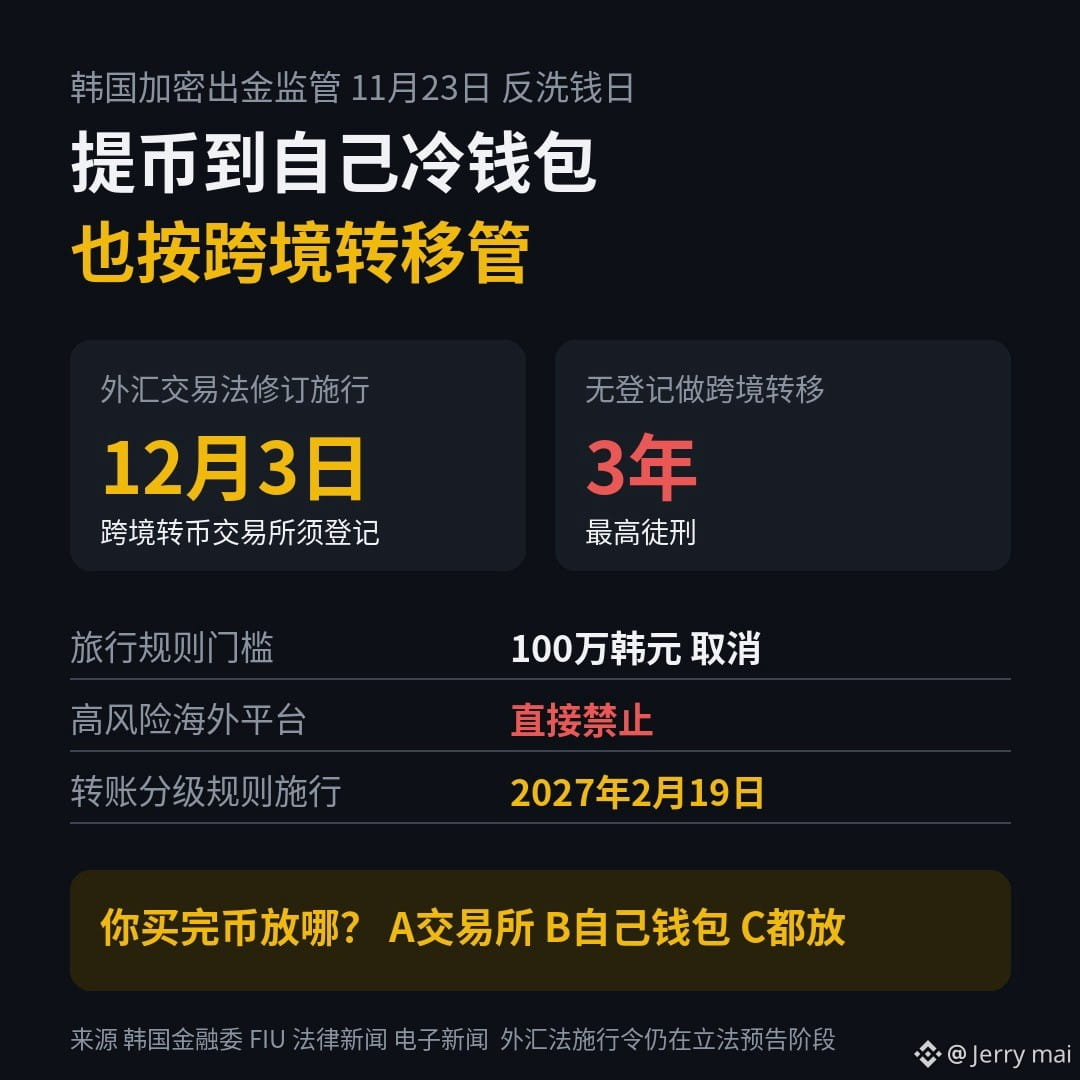
South Korea plans to regulate transfers of crypto to your own cold wallet as cross-border transfers, starting December 3.
Today, Financial Services Commission Chairman Lee Eok-won said at an Anti-Money Laundering Day ceremony that funds flowing to high-risk overseas exchanges and personal wallets must be thoroughly regulated.
He cited the Enforcement Decree of the Special Financial Information Act, which was approved in August. The 1 million won threshold under the Travel Rule will be removed. Low-risk overseas platforms will be exempt, while other overseas platforms and personal wallets will be required to have the same person send and receive the funds. Transfers involving high-risk platforms will be prohibited outright.
These provisions will not take effect until February 19, 2027.
An August press release from the Financial Services Commission gave an example: someone deposited about 200 million won over three months, bought USDT, split it into amounts under 1 million won, and withdrew it in 216 separate transactions.
More recently, amendments to the Foreign Exchange Transactions Act are set to take effect on December 3. Exchanges handling cross-border crypto transfers will have to register with the Ministry of Finance and Economy and report transaction details to the Bank of Korea, which will share them with the National Tax Service and the Korea Customs Service.
Operating without registration could carry a prison sentence of up to three years.
An article in Legal News by a lawyer at Kim & Chang says the Ministry of Finance and Economy interprets transfers between an exchange and a personal wallet as cross-border transfers, regardless of where the wallet owner lives.
You could be in Seoul, and your wallet could be in Seoul too—it would still fall under foreign exchange monitoring.
The Enforcement Decree of the Foreign Exchange Transactions Act is still at the legislative notice stage. In an article in Electronic Times, lawyer Kim Kyung-hwan wrote that treating all transfers to personal wallets as cross-border transfers raises questions about whether the measure exceeds the authority granted by law.
The Financial Services Commission is due to announce the government’s draft of the Digital Asset Basic Act tomorrow.
My take: after December 3, withdrawals from South Korean exchanges to personal wallets will probably face slower reviews, and some demand may shift to overseas platforms...
Where do you usually keep your crypto after buying it?
A. Leave it on the exchange
B. Withdraw it to your own wallet
C. Keep it in both places
#韩国将加强加密境外转账监管 #韩国拟发布数字资产基本法草案 #韩国