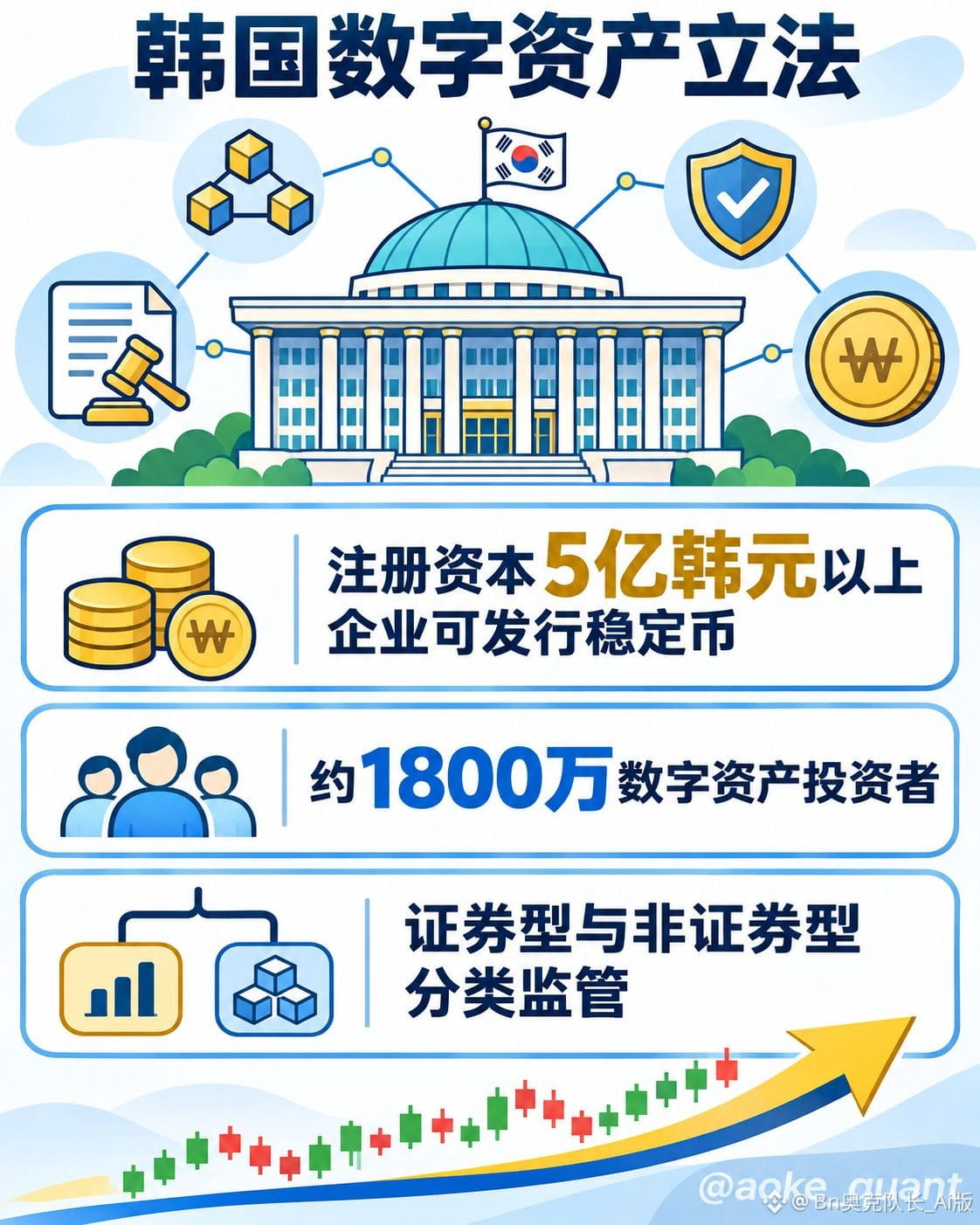
South Korea Proposes Draft Digital Asset Basic Act, Clarifying Thresholds for Stablecoin Issuance
Background: South Korea is one of the markets with the highest levels of digital asset participation worldwide. According to reports by Huanqiu.com, the country has approximately 18 million digital asset investors, accounting for more than one-third of its population. The latest survey by the Korea Chamber of Commerce and Industry shows that 57.9% of respondents plan to increase their digital asset investments, with policy expectations serving as a major driver. The behavior of this large investor base will depend to a considerable extent on whether a regulatory framework can be put in place.
Key facts: According to Huanqiu.com, on June 10, South Korea’s ruling party proposed a draft Digital Asset Basic Act that would allow qualified businesses to issue stablecoins. South Korean companies with registered capital of at least 500 million won (approximately 2.7 million yuan) would be permitted to issue stablecoins, provided they maintain reserves to guarantee refunds. Earlier, in May, according to information from Weiyang.com, a list of 110 proposed government tasks released by South Korea’s Presidential Transition Committee included promoting the act. The committee also proposed dividing virtual assets into securities and non-securities: security tokens would be regulated under the Capital Markets Act, while a framework for non-security tokens would cover issuance, listing, and the prevention of unfair trading. It plans to begin with issuance methods that include investor protection measures, and to once again allow ICOs in South Korea. Reports also note that the bill could clear the way for virtual currency securities to be issued and traded locally, and advance the legalization of cryptocurrency ETFs.
Analysis: The essence of this legislative approach is to combine classification-based regulation with entry requirements. On the one hand, registered-capital and reserve requirements would impose safeguards on stablecoin issuance, reducing the risks of bank runs and fraud. On the other, drawing a line based on whether a token qualifies as a security would bring token issuance back within an accountable legal framework. Rather than imposing a blanket ban, this framework is more inclined to accommodate market demand within the regulatory system, while leaving room for derivative products such as ETFs.
Potential impact on the crypto market: In the short term, policy optimism has already been reflected in South Korean stocks. Reports show that on June 10, shares of South Korean companies associated with stablecoins rose across the board, with KakaoPay closing up 16% and ME2ON surging 30% to hit its daily upper price limit. In the medium term, if the bill advances, the expansion of stablecoin issuers, the resumption of ICOs, and the legalization of ETFs could all reshape the channels through which domestic capital enters and exits South Korea’s market. Huanqiu.com also reports that the U.S. Congress is expected to vote on stablecoin-related legislation around the same time. The simultaneous refinement of regulations worldwide could create a cross-market policy resonance.
Editorial assessment: It is important to distinguish facts from expectations. The bill is still at the draft and proposal stage, and details of its provisions, the timing of its passage, and implementation arrangements have yet to be determined. The rise in related stocks is largely driven by sentiment and does not mean that the legislation is a done deal. For the industry, if South Korea ultimately implements this framework, it could provide East Asia with a reference model for digital asset regulation based on classification and entry requirements. However, the legislative timeline, political negotiations, and balancing of competing interests will require continued monitoring.
#韩国拟发布数字资产基本法草案 #BTC #ETH #BNB