


Compiled and edited by: DeepChao TechFlow
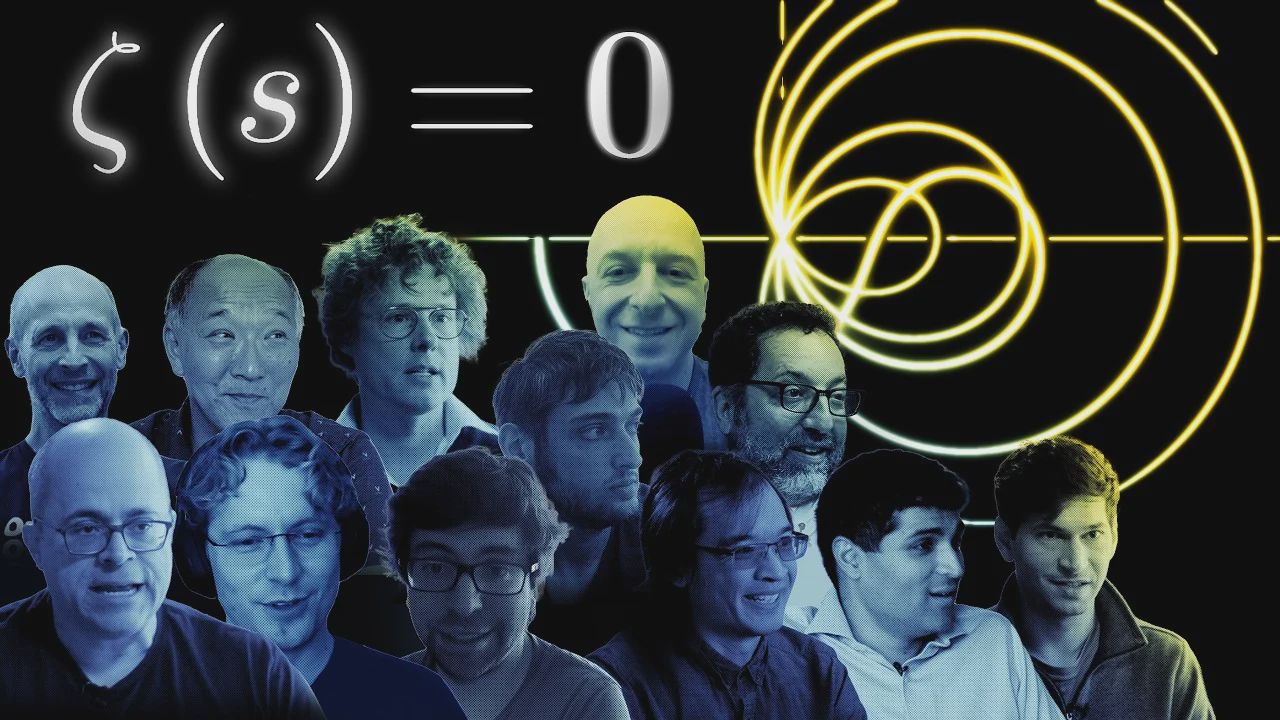
DeepChao introduction: Over the past year, 3Blue1Brown founder Grant Sanderson has spoken with some of the world’s leading mathematicians and theoretical scholars, including Terence Tao, Scott Aaronson, Ken Ono, and Kevin Buzzard. He posed a once-absurd thought experiment: What would happen to mathematics if AI suddenly produced a machine-verified proof, billions of tokens long, with no textual explanation and unreadable to humans, solving the Riemann Hypothesis—the crown jewel of human mathematics?
With Anthropic researcher Levent Alpöge recently announcing that an internal AI model had successfully generated a machine-verified Lean proof of the Generalized Riemann Hypothesis (GRH), this thought experiment instantly became a seismic reality. In this intense exchange, leading mathematicians examined in depth the demise of romanticism, the century-long divide between machine proofs and human understanding, the co-evolution of humans and superhuman explainers, and the ultimate meaning of humanity’s pursuit of mathematics once problem-solving becomes a commodity.
Guests: Terence Tao (Fields Medalist, Distinguished Professor at UCLA), Scott Aaronson (scholar of quantum complexity and metamath, Distinguished Professor at UT Austin), Ken Ono (leading number theorist and Ramanujan scholar, Distinguished Professor at the University of Virginia), Kevin Buzzard (leading scholar in formal mathematics, Professor of Pure Mathematics at Imperial College London), Michael Nielsen (theoretical physicist and pioneer of quantum computing), Jordan Ellenberg (mathematician, bestselling author, professor at the University of Wisconsin), Alex Kontorovich (Professor of Number Theory at Rutgers University)
Host: Grant Sanderson (founder of 3Blue1Brown and mathematics communicator)
Podcast source: 3Blue1Brown (https://www.youtube.com/watch?v=zqzk43bSdDI)
Original title: Since last year, we asked: “What if AI solved the Riemann Hypothesis?”
Air date: Beijing time: 2026-11-22 10:02
Key Takeaways
Thought experiment becomes reality: Grant Sanderson’s hypothetical scenario, posed to leading scholars over the past year, of “AI solving the Riemann Hypothesis with billions of tokens of inscrutable code” has transformed from science fiction into a real-world shockwave, as Anthropic researcher Levent Alpöge announced a machine-verified Lean proof of the Generalized Riemann Hypothesis (GRH), and Alessandro Masullo published a human proof.
Romanticism fades as number theory takes a leap forward: Jordan Ellenberg admits that, for a mathematical romantic, it would be a disaster if a long, ugly piece of code with no human involvement solved a century-old problem. But Ken Ono points out that thousands of papers in modern number theory assume the Riemann Hypothesis; once it is established, humanity’s body of mathematical knowledge will make an immediate quantum leap.
Machine proofs are no static end point; reverse engineering will bring the world’s intellect to bear: Kevin Buzzard emphasizes that when faced with a Lean proof billions of tokens long, kernel-comparison tools will first verify that it is absolutely correct and free of flaws. Even if humans can’t initially read it, mathematicians won’t sit idly by. A proof is no lifeless object: the world’s top minds will immediately assemble to break it down into independent lemmas and modular pieces for deep reverse engineering.
The Riemann Hypothesis is nothing like the Four Color Theorem; brute-force enumeration has cognitive limits: Terence Tao points out that some problems, such as the Four Color Theorem, can be solved by exhaustively checking every possible case. But the Riemann Hypothesis cannot be cracked by mechanical enumeration. Solving it will necessarily depend on a completely new mathematical framework, or on establishing a profound structural bridge between two previously unrelated fields.
The great divorce between proof and understanding: For thousands of years, “proving a proposition” and “understanding a proposition” were inseparable. In the AI era, the two are coming apart. Humanity may receive an oracle from on high, with no explanation at all. But Michael Nielsen is optimistic that a superhuman prover will also become a superhuman explainer. With limitless patience and no judgment, AI can reconstruct the most obscure machine-written texts as beautiful logic that humans can grasp.
Mathematics’ Move 37 and the ultimate shift in values: Just as AlphaGo’s Move 37 against Lee Sedol reshaped our understanding of the limits of Go, once AI rapidly turns routine problem-solving into a low-cost commodity, the direction of mathematical inquiry will shift orthogonally. The end of a century-old problem is never the end of mathematics. The new paradigms it creates will give rise to deeper conjectures, and humanity’s quest to explore prime numbers and the order of the universe will never end.
Highlights
“If a computer generated a Lean proof billions of lines long, with no explanation in words, as a logician who studies metamath, I might even take a perverse pleasure in it. But if it were 20 billion tokens long and no one on Earth could read it, then in the human body of knowledge it wouldn’t count as a proof at all. I wouldn’t even care that it existed; humanity will ultimately pursue its own understanding.” (Scott Aaronson)
“From a mathematical romantic’s perspective, a purely machine-generated solution would be a nightmare. I want genuine human intelligence to be involved in a proof, and I believe mathematical proofs possess the utmost beauty. If this code has no beauty at all, humanity’s desire to find elegant, conceptual proofs will not diminish one bit.” (Jordan Ellenberg)
“Thousands of leading papers have been written on the assumption that the Riemann Hypothesis is true. Once it has been fully proved by a formal system, it will give humanity an entirely new arsenal of tools, and the whole edifice of mathematical knowledge will make a true quantum leap.” (Ken Ono)
“A proof is not a static, lifeless object. If multiple independent verification kernels confirm that it contains no logical flaws, then even if no one can understand it at the time, it will still be an extraordinarily great day for mathematics. Thousands upon thousands of mathematicians will drop everything they’re doing, break this behemoth into countless pieces, and spend years or even decades reverse-engineering it, until every last bit of insight has been extracted.” (Kevin Buzzard)
“A fully autonomous, one-shot black box pulling off a miracle is absolutely not the right way to tackle problems of this century-defining scale. The true breakthrough will inevitably take the form of unprecedented, deeply symbiotic collaboration between human intelligence and extraordinarily powerful AI tools. Human intuition, though prone to error, is not the same as understanding: formal systems are merely the baseline for verifying it. Understanding itself happens in a higher-dimensional space.” (Terence Tao)
“For thousands of years, proving something and understanding it went hand in hand. Today, for the first time, we are facing the reality that they may diverge. But I firmly believe that superhuman theorem-proving models will also become superhuman explainers. They have more patience than humans and can teach without bias, translating complex machine-written texts step by step into conceptual models that humans can understand.” (Michael Nielsen)
“If AI spits out a proof with millions of tokens and says it has solved the problem, I’m not going to say, ‘Great, let’s move on to the next one.’ I’ll be asking relentlessly: ‘What’s the answer? How exactly did you do it? Tell me right now!’ Because from the very beginning, the only reason I went into mathematical research was to understand.” (Alex Kontorovich)
“In great mathematical research, solving a century-old problem has never been the end. Even if the Riemann Hypothesis is completely solved, the new tools it leaves behind will give rise to countless deeper questions and conjectures. Humanity’s eternal pursuit of prime numbers, integers, and the laws of the universe will surge onward forever.” (Ken Ono)
Body
Thought Experiment Becomes Reality: When a Proof Written in Billions of Tokens Lands Before Humanity
Grant Sanderson: Over the past year, in conversations with many leading mathematicians, I’ve often posed an extreme hypothetical scenario: What if, one day in the future, a string of Lean code billions of lines long suddenly appeared on a computer screen, with no natural-language explanation whatsoever? It would coldly state, “Let function A be a certain mapping; let function B be a certain operator,” and then announce, following formal verification, that it had proved the Riemann Hypothesis. Faced with code that lies completely beyond the limits of human readability, would you feel delighted or terrified?
Scott Aaronson: Ha! That’s a fantastic question! Honestly, if that really happened, as a logician who studies metamath and computational complexity, I might even take a perverse pleasure in it. I’m naturally fascinated, as a scholar, by these incredible, inscrutable proofs.
But from another angle, is this really dangerous? Or does it really matter? I’ve always held that if there were a Lean proof 20 billion tokens long that no human being on Earth could understand, then in terms of human knowledge, it simply could not be called a proof of the Riemann Hypothesis. I wouldn’t even care that it objectively existed. There’s no need to panic; we’d just shrug and say, “What a shame. Hopefully, someday, we humans will find a real proof ourselves.”
Jordan Ellenberg: From the perspective of a mathematical romantic, the scene you describe is a nightmare. I’ve always believed that a mathematical proof must involve the human spirit, and I’m convinced that a great proof must contain a captivating beauty. If a proof is just a pile of ugly code fragments stitched together, the scholarly pursuit of elegant, profound, and conceptually rich proofs will not become one bit less important just because machine code exists.
Ken Ono: Romanticism is one thing, but we have to face the objective reality: hundreds, even thousands, of top papers in mathematics today have core results based on the assumption that the Riemann Hypothesis is true. If this code is confirmed to be correct, it would instantly activate all those thousands of conditional results, making them established truths. This would give humanity an unprecedented arsenal of new tools, and the entire body of mathematical knowledge would undergo a quantum leap forward.
Formal Verification Kernels and Reverse Engineering: Machine Proofs Are No Static End Point
Grant Sanderson: If this behemoth really appeared, what would our first reaction be? How could we make sure it wasn’t exploiting a flaw in the formal verification system itself?
Kevin Buzzard: This is an extremely serious engineering and scientific question. The good news is that the formal mathematics community already has a precisely stated version of the Riemann Hypothesis that has been rigorously scrutinized and refined. So when we receive a proof like this, our first step is to run a comparator tool and verify it using two or three completely independent underlying kernels, checking for any potential compiler bugs or logical cheating.
Suppose every independent verification kernel gives the green light and agrees that the proof is flawless. Even if no one in the world can understand it at the time, I have to say unequivocally: this is an extraordinarily great day in the history of mathematics!
Grant Sanderson: But if no one can understand it, how do we digest it? Wouldn’t this create a serious gap in our knowledge?
Kevin Buzzard: Absolutely not! A proof has never been a static object sitting on display. Once mathematicians have absolute confidence in its correctness, countless scholars around the world will drop their current research without hesitation and throw themselves into studying it. We’ll break it down into thousands of independent lemmas, isolate the core modules, and reverse-engineer the mathematical constructions piece by piece. The process itself will generate astonishing new mathematics, until we completely understand the principles behind it.
The Limits of Brute-Force Enumeration: The Riemann Hypothesis Is Nothing Like the Four Color Theorem
Grant Sanderson: Could a machine proof like this just be an enormous brute-force search? We’ve seen computer-assisted proofs of the Four Color Theorem, and many mathematicians still feel uneasy about them because they lack conceptual elegance. Could the Riemann Hypothesis also be cracked by brute force in a similar way?
Terence Tao: It’s important to clarify that certain problems can indeed be solved by exhaustively splitting them into a vast number of special cases and then using a computer to check each one by brute force. The Four Color Theorem is a classic example. To this day, humanity still hasn’t found a conceptually elegant, human-readable proof, and perhaps we never will.
But the reason the Riemann Hypothesis holds such a hallowed place in the mathematical pantheon is precisely that everyone knows it cannot be solved by simple exhaustive verification. Solving it will necessarily require creating a completely new mathematical framework, or building a profound bridge between two major branches of mathematics that once seemed entirely unrelated. We can’t even begin to foresee the outline of the eventual solution; it simply cannot be found by throwing computational power at an exhaustive search.
Grant Sanderson: So could a fully autonomous AI achieve a breakthrough all by itself, in one shot?
Terence Tao: I’ve always believed that fully autonomous, one-shot black-box generation is absolutely not the right way to tackle Millennium Prize problems. The real breakthrough will inevitably come from deeply intertwined, symbiotic collaboration between human intelligence and extraordinarily powerful AI tools. Human mathematicians will provide high-level intuition, strategic frameworks, and guidance, while extremely powerful AI tools will provide a hundredfold boost in microscopic derivations, cross-disciplinary connections, and rigorous formal verification. This collaboration may take a completely new form that we haven’t yet seen.
The Great Divorce Between Proof and Understanding: Accepting an Oracle or Embracing Human-AI Symbiosis
Grant Sanderson: Throughout most of human mathematical history, “proving a theorem” and “understanding a theorem” have been closely intertwined. In the age of AI, are we forced to accept that the two are coming apart?
Michael Nielsen: This really is a profound turning point. In the past, understanding came naturally as we worked through a proof. Now, for the first time, we’re entering a new era: we may receive an oracle, written on an ancient scroll like something delivered to priests of antiquity, that tells us with absolute certainty that something is true, while leaving us completely in the dark about why.
But I’m extremely optimistic about this. I believe that as large language models develop superhuman theorem-proving abilities, they will also develop superhuman explanatory abilities. I’m a theoretical physicist, and there are plenty of niche subjects that I ought to know well but haven’t studied. I might feel awkward asking a colleague about them, but when I ask a large language model, it responds with extraordinary patience and complete lack of judgment, laying things out for me with great clarity.
If this explanatory ability extends from established knowledge to the frontiers of the unknown, large language models could eventually serve as a bridge, breaking down obscure machine proofs billions of tokens long, translating them, and turning them into concepts humans can absorb. They will work alongside human mathematicians to explain the proof.
Alex Kontorovich: I completely agree. If an AI system spits out a massive piece of code and says it has solved the Riemann Hypothesis, I’m not going to happily shut down my computer and move on. I’ll jump up and demand: “What’s the answer? How exactly did you do it? Tell me right now!” Because from the very beginning, our only reason for exploring mathematics has been to understand.
Humanity established rigorous formal, axiomatic proof as a way of seeking truth because, throughout our long history, intuition has fooled us far too many times: from subtle, hard-to-spot gaps in Euclid’s Elements to countless bogus proofs that 1 equals 0. Formal axioms provide a firm baseline for checking understanding, but they are not understanding itself. Understanding lies in spatial intuition, geometric vision, and conceptual leaps in the mind. As long as the human desire to understand persists, the flame of mathematics will never go out.
Mathematics’ Move 37 and the Orthogonal Shift in Values
Grant Sanderson: In the human-versus-machine Go matches, AlphaGo’s Move 37 against Lee Sedol was seen as a defining moment when a machine surpassed human intuition. If we draw an analogy to mathematics, what form might mathematics’ Move 37 take?
Michael Nielsen: When the marginal cost of a capability is driven extremely low by machines and it becomes a cheap commodity, the values humans cherish will inevitably shift orthogonally. If AI turns routine problem-solving and standard proofs into commodities, then what humans value most will shift toward deeper philosophical meta-questions: asking the right questions, building ambitious programs, and choosing the most insightful directions.
Mathematics’ Move 37 would be more than just solving a difficult problem. It would be a machine independently giving rise to an entirely new, grand theoretical framework that perfectly fuses number theory, algebraic geometry, and theoretical physics. That would be a genuine leap in intelligence, one that would astonish all of humanity.
Ken Ono: I’d like to conclude with a simple conviction: in the great edifice of mathematics, solving a century-old mystery has never been the end of a line of inquiry. If someone completely solves the Riemann Hypothesis, that may mark the close of many old chapters, but it certainly won’t be the twilight of mathematics.
All the new tools, ideas, and insights we forge in tackling century-old problems will be used to give rise to deeper conjectures and new fields. Humanity’s eternal exploration of prime numbers, integers, and the inner mathematical order of the universe will flow onward like a mighty, unceasing river.