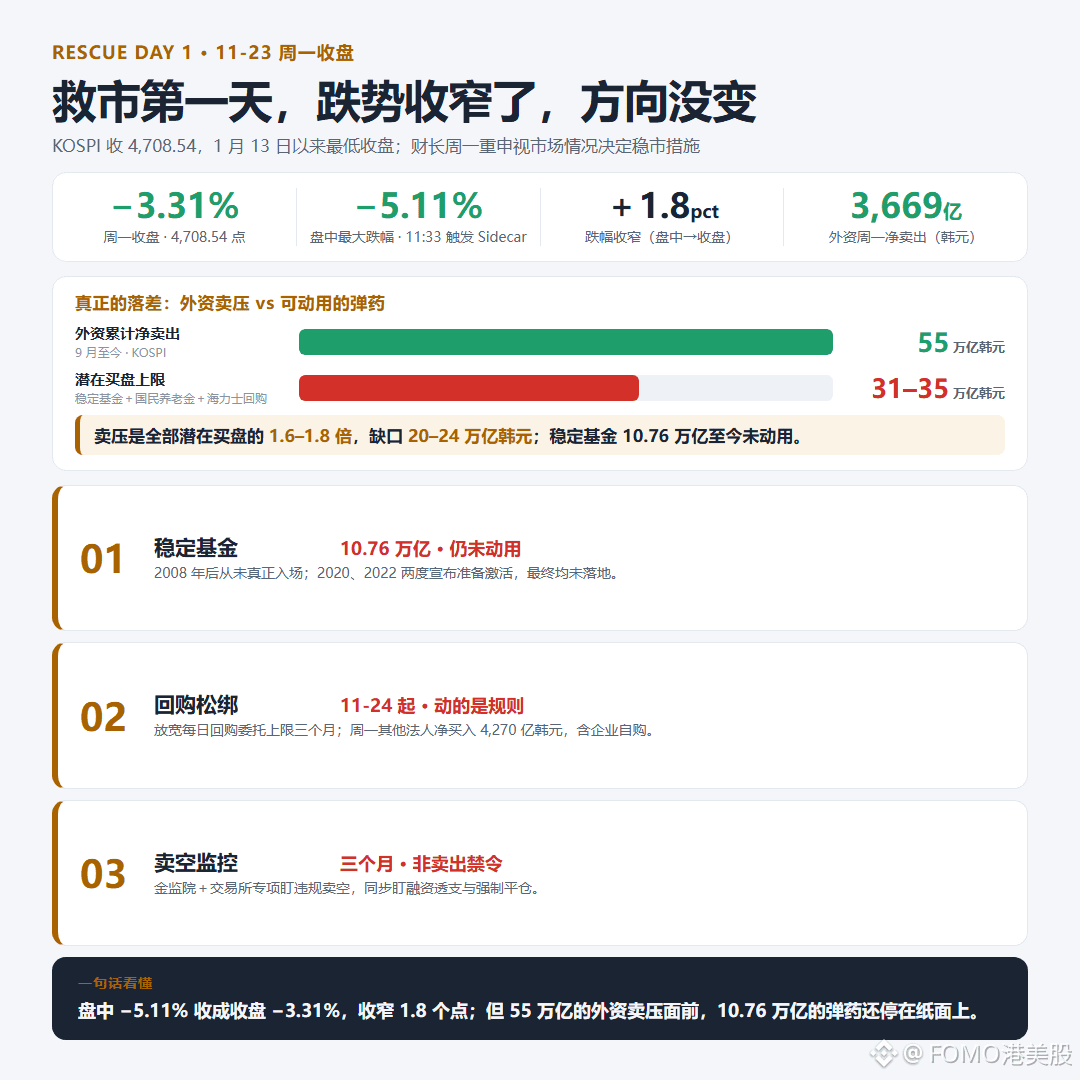
The three measures to rescue the market announced Sunday got their report card Monday. KOSPI closed at 4,708.54, down 3.31%—its lowest close since Jan. 13. It fell as much as 5.11% intraday; at 11:33 a.m., the “sell-sidecar” (Sidecar) mechanism was triggered. By the close, losses had narrowed by 1.8 percentage points. Foreign investors were net sellers of 366.9 billion won.
The three measures were laid out yesterday. The stabilization fund began preparations for activation, standing by for the first time since 2008, with around 10 trillion won. Starting Nov. 24, the buyback cap will be relaxed for three months, and illegal short selling will be strictly investigated.
What came to light today was the gap in scale: foreign investors have cumulatively net sold 55 trillion won of KOSPI stocks since September, while the market estimates that the potential buying power of the stabilization fund, the National Pension Service’s investment capacity, and Hynix’s buybacks amounts to only 31 trillion to 35 trillion won in total. Selling pressure is 1.6 to 1.8 times all available firepower, leaving a gap of 20 trillion to 24 trillion won. Put plainly, the late-session recovery was supported by institutions and companies, while the stabilization fund remains stuck at the “preparation” stage.
The last time the fund actually put money into the market was in 2008. Together with the pension fund, it managed to prop up the market with net purchases of 7.4 trillion won over two months. In 2020 and 2022, it announced preparations twice but ultimately never stepped in. There is no apparent source to fill this gap in the short term, and the central bank is meeting on Thursday; the market expects another 25-basis-point increase.
#韩国股市 #半导体 #宏观