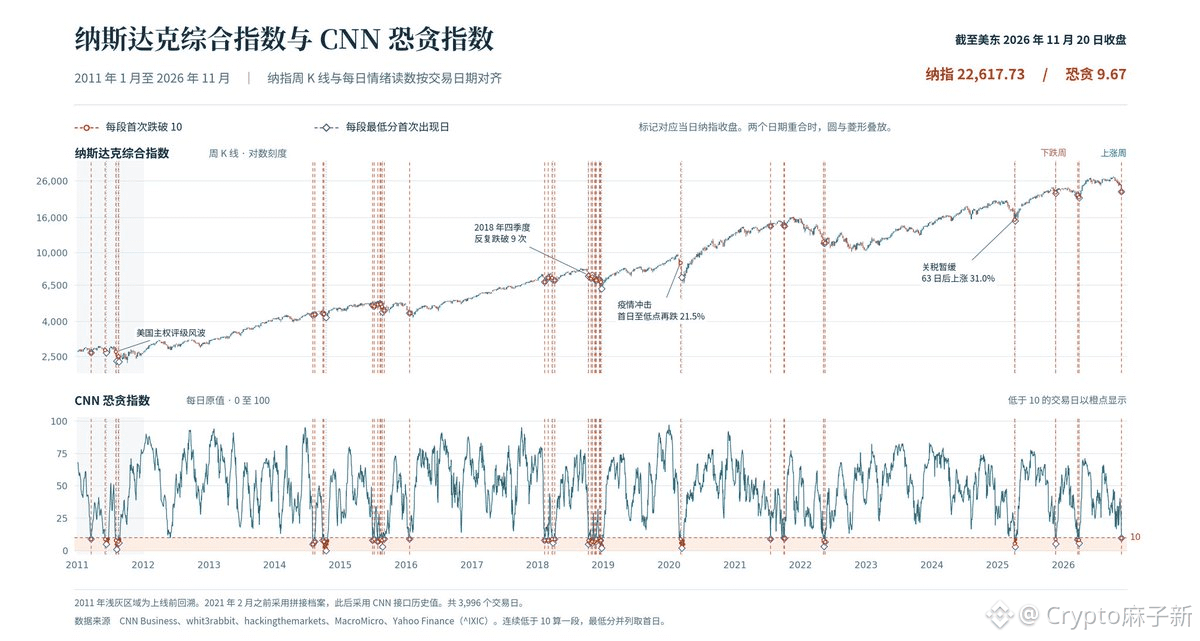
The CNN Fear & Greed Index for U.S. stocks fell to 9, entering the extreme fear zone. Looking back over the past decade or so, whenever market sentiment has fallen this low, a new market rally has often started within the following year!
Since 2011, there have been 17 instances in which signals with a Fear & Greed Index below 10 were combined. Of the 16 instances that had ended, 7 were followed by a rapid rebound, 5 rebounded before retesting their lows, and the other 4 continued to decline for a while before bottoming out.
One detail is worth noting: in 14 of the 16 instances, the market closed higher 21 trading days after the signal was triggered.
This suggests that extreme fear can be a useful contrarian indicator to some extent, but it doesn’t mean the market has already bottomed.
What I’m paying more attention to now isn’t whether the index can rebound, but whether money actually comes back after the rebound—especially in credit markets.
Recently, U.S. high-yield bond spreads widened from 323 basis points on November 13 to 352 basis points on November 19. The CDX IG spread also briefly rose to 65.5 basis points intraday on November 20, its highest level since the end of March.
This suggests that market concerns may no longer be limited to tech stock valuations, and may be spreading to corporate financing costs and credit risk.
If the Nasdaq rebounds and credit spreads narrow at the same time, that would suggest risk appetite is recovering and the market could stabilize fairly quickly.
But if stocks rise while credit spreads continue to widen, we should be cautious. The stock market rebound may simply reflect a recovery in sentiment, with the risk of a second bottom still ahead.
At the moment, I personally think the market is more likely to remain volatile than to stage an immediate V-shaped recovery. The direction of macro policy is still unclear, and concerns over AI industry valuations and capital spending have not been fully digested.
If the fear index falls further below 5 and credit spreads start to narrow, I’d actually be more willing to seriously look for opportunities.
The market’s moment of greatest despair isn’t necessarily the bottom, but it’s often when the risk-reward ratio is worth starting to watch.