

When an executive exits amid an investigation, clawback policies and unvested equity rules operate on two distinct tracks: mandatory financial-restatement clawbacks (which do not require proving personal fault) and misconduct / "for cause" clawbacks and equity forfeitures (which depend heavily on employment contracts, grant agreements, and investigative findings).
1. Mandatory Restatement Clawbacks vs. Misconduct Clawbacks
Accounting Restatement Clawbacks (No-Fault Trigger): Under exchange listing standards implementing SEC Rule 10D-1, public companies must recover erroneously awarded incentive-based compensation received by covered executive officers over the three completed fiscal years preceding an accounting restatement ("Big R" or "little r"). Crucially, this recovery is triggered by the accounting error itself—not by proving the departing executive acted with bad intent or personal misconduct—and applies to incentive awards tied to financial reporting measures, stock price, or total shareholder return (TSR).
Misconduct / "Cause" Clawbacks (Fault-Based): Many companies also maintain separate supplemental clawback policies covering detrimental conduct, fraud, ethics violations, or regulatory/compliance breaches, even when no accounting restatement occurs. Enforcement here typically turns on whether the investigation establishes misconduct or a "for cause" violation under the company’s policy and contract terms.
Limited Exceptions & No Indemnification: Mandatory restatement clawbacks allow only narrow exceptions (such as impracticability due to third-party recovery costs exceeding the amount recoverable or conflict with certain pre-existing home-country laws), and companies generally cannot indemnify executives for clawed-back incentive pay or pay insurance premiums shielding them from recovery.
2. How Unvested Equity Is Treated During & After an Exit
Unvested awards—such as RSUs (Restricted Stock Units), PSUs (Performance Stock Units), or unvested stock options—are governed primarily by the underlying equity plan and grant agreement rather than automatic statutory clawback rules:
Standard Forfeiture Upon Departure: In most equity plans, unvested shares or options are forfeited immediately upon termination or resignation unless a specific exception applies (such as retirement, death/disability, or negotiated severance).
Good Reason / Without Cause vs. "For Cause": Departures during an investigation often create a dispute over how the exit is characterized. A "for cause" termination or finding of misconduct typically wipes out unvested equity and can cut off severance, whereas a resignation or negotiated separation without a "cause" finding may leave certain transition or severance terms open to negotiation—and potential legal challenge.
Suspension or Tolling Pending Fact-Finding: Some equity agreements or transition arrangements allow the board or compensation committee to suspend vesting, hold back settlement, or toll forfeiture determinations while an active investigation is underway, preventing premature payouts before facts are verified.
3. Practical Friction Points for Boards and Departing Executives
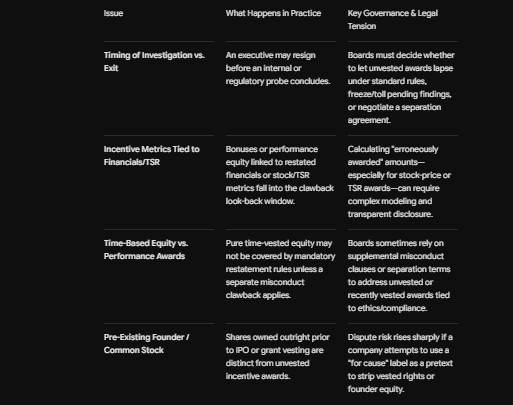
4. What Boards Typically Watch
When an exit happens mid-probe, compensation and governance committees generally focus on documenting the factual record, applying policy terms consistently (to avoid selective enforcement or fiduciary claims), and aligning any separation or settlement terms with audit and legal findings so short-term expediency does not create larger regulatory or shareholder liability later.